Ashoka - Mauryan Emperor and Buddhist Patron
In the grand tapestry of Indian history, few figures loom as large or as complex as Devanampiya Priyadarsi Ashoka Maurya. Grandson of the dynasty's founder, Chandragupta Maurya, Ashoka inherited an empire of unparalleled scale. Yet, his legacy is not defined by the territories he conquered, but by the one conquest he came to abhor. His reign marks a pivotal moment in world history: the transformation of a ruthless conqueror into a messenger of peace, a shift from the sword of empire to the philosophy of non-violence, and the elevation of a regional faith, Buddhism, onto the global stage. His story, etched in stone on pillars and rocks across the subcontinent, is a timeless testament to the power of remorse and the potential for enlightened governance.
Early Life & Background
Born around 304 BCE, Ashoka was a prince of the formidable Mauryan dynasty, which had established the first great pan-Indian empire from its capital at Pataliputra (modern-day Patna). His grandfather, Chandragupta, had famously forged this empire through military genius and political acumen, while his father, Bindusara, consolidated and maintained this vast territory that stretched from the Hindu Kush to Bengal and deep into the Deccan peninsula.
Details of Ashoka’s early years are sparse and often colored by later Buddhist legends, which sought to dramatize his eventual conversion. These texts, like the Ashokavadana, paint a picture of a prince with a fierce temperament, earning him the moniker 'Chandashoka' (Ashoka the Fierce). While these accounts must be treated with caution, it is certain that as a Mauryan prince, Ashoka would have received a rigorous education in statecraft, military strategy, and administration.
His royal training was not merely theoretical. As a young man, he was appointed as the viceroy (uparaja) to key provincial capitals, first in Taxila (Takshashila) and later in Ujjain (Ujjayini). These were not ceremonial posts; they were crucial administrative and military hubs on the empire's frontiers. Governing these regions gave him invaluable firsthand experience in managing a diverse and complex territory, a skill that would later define his imperial rule.
Career & Major Contributions
Accession and the Kalinga War
Ashoka’s ascension to the throne around 268 BCE was, according to some Buddhist sources, a bloody affair marked by a war of succession against his brothers. However, this narrative of fratricide is not supported by Ashoka's own inscriptions. In his rock edicts, he speaks with care and concern for the welfare of his brothers' families, suggesting a more complex, or perhaps less violent, path to power than the legends suggest.
For the first eight years of his reign, Ashoka governed as a typical Mauryan emperor, focusing on the administration and potential expansion of his inherited empire. But one region remained outside Mauryan control: Kalinga, a prosperous and powerful kingdom on the eastern coast (modern-day Odisha). In 261 BCE, Ashoka launched a massive military campaign to conquer it.
The Kalinga War was a brutal and devastating conflict. Ashoka himself, in his own words inscribed in Rock Edict 13, documents the horrific scale of the violence: one hundred thousand people were killed, one hundred and fifty thousand were deported, and many more perished from famine and disease in the war's aftermath. The victory was absolute, but its cost was unimaginable.
The Great Transformation
The carnage at Kalinga triggered a profound spiritual and psychological crisis in Ashoka. Standing amidst the ruins of the conquered kingdom, he was struck with deep remorse and revulsion at the suffering he had caused. This moment of crisis became the defining turning point of his life. He renounced military conquest (digvijaya) and embraced a new policy he called Dhammavijaya—conquest by righteousness and piety.
Following this transformation, Ashoka gradually embraced Buddhism. He sought solace and guidance in its teachings of non-violence (ahimsa), compassion (karuna), and moral responsibility. He famously declared, "All men are my children," articulating a new philosophy of kingship where the ruler was not a conqueror but a paternal guardian, responsible for the material and spiritual well-being of his subjects.
The Policy of Dhamma and the Edicts
Ashoka’s most unique and enduring contribution was his policy of Dhamma. This was not simply the enforcement of Buddhist doctrine, but a universal ethical code designed to create a just, harmonious, and compassionate society. The core principles of his Dhamma included:
- Non-violence: Respect for all living beings and a reduction in the slaughter of animals for sacrifice or food.
- Tolerance: Respect for all religious sects, including Brahmins and Sramanas.
- Social Welfare: Kindness and proper behavior towards parents, elders, teachers, servants, and the poor.
- Truthfulness and Morality: The promotion of honesty, self-control, and purity of thought.
To communicate this vision directly to his people, Ashoka commissioned a series of inscriptions on pillars and rock faces throughout his empire. These Edicts of Ashoka, written in local Prakrit dialects using Brahmi and Kharosthi scripts, are the first tangible evidence of writing in ancient India since the Indus Valley Civilization. They were placed in public areas, along trade routes, and at pilgrimage sites, ensuring his message reached the widest possible audience.
These edicts are a remarkable historical record, offering a direct window into the emperor's mind. In them, he publicly confesses his remorse over Kalinga, details his administrative reforms, and implores his subjects—and future generations—to follow the path of Dhamma. For instance, Rock Edict 2 speaks of his establishment of medical facilities for both humans and animals, and the planting of medicinal herbs and roadside trees. Pillar Edict 7 summarizes his life's work, seeing it as a mission to ensure his people's happiness in this world and the next.
Administration and Propagation of Buddhism
Ashoka's new philosophy was embedded into the fabric of his administration. He created a special cadre of officials known as the Dhamma Mahamattas, who were tasked with traveling the empire to promote Dhamma, oversee justice, and report on the welfare of the people. He undertook regular inspection tours, called Dhamma-yatas, to connect with his subjects personally.
As a patron of Buddhism, his contributions were monumental. Around 250 BCE, he is said to have convened the Third Buddhist Council at Pataliputra. This assembly aimed to purify the Buddhist Sangha (monastic community) of corruption and heresy, and to codify the canonical scriptures.
Perhaps most significantly, Ashoka transformed Buddhism into a world religion by sponsoring missions to spread its message far beyond the borders of India. His edicts mention missions sent to the Hellenistic kingdoms of the West—to rulers such as Antiochus II of the Seleucid Empire, Ptolemy II of Egypt, and Magas of Cyrene. His most successful mission was to Sri Lanka, led by his own son, Mahinda, and daughter, Sanghamitta, who carried a sapling of the Bodhi tree. This act cemented Sri Lanka's status as a stronghold of Theravada Buddhism, a tradition that endures to this day.
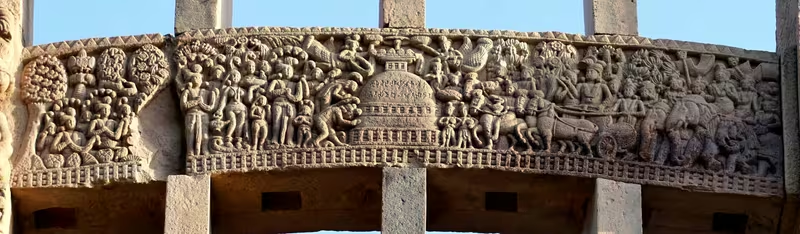
He is also credited with the construction of thousands of stupas (mound-like structures containing Buddhist relics) and viharas (monasteries) across his empire, including the foundation of the great stupa at Sanchi.
Legacy & Influence
Ashoka Maurya died in 232 BCE after a reign of nearly four decades. While the Mauryan Empire declined and disintegrated within fifty years of his death, his true legacy proved far more enduring than his political one.
His historical significance is immense. He was the first ruler to unite nearly the entire Indian subcontinent under a single, efficient, and compassionate administration. He fundamentally redefined the concept of kingship, shifting it from a paradigm of military might to one of moral responsibility. His policy of Dhamma was a pioneering experiment in building a pluralistic and ethical state, advocating for religious tolerance and non-violence centuries before such concepts became global ideals.
Ashoka's impact on Indian culture is indelible. After being largely forgotten for centuries, his edicts were famously deciphered in 1837 by the British scholar James Prinsep. This breakthrough unlocked a lost chapter of Indian history and revealed the greatness of the emperor. In modern India, Ashoka is revered as a national hero. The Lion Capital of Ashoka from his pillar at Sarnath, depicting four lions standing back to back, was adopted as the National Emblem of India. The wheel from its base, the Ashoka Chakra, is the central motif of the Indian national flag, symbolizing the eternal wheel of law and righteousness.
Today, Ashoka is remembered globally as 'Ashoka the Great,' not for the empire he ruled, but for the ideals he championed. His life story remains a powerful narrative of redemption—the journey from the fierce 'Chandashoka' to the pious 'Dhammashoka.' He stands as a unique figure in the annals of royalty: an emperor who apologized for his conquests, sought the forgiveness of his people, and dedicated the immense power of his state to the promotion of peace, compassion, and human dignity.