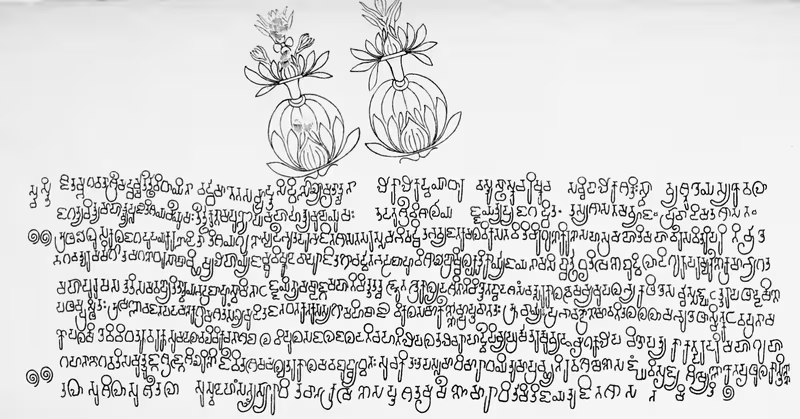
Chanakya: The Master Strategist of the Mauryan Empire
In the tumultuous crucible of 4th century BCE India, a landscape of warring kingdoms and shifting allegiances, one man emerged not with a crown, but with a mind so sharp it could forge an empire. Chanakya, also known as Kautilya or Vishnugupta, was a philosopher, economist, and political strategist whose genius would dismantle a corrupt dynasty and lay the foundation for the first great pan-Indian empire: the Mauryan Empire. He was the kingmaker behind the throne of its first emperor, Chandragupta Maurya, and the author of a political treatise so pragmatic and profound, the Arthashastra, that its principles continue to be studied and debated millennia later. This is the story of the scholar who reshaped the destiny of a subcontinent.
Early Life & Background
The precise details of Chanakya's early life are shrouded in the mists of ancient history, with different Buddhist, Jain, and Hindu traditions offering varying accounts of his origins. While his exact birthplace remains a subject of scholarly debate, it is widely accepted that he was a highly educated Brahmin, deeply learned in the Vedas and political science.
His intellectual formation took place at Takshashila (modern-day Taxila in Pakistan), one of the most renowned centers of learning in the ancient world. A bustling cosmopolitan hub, Takshashila attracted scholars and students from across the subcontinent and beyond. Here, Chanakya would have immersed himself in a curriculum that spanned economics, warfare, law, medicine, and philosophy. This environment, where practical knowledge was valued as highly as spiritual wisdom, profoundly shaped his worldview, instilling in him a pragmatic and analytical approach to the problems of state and society.
It was during this period that the political fabric of northern India was dominated by the powerful but increasingly decadent Nanda Dynasty, ruling from their magnificent capital, Pataliputra. Later legends, particularly in texts like the Mudrarakshasa and Jain accounts, provide a powerful, if perhaps dramatized, narrative for Chanakya's motivation. According to these stories, Chanakya, possessing immense intellect but a plain appearance, traveled to the court of the Nanda king, Dhana Nanda. There, he was publicly insulted and dismissed by the arrogant king. Enraged by this humiliation, Chanakya is said to have vowed to uproot the Nanda dynasty and replace it with a more worthy ruler. While the historical accuracy of this specific event is uncertain, it serves as a potent symbol of the clash between intellect and arrogant power that defined his subsequent career.
Career & Major Contributions
Chanakya's historical greatness lies in his unparalleled ability to translate political theory into decisive action. His career was a masterclass in strategy, mentorship, and nation-building.
The Making of a King
Driven by his mission to overthrow the Nandas, Chanakya sought a candidate worthy of the throne. His search led him, according to popular accounts, to a young boy of humble but noble lineage named Chandragupta Maurya. Chanakya recognized in him the sparks of leadership and courage. He took the young Chandragupta under his wing, transporting him to Takshashila for a rigorous education in military strategy, political administration, and the principles of dharma (righteous duty).
This mentorship was transformative. Chanakya molded Chandragupta from a raw youth into a disciplined and formidable leader, ready to challenge the mightiest empire of the age. He understood that a successful ruler needed not just martial prowess but also a deep understanding of economics, diplomacy, and law.
The Architect of an Empire
The political climate was ripe for revolution. The Nanda regime was unpopular due to its oppressive taxation and arrogance. Furthermore, the northwestern frontiers of India had been destabilized by the invasion of Alexander the Great, whose departure in 325 BCE created a significant power vacuum.
Chanakya’s strategy was brilliant and methodical. Instead of launching a direct assault on the Nanda heartland of Pataliputra, he advised Chandragupta to first consolidate power on the periphery. They raised a formidable army, recruiting from the fierce martial clans of the northwest and forming strategic alliances. They systematically conquered the territories previously held by Greek satraps, securing resources and building momentum. Once the frontiers were secure, they turned their sights on the Nanda capital. The ensuing war culminated around 322 BCE with the fall of Pataliputra and the complete annihilation of the Nanda dynasty. Chandragupta Maurya was crowned emperor, and Chanakya assumed the role of his Mahamatya, or Prime Minister.
The Magnum Opus: The Arthashastra
With the empire established, Chanakya's focus shifted from conquest to governance. His enduring intellectual legacy is the Arthashastra (literally, "The Science of Material Gain"), a comprehensive treatise on statecraft traditionally attributed to him. Far more than a book of abstract philosophy, the Arthashastra is a practical manual for running a state.
Its scope is staggering, covering nearly every aspect of administration:
- The Duties of a King: It outlines how a ruler should manage his kingdom, protect his subjects, and ensure economic prosperity. It emphasizes that the happiness of the subjects is the happiness of the king.
- Economic Policy: The text details policies for taxation, agriculture, trade, mining, and forestry, creating a blueprint for a robust and centralized economy.
- Law and Order: It provides a detailed civil and criminal code, with a focus on efficient justice and the suppression of crime.
- Espionage and Intelligence: One of its most famous aspects is its advocacy for a vast and intricate network of spies to monitor officials, gather intelligence on foreign states, and preempt internal rebellion. For Chanakya, information was a critical tool of power.
- Foreign Policy and Diplomacy: The Arthashastra introduces the Mandala (Circle of States) theory, a pragmatic model for managing international relations. It posits that a king's immediate neighbors are likely enemies, while the states beyond them are potential allies. This sophisticated understanding of geopolitical realism is a hallmark of the text.
At its core, the Arthashastra is secular and pragmatic, often ruthless. It argues that for the security and prosperity of the state, a ruler must be prepared to use any means necessary, including deception, covert operations, and aggressive force. This has led many to compare Chanakya to Niccolò Machiavelli, whose work The Prince was written nearly 1,800 years later. However, unlike Machiavelli, Chanakya’s pragmatism was always framed within the ultimate goal of creating a stable, prosperous, and well-ordered state for the welfare of the people.
Legacy & Influence
Chanakya's impact on Indian history is immeasurable. He was the intellectual force behind the political unification of the Indian subcontinent on a scale never before seen. The Mauryan Empire, which he helped build, became a model for centralized administration, economic integration, and imperial power that would influence Indian polities for over a thousand years.
His legacy endures primarily through two channels:
1. The Mauryan Blueprint: The administrative structure he designed—with its organized bureaucracy, efficient tax-collection system, and standing army—provided the stability that allowed Mauryan culture, art, and trade to flourish, reaching its zenith under Chandragupta's grandson, Ashoka the Great. He proved that a vast and diverse subcontinent could be governed effectively from a central authority.
2. The Timeless Wisdom of the Arthashastra: Rediscovered in 1905, the Arthashastra has been hailed as one of the world's most important political texts. It provides an invaluable window into the political and economic life of ancient India. Its principles of governance, diplomacy, and economic management remain subjects of intense study in universities and military academies worldwide. The text serves as a powerful reminder that sophisticated political and strategic thinking was thriving in India long before the rise of modern Western political science.
Today, Chanakya is revered in India as a national hero. He is a symbol of strategic genius, unwavering resolve, and profound patriotism. His name is synonymous with political sagacity, and his teachings, often compiled into a set of aphorisms known as Chanakya Niti, are widely quoted as timeless wisdom for life, leadership, and politics. From television series and films that dramatize his life to business schools that teach his strategies, Chanakya remains a towering and relevant figure—the scholar who not only wrote history, but decisively shaped its course.