The King of Kings: Rajaraja I and the Forging of an Empire
In the grand tapestry of Indian history, few rulers command as much reverence as Rajaraja I, the Chola emperor whose reign marked the dawn of a golden age. He was more than a conqueror; he was a visionary administrator, a devout patron of the arts, and the architect of a maritime empire that would dominate the Indian Ocean. Ascending the throne in 985 CE, he inherited a recovering kingdom and transformed it into the most powerful and sophisticated state of its time. His story is not merely one of battles won, but of an empire meticulously built, a culture brilliantly expressed, and a legacy carved in granite that continues to inspire awe a millennium later.
Early Life & The Path to the Throne
Born Arulmozhivarman around 947 CE, he was the third child of the Chola king Parantaka II (Sundara Chola) and Queen Vanavan Mahadevi. He grew up in a court pulsating with ambition and artistic fervour, but also shadowed by political intrigue. The Cholas, once a formidable power, were re-establishing their dominance in the Tamil country after a period of decline. Arulmozhivarman's elder brother, Aditya Karikalan, was the charismatic crown prince, a fierce warrior who had already proven his mettle on the battlefield.
Arulmozhivarman's formative years were profoundly shaped by two figures: his elder sister, Kundavai Pirattiyar, a woman of remarkable intelligence and political acumen who would remain his lifelong confidante and advisor; and the looming tragedy that would alter the course of Chola history.
The promising future of the heir apparent, Aditya Karikalan, was brutally cut short when he was assassinated under mysterious circumstances around 969 CE. This event threw the line of succession into turmoil. The throne, by right, should have passed to Sundara Chola's brother, Uttama Chola. In a display of political maturity and patience that would define his character, the young Arulmozhivarman stepped aside, honouring his uncle's claim.
For the next sixteen years, during Uttama Chola's reign, Arulmozhivarman waited. He did not conspire or rebel but instead served loyally, likely as a co-regent (Yuvaraja), learning the intricacies of statecraft, military strategy, and diplomacy. This period was his crucible, forging a patient and strategic mind. When he finally ascended the throne in 985 CE, taking the regnal title Rajaraja—meaning “King of Kings”—he was not an untested youth but a seasoned leader ready to unleash his grand vision.
Career & Major Contributions
Rajaraja's reign can be understood through three monumental pillars: his military conquests that forged an empire, his administrative reforms that sustained it, and his architectural patronage that immortalized it.
The Unstoppable Conqueror
Rajaraja’s military campaigns were not mere raids for plunder; they were systematic, strategic operations aimed at annexation and integration. He envisioned a consolidated empire with secure borders and absolute control over lucrative trade routes.
His first major campaign, initiated around 994 CE, was against the confederacy of the Chera and Pandya kingdoms to the south. The key to this victory was the naval assault on the Chera port of Kandalur Salai, described in his inscriptions as a resounding success. This victory crippled Chera naval power, established Chola supremacy in the southern seas, and earned him the title “Mummudi Chola”—the Chola king who wears the three crowns of the Cholas, Pandyas, and Cheras.
With the south subdued, Rajaraja turned his attention to the north. He waged a long and arduous war against the Western Chalukyas, a rival power in the Deccan. His campaigns pushed the Chola frontier to the banks of the Tungabhadra River. He also intervened in the affairs of the Eastern Chalukyas of Vengi, using a shrewd mix of military force and matrimonial diplomacy. He gave his daughter Kundavai in marriage to the Vengi prince Vimaladitya, effectively turning the kingdom into a key Chola protectorate and creating a buffer against the Western Chalukyas.
His most audacious campaigns, however, were overseas. Recognizing the strategic importance of maritime trade, he built a formidable navy. Around 993 CE, his forces crossed the Indian Ocean and conquered the northern part of Sri Lanka (Eelam). He annexed the region, renaming it “Mummudi Chola Mandalam,” and established a new capital at Polonnaruwa. This conquest gave the Cholas direct control over the vital sea lanes and the island's pearl fisheries. Decades later, his navy would go on to conquer the Maldives, solidifying Chola dominance over the Indian Ocean trade network that connected South India to the Arabian Peninsula and distant China.
The Master Administrator
While his military victories were spectacular, Rajaraja's true genius lay in his administrative reforms. He understood that a vast empire could not be sustained by force alone; it required a robust and efficient system of governance and revenue.
In 1000 CE, he launched his most significant domestic project: a comprehensive land survey and assessment of his entire empire. This was a revolutionary undertaking. For the first time, land was meticulously measured, classified by soil type and fertility, and centrally registered. This allowed for a fair and systematic collection of land revenue, the state's primary source of income. The survey eliminated the power of arbitrary local chieftains and brought the empire's economic resources directly under the emperor's control, providing the financial foundation for his massive army, navy, and building projects.
He reorganized the empire into a logical administrative hierarchy. The largest units were provinces or mandalams, which were subdivided into districts (valanadus) and further into groups of villages (nadus). He did not dismantle the traditional, self-governing village assemblies (sabhas and urs) but instead strengthened them and integrated them into the imperial structure, creating a system that balanced central authority with local autonomy.
The Builder of the Gods: The Rajarajesvaram
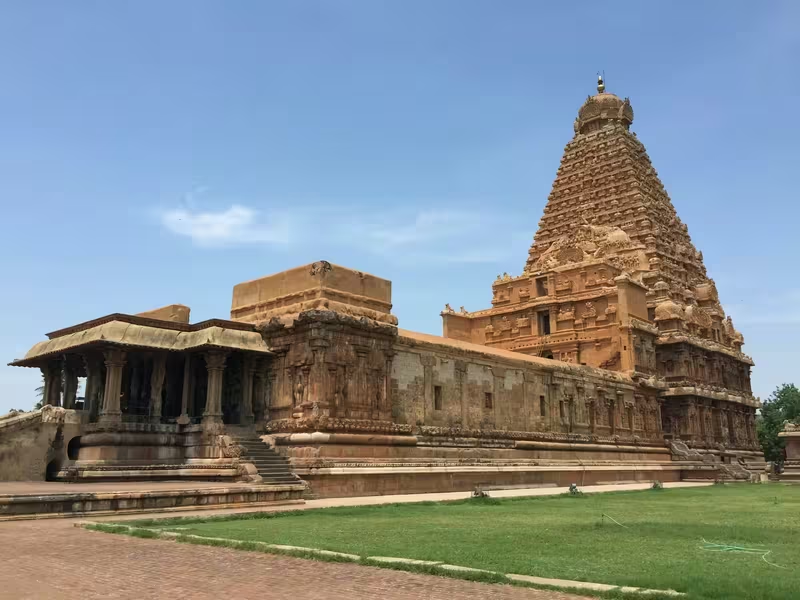
The crowning achievement of Rajaraja’s reign, the ultimate symbol of his power, piety, and artistic vision, is the magnificent Rajarajesvaram (the Lord of Rajaraja's temple), now known as the Brihadisvara Temple, in his capital, Thanjavur.
Consecrated in 1010 CE, the temple was an architectural and engineering marvel unlike anything seen before. Built entirely of granite, its main tower, or vimana, soars to a height of 66 meters, capped by a single monolithic stone weighing an estimated 80 tons. The sheer scale and precision of its construction, accomplished with rudimentary tools, remains a source of wonder.
But the Brihadisvara Temple was far more than a place of worship. It was the socio-economic and cultural heart of the Chola empire. The temple's walls are covered in detailed inscriptions, a public ledger documenting Rajaraja's incredible endowments. He gifted it with revenues from countless villages, vast quantities of gold, silver, and jewels. The inscriptions list in meticulous detail the temple's staff: hundreds of priests, musicians, treasurers, accountants, and over 400 exceptionally talented temple dancers, or devadasis, who were revered artists.
The temple functioned as a major economic institution, a central bank that lent money to village assemblies and trade guilds. It was a patron of the arts, commissioning exquisite bronze sculptures, including the iconic Nataraja (Shiva as the cosmic dancer), which reached its zenith of expression during this period. The temple was a physical manifestation of the Chola state—ordered, prosperous, and divinely sanctioned under the emperor, who was a devout Shaivite and called himself “Sivapadasekara” (one who has the feet of Shiva as his crown).
Legacy & Influence
Rajaraja I passed away in 1014 CE, leaving behind an empire at its absolute zenith. His son and successor, Rajendra Chola I, would inherit this powerful state and expand its boundaries even further, launching an audacious naval expedition to Southeast Asia.
Rajaraja's legacy is profound and multi-faceted:
The Imperial Architect: He transformed the Chola kingdom into a centralized, bureaucratic empire with a powerful military and a stable revenue system. This model of administration and governance influenced South Indian polity for centuries.
Master of the Seas: He was among the first Indian rulers to fully appreciate the importance of naval power. His control over the Indian Ocean secured immense wealth through trade and established a sphere of influence that extended far beyond the Indian subcontinent.
A Cultural Renaissance: His reign was a period of extraordinary cultural efflorescence. The architectural style perfected in the Brihadisvara Temple became the benchmark for Dravidian temple architecture. The bronze casting techniques of his era produced masterpieces that are considered among the finest works of Indian art.
Enduring Memory: Today, Rajaraja I is remembered as one of India’s greatest emperors. He is a towering figure in Tamil culture, celebrated for his might, his administrative genius, and his piety. His life and times are immortalized in popular culture, most notably as the hero Arulmozhivarman in Kalki Krishnamurthy's epic historical novel, “Ponniyin Selvan” (The Son of Ponni).
More than a thousand years after his death, the great temple at Thanjavur stands as a silent, magnificent testament to his vision. It is the legacy of a king who not only conquered territories but also captured the imagination of his people, building an empire not just of land, but of enduring art, order, and faith.