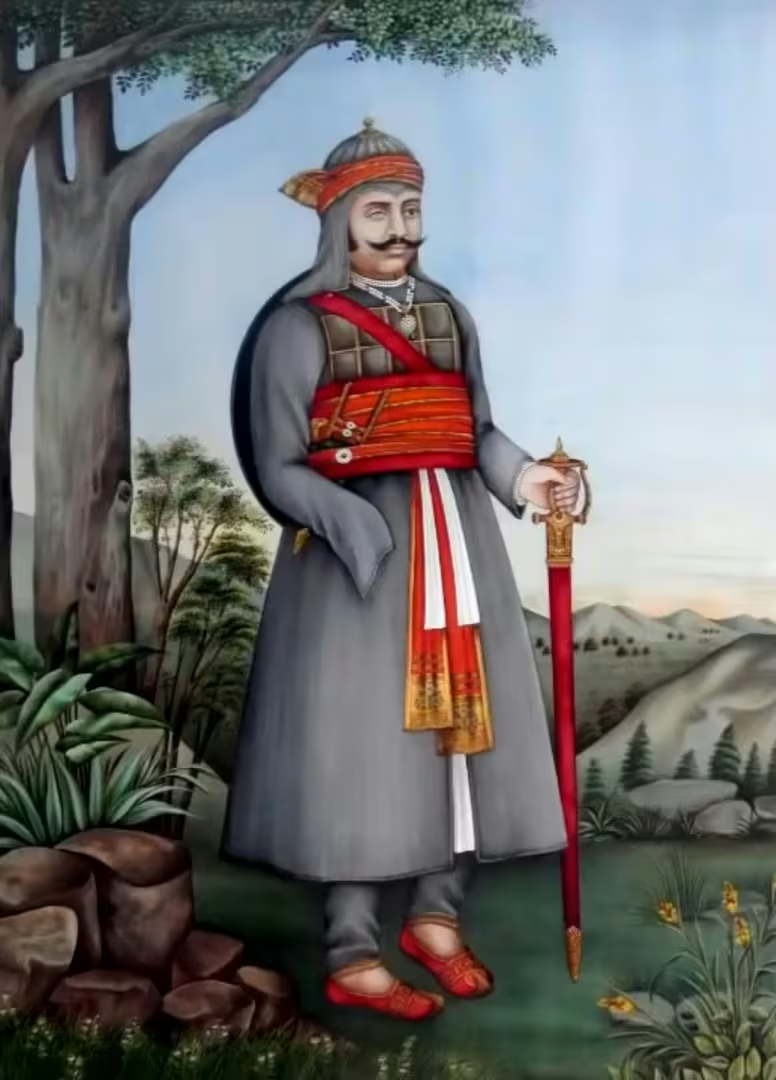
The One-Eyed Lion of Mewar: The Saga of Maharana Sangram Singh I
In the grand tapestry of Indian history, few figures embody the spirit of martial defiance and tragic grandeur as completely as Maharana Sangram Singh I, known to posterity as the indomitable Rana Sanga. He was the last great bulwark against the tide of foreign invasion in the early 16th century, a warrior-king who bore the scars of eighty battles on his body and a dream of a united Rajput empire in his heart. His story is not merely one of conquest, but of a monumental struggle to preserve a political and cultural order against the inexorable march of a new era, an era defined by gunpowder and imperial ambition from Central Asia.
Early Life: Forged in Fratricidal Fire
Born in 1482 into the revered Sisodia dynasty of Mewar, Sangram Singh was the son of the reigning monarch, Rana Raimal. His was a lineage steeped in resistance, tracing its ancestry to heroic figures like Bappa Rawal and Rana Kumbha, who had defended their desert kingdom against the might of the Delhi Sultanate for centuries. Yet, Sanga’s path to the throne of Chittorgarh was not preordained; it was a brutal trial by fire, carved through the crucible of a bitter and bloody fratricidal war.
He was one of several ambitious sons of Rana Raimal, with his elder brothers Prithviraj and Jaimal being his chief rivals. Prithviraj, in particular, was renowned for his fiery temperament and martial prowess, earning the moniker "the flying prince." The rivalry among the brothers was legendary and became the subject of many a bardic tale. The most famous of these recounts a fateful visit to a Charani priestess to seek a prophecy about Mewar’s future ruler. The priestess, foreseeing Sanga’s destiny, named him as the heir. Enraged, Prithviraj drew his sword and attacked his younger brother. In the ensuing melee, as their uncle Surajmal tried to intervene, Sangram Singh was struck in the eye, an injury that would leave him half-blind for the rest of his life.
Fleeing for his life, the wounded prince became a fugitive. He spent years in exile, wandering through the Aravalli hills and seeking refuge under assumed identities. This period of hardship was a formative one. He found shelter with Karam Chand, a chieftain of the Parmar clan in Ajmer, who recognized the prince's noble bearing despite his disguise. This time away from the courtly intrigues of Chittor gave Sanga a profound understanding of the complex web of Rajput alliances and the geo-political landscape of Rajasthan. It taught him patience, diplomacy, and the art of survival—skills that would prove far more valuable than the throne he had fled.
Destiny, however, could not be denied. His brother Jaimal was killed in a duel over a woman, and the volatile Prithviraj was poisoned by his own brother-in-law. With his rivals gone, the path to the throne was clear. In 1508, Sangram Singh was recalled from exile to ascend the gaddi (throne) of Mewar. The prince who had left as a blinded fugitive returned as Maharana, his body already marked by the violence that would define his reign.
Career: The Architect of a Rajput Confederacy
Rana Sanga inherited a kingdom, but his ambition was to build an empire. The political landscape of North India was fractured. The Delhi Sultanate, under the weak and ineffective Lodi dynasty, was a shadow of its former self. The Sultanates of Malwa and Gujarat were powerful but constantly mired in internal conflicts. Sanga saw an opportunity to not just secure Mewar but to restore Rajput supremacy over the heartland of Hindustan.
His reign was a whirlwind of relentless military campaigning, where he methodically dismantled the power of his rivals.
Victories Against the Sultanates
His primary target was the Delhi Sultanate under Ibrahim Lodi. The clash between the two powers was inevitable.
Battle of Khatoli (1518): Sanga marched his forces north and met the much larger army of Ibrahim Lodi at Khatoli, on the borders of Haravati. In a fierce and bloody encounter, the Rajput cavalry charge proved irresistible. The Sultan's army was routed, and a Lodi prince was captured. The victory came at a great personal cost to Sanga; he lost his left arm to a sword cut and an arrow permanently lamed his leg. But the message was clear: Mewar was now the dominant military power in the region.
Battle of Dholpur (1519): Stung by the defeat, Ibrahim Lodi dispatched another massive army under his most capable commanders. Sanga met them again near Dholpur. Once more, the disciplined ferocity of the Mewari army shattered the Sultanate's forces. This victory pushed the boundaries of Mewar’s influence to the very outskirts of Agra, the Lodi capital.
Having humbled Delhi, Sanga turned his attention to his other rivals. He intervened in the internal politics of the Malwa Sultanate, where the Hindu minister Medini Rai was seeking to assert his authority against Sultan Mahmud Khalji II. When the Sultan, aided by the Gujarat Sultanate, tried to oust Medini Rai, Sanga came to the Rajput minister's aid.
- Battle of Gagron (1519): At Gagron, Sanga’s army met the combined forces of Malwa and Gujarat. The result was another spectacular victory. Sultan Mahmud Khalji II was wounded and taken prisoner. In a display of classic Rajput chivalry, Sanga treated the captured Sultan with immense respect, nursed him back to health, and escorted him back to his capital, restoring him to his throne. This was not an act of weakness, but a masterstroke of diplomacy. While annexing key territories like Chanderi (which he granted to Medini Rai), he had turned a rival into a grateful, subordinate ally.
By 1525, Rana Sanga was the undisputed master of Northern India. He had forged a powerful confederacy of nearly all the Rajput kings of Rajasthan. Rulers from Marwar, Amber, Gwalior, Ajmer, and Chanderi paid him homage. Even some Afghan chieftains, disaffected with Ibrahim Lodi, like Hasan Khan Mewati, joined his alliance. He was at the zenith of his power, a battle-hardened sovereign who commanded the loyalty of over 100,000 warriors, dreaming of a final march on Delhi to reclaim it for an indigenous power.
The Mughal Storm and the Battle of Khanwa
It was at this peak of his power that a new, formidable force entered the Indian subcontinent. Zahir-ud-din Muhammad Babur, the Timurid prince of Ferghana, had established a kingdom in Kabul and now set his sights on the vast wealth of Hindustan. According to Babur’s own memoir, the Baburnama, Rana Sanga had sent an envoy to him in Kabul, proposing a joint attack on Ibrahim Lodi. The alleged plan was that while Babur engaged Lodi from the north-west, Sanga would attack Agra. Historians debate the veracity of this claim; it is equally likely that Sanga, a shrewd strategist, intended for his two main rivals to exhaust each other, leaving him to pick up the pieces.
Whatever the arrangement, Babur invaded and, using his superior artillery and mobile cavalry tactics, crushed Ibrahim Lodi’s army at the First Battle of Panipat in 1526. Delhi and Agra fell into Babur's hands. But the Mughal conqueror soon realized that his true test was not the crumbling Lodi dynasty, but the vast Rajput confederacy led by Rana Sanga.
A clash was inevitable. Sanga saw Babur not as an emperor, but as a foreign usurper, another in a long line of invaders to be driven from the sacred land of Bharat. He began to mobilize his grand alliance. The initial skirmishes were promising. A Mughal garrison at Bayana was annihilated by the Rajputs, a victory that sent a wave of confidence through Sanga’s camp and a tremor of fear through Babur’s.
On March 17, 1527, the two armies met at Khanwa, a village near Fatehpur Sikri. It was a confrontation of two worlds. On one side stood Rana Sanga’s massive, traditional army—a sea of Rajput horsemen, supported by war elephants, fighting with sword and spear, driven by ideals of honor and chivalry. On the other stood Babur’s smaller, tightly disciplined force, built around a revolutionary core of gunpowder technology: Turkish artillery and matchlock-wielding musketeers, protected by a fortified laager of carts (araba).
Babur, sensing the terror his cannons inspired in an army that had never faced them, masterfully prepared his battlefield. He also rallied his demoralized troops with a charismatic speech, breaking his wine goblets and swearing off alcohol, framing the battle as a holy war (jihad) to galvanize their spirits.
The battle began with a furious Rajput charge that, in its initial momentum, overwhelmed the Mughal flanks. The Rajputs fought with desperate courage, and for a few hours, the outcome hung in the balance. But they could not break through the fortified Mughal center, where the cannons and muskets spat fire and death, mowing down men and horses in terrifying numbers. In the heat of the battle, while leading from the front atop his elephant, Rana Sanga was struck by a bullet or an arrow and fell unconscious. His loyal retainers quickly removed him from the battlefield to save his life. But his disappearance from view caused a catastrophic collapse in morale. The Rajput army, leaderless and confused, fell into disarray and was routed. The alleged betrayal of Silhadi, a chieftain from Raisen who defected to Babur mid-battle, only compounded the disaster.
The defeat at Khanwa was a watershed moment in Indian history. It shattered the Rajput confederacy and ended the last realistic chance of a native power stopping the establishment of the Mughal Empire. Panipat gave Babur a throne; Khanwa gave him an empire.
Legacy: The Undefeated Spirit
Rana Sanga survived his wounds but not the defeat. When he regained consciousness, he learned of the rout and was consumed by shame and a desire for revenge. He took a solemn vow to never re-enter the gates of his capital, Chittorgarh, until he had vanquished Babur. He wrapped a turban around his head, a symbol of a king ready for battle, and began preparations for a new campaign.
However, his own nobles, traumatized by the slaughter at Khanwa and terrified of the destructive power of Mughal cannons, had no stomach for another war. Fearing that their Maharana’s obsessive quest for vengeance would lead to the annihilation of Mewar, a conspiracy was hatched. In 1528, while on the march, Rana Sanga was poisoned by his own chieftains. He died at Kalpi, his dream of a unified Hindu-led empire dying with him.
His legacy, however, is not one of failure, but of epic and unyielding resistance. The chronicler James Tod famously described him as a fragment of a warrior, a man who carried the marks of his life on his body: one eye lost, an arm disabled, a leg crippled, and no less than eighty honorable wound scars from sword and lance. This physical image perfectly encapsulates his spirit—battered but never broken.
Maharana Sangram Singh I is remembered today as a symbol of Rajput valor at its zenith. He was a brilliant strategist and an inspiring leader who, for a brief, glorious period, united the perpetually feuding clans of Rajasthan under a single banner. He brought Mewar to the pinnacle of its power and came tantalizingly close to altering the course of Indian history. His life serves as a poignant reminder of the old martial order of Rajput chivalry, which clashed heroically, and tragically, with the new, impersonal mechanics of gunpowder warfare. He remains, in the memory of his people, the one-eyed lion of Mewar who dared to challenge an emperor and, in doing so, became a legend.