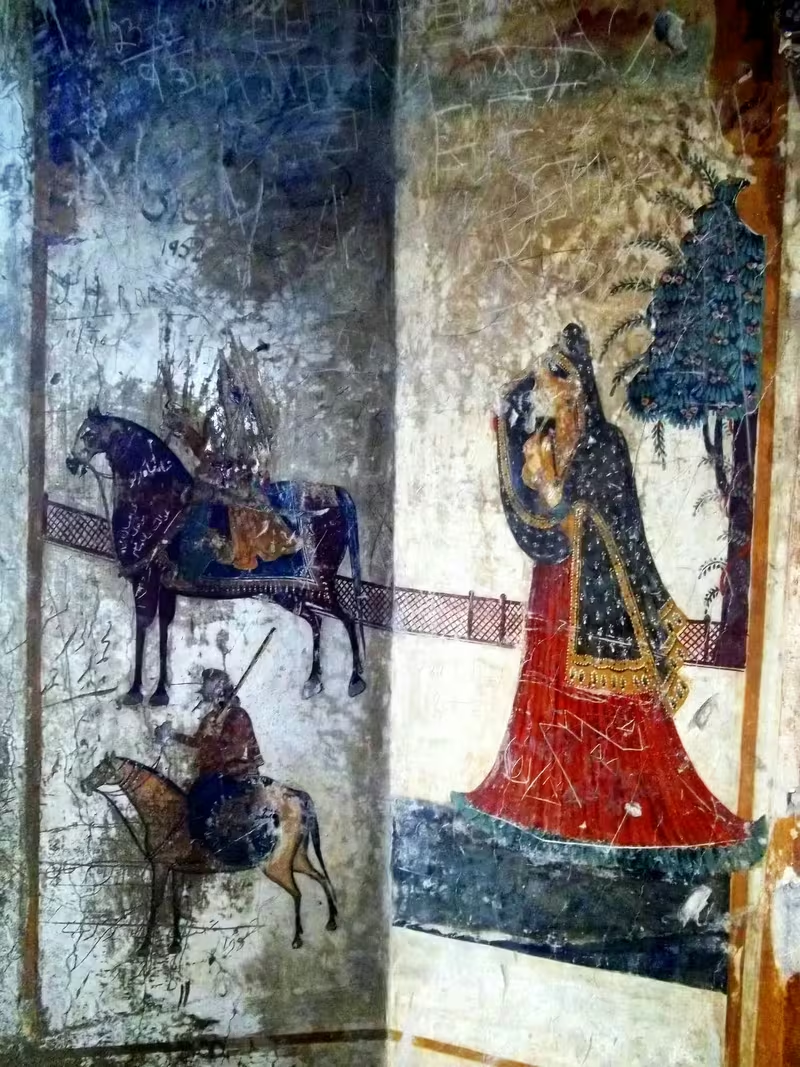
The Lion of Punjab: The Saga of Maharaja Ranjit Singh
In the grand tapestry of Indian history, few figures loom as large or as luminous as Maharaja Ranjit Singh. Known affectionately and fearfully as Sher-e-Punjab, the Lion of Punjab, he was the visionary founder of the Sikh Empire, a unifier of a fractured land, and a ruler whose name became synonymous with strength, secularism, and sovereignty. In an era marked by the decline of Mughal authority and the relentless advance of the British, Ranjit Singh carved out a powerful kingdom that stood as a formidable bulwark, a testament to his unparalleled military genius and political acumen. His story is not just of conquest, but of creation—the forging of a nation from the crucible of chaos.
Early Life & Background
Ranjit Singh was born on November 13, 1780, in Gujranwala, in the heart of Punjab. He was the son of Maha Singh, the formidable chieftain of the Sukerchakia Misl, one of the twelve sovereign confederacies into which the Sikh community was then divided. His mother, Mai Raj Kaur, was the daughter of the ruler of the Jind state. His was a world of constant conflict, where survival depended on martial prowess and strategic alliances.
His childhood was brutally formative. At a very young age, he survived a severe bout of smallpox. The disease, a common scourge of the time, left him with a pockmarked face and, most significantly, claimed the sight in his left eye. This physical imperfection, however, did little to dim his inner vision or his fierce ambition. It perhaps sharpened his other senses, forcing him to perceive the world through a lens of acute awareness and unwavering resolve.
Formal education in letters and scriptures eluded him; Ranjit Singh remained illiterate throughout his life. His true classroom was the battlefield, and his tutors were war and statecraft. From the age of ten, he began accompanying his father on military expeditions, learning the harsh lessons of command, loyalty, and strategy firsthand. The saddle was his throne, the sword his pen.
The defining moment of his youth came in 1792 with the sudden death of his father. At the tender age of twelve, Ranjit Singh inherited the leadership of the Sukerchakia Misl. His early years as a ruler were managed by a regency council, which included his mother and, most importantly, his future mother-in-law, Sada Kaur of the Kanhaiya Misl. Sada Kaur was a woman of exceptional intelligence and political savvy. Recognizing the spark of greatness in the young chief, she became his mentor and most crucial early ally, guiding his hand and helping him navigate the treacherous politics of the warring Misls.
Career & Major Contributions: The Forging of an Empire
Ranjit Singh’s rise from a minor chieftain to the undisputed Maharaja of Punjab is a masterclass in ambition and execution. His career was defined by three core objectives: the unification of the Sikh Misls, the modernization of his army, and the establishment of a just and secular administration.
The Unification of Punjab
At the close of the 18th century, Punjab was a patchwork of petty principalities, vulnerable to the recurring invasions of Afghan rulers like Zaman Shah Durrani. Ranjit Singh envisioned a united, sovereign Punjabi state, strong enough to defend its own borders. His first major step towards this goal was the capture of Lahore.
In 1799, at just nineteen years old, he set his sights on the historic capital of Punjab. With the strategic backing of Sada Kaur's forces and the support of Lahore's citizens, who were weary of the inept rule of the Bhangi Misl, Ranjit Singh marched into the city with minimal resistance. This single act transformed him from just another Misl leader into a major regional power.
On April 12, 1801, coinciding with Vaisakhi, the most significant day in the Sikh calendar, Ranjit Singh was formally coronated. In a move that signaled his inclusive vision, he assumed the secular title of Maharaja (Great King) rather than a religious one. He dedicated his rule to the Sikh Gurus, issuing coins known as Nanakshahi in their name, inscribed with reverence for Guru Nanak and Guru Gobind Singh. His government, the Sarkar-i-Khalsa, was proclaimed as the government of all Punjabis.
Military Conquests and Diplomatic Triumphs
With Lahore as his capital, Ranjit Singh embarked on a systematic campaign of expansion. In 1805, he captured the holy city of Amritsar from the Bhangi Misl, thus uniting the political and spiritual centers of Sikhism. Over the next decade, he absorbed the remaining Misls through a combination of military force, diplomacy, and strategic matrimonial alliances.
A defining moment in his reign was the Treaty of Amritsar in 1809. The British East India Company, rapidly expanding its influence across India, had reached his eastern frontier. Rather than engage in a premature and potentially disastrous conflict, Ranjit Singh negotiated with the British envoy, Charles Metcalfe. The treaty established the Sutlej River as the formal boundary between the Sikh Empire and British territories. This pragmatic agreement secured his eastern flank, granting him the freedom to consolidate his power and expand his empire north and west.
Freed from the British threat, his Khalsa army marched to victory after victory:
- Multan (1818): After several failed attempts, his forces finally conquered the heavily fortified city of Multan, a vital trading hub, from its Afghan rulers.
- Kashmir (1819): In a brilliant campaign through treacherous mountain passes, his army ousted the Durrani governors from the Kashmir Valley, annexing the prized region into his empire.
- Peshawar (1834): The final jewel in his imperial crown was the capture of Peshawar, the strategic gateway to the Indian subcontinent. This victory, led by his legendary general Hari Singh Nalwa, pushed the empire's frontiers to the foothills of the Hindu Kush, effectively ending the era of Afghan invasions that had plagued Punjab for centuries.
The Modern Khalsa Army
Perhaps Ranjit Singh’s most enduring contribution was the transformation of the Sikh fighting force. The traditional Khalsa army, renowned for its guerrilla cavalry tactics, was reshaped into a modern, disciplined, and formidable military machine—the Fauj-i-Ain.
Realizing the superiority of European military techniques, he employed dozens of foreign officers, primarily French and Italian veterans of the Napoleonic Wars. Figures like Jean-François Allard (cavalry), Jean-Baptiste Ventura (infantry), and Claude Auguste Court (artillery) were given high commands and tasked with training his soldiers in Western drills, command structures, and infantry tactics. He invested heavily in a modern artillery corps, establishing foundries in Lahore to manufacture cannons and munitions.
Under his command, the Khalsa army became one of the most powerful indigenous armies in Asia, a diverse and meritocratic force. It included not only Sikhs but also Punjabi Muslims, Hindus, and even European Christians, with promotions based on skill and loyalty, not faith.
A Secular and Prosperous Administration
The governance of the Sikh Empire reflected its founder's pragmatic and inclusive worldview. The Lahore Durbar, his royal court, was a testament to his secularism. His key ministers were chosen for their competence, not their creed.
- Fakir Azizuddin, a Muslim, was his trusted foreign minister and advisor.
- Dina Nath, a Hindu Brahmin, was his finance minister.
- Dhian Singh, a Hindu Dogra, served as his prime minister.
An often-told anecdote perfectly captures his spirit. When a British official asked the Maharaja which of his eyes was missing, his foreign minister, Fakir Azizuddin, famously replied: “The Maharaja is like the sun and the sun has only one eye. The splendour and luminosity of his single eye is so much that I have never dared to look at his other eye.” When the Maharaja heard of this, he remarked that the official had wanted to know which eye was blind, to which Azizuddin replied, “It is the left eye, so that he may look upon all his subjects—Hindu, Sikh, and Muslim—with the same eye.”
He established a system of courts (adalats) and ensured the security of trade routes, which brought immense prosperity to the region. While land revenue was the state's main income and taxes could be high, his rule was generally seen as just and stable, a welcome relief after decades of anarchy.
A devout Sikh, he famously funded the gilding of the Harmandir Sahib in Amritsar, transforming it into the iconic Golden Temple. Yet, his patronage extended to other faiths. He made generous donations to Hindu temples and Sufi shrines and supported the maintenance of mosques, embodying a spirit of genuine respect for all his subjects.
Legacy & Influence
Maharaja Ranjit Singh died on June 27, 1839. His death left a power vacuum that his fractious heirs and ambitious courtiers could not fill. The magnificent empire he had built over four decades began to crumble from within, weakened by intrigue and assassinations. This internal decay ultimately paved the way for the British, who defeated the Khalsa army in the two hard-fought Anglo-Sikh Wars and annexed Punjab in 1849, just a decade after his passing.
Despite the empire's eventual fall, Ranjit Singh's legacy remains monumental.
- The Creator of the Sikh Empire: He remains the only ruler to have established a sovereign, unified Sikh state, stretching from the Khyber Pass to the Sutlej and from Kashmir to the deserts of Sindh. He gave the Sikhs a kingdom they could call their own.
- A Punjabi Icon: He created a powerful sense of Punjabi identity that transcended religious divides. For the first time in nearly 800 years, Punjab was ruled not by foreign invaders but by a son of its own soil.
- The Last Great Indian King: His empire was one of the last in the subcontinent to hold out against the British, a testament to his diplomatic skill and the might of his army. His life represents a final, brilliant flame of Indian sovereignty before the darkness of colonial rule enveloped the entire subcontinent.
- A Model of Secular Governance: In an age of religious strife, he stands as an enduring symbol of enlightened and pluralistic leadership. His ability to unite diverse communities under a single banner remains a powerful lesson for modern India.
Today, the ‘Lion of Punjab’ is remembered not just for the empire he built or the battles he won. He is revered for his indomitable spirit, his sharp intellect, and the inclusive, prosperous kingdom he nurtured. From the humble beginnings of a one-eyed boy who inherited a small fiefdom, he rose to become one of the most charismatic and effective leaders in Indian history, a true Maharaja in every sense of the word.