
Raghuvaṃśa - Kalidasa's Epic of the Solar Dynasty
Raghuvaṃśa, Kalidasa's 5th century Sanskrit mahakavya in 19 cantos, narrates the illustrious lineage of the Raghu dynasty from Dilipa to Agnivarna.
Gallery
Gallery

17th-century manuscript copy of Raghuvamsa in Nepali script, demonstrating the work's transmission across regions and centuries
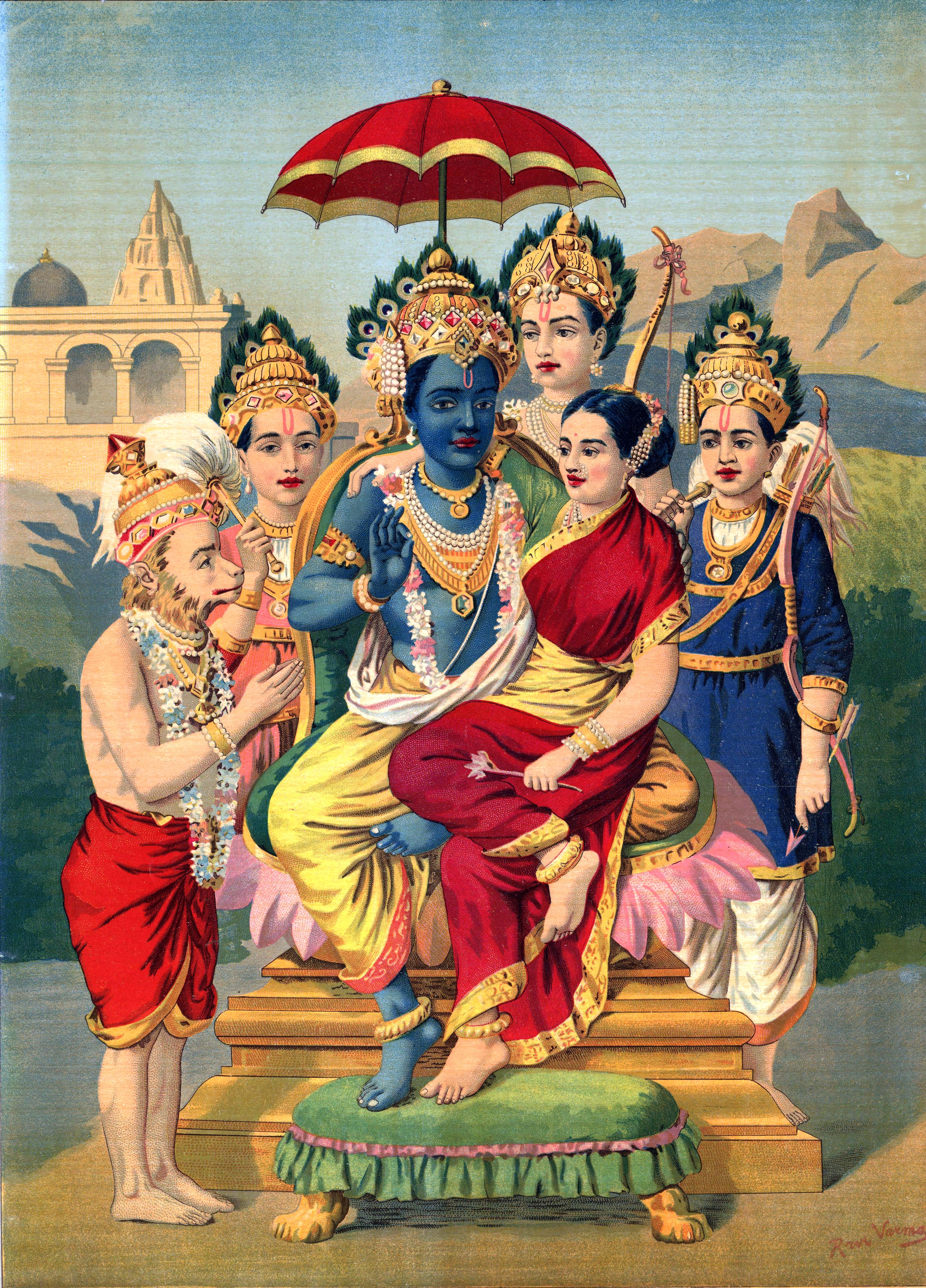
Ramapanchayan by Raja Ravi Varma - artistic representation of characters from the Raghu dynasty

Bazaar art print circa 1910, showing popular visualization of epic narratives
Introduction
The Raghuvaṃśa (रघुवंशम्, “The Dynasty of Raghu”) stands as one of the most celebrated mahakavyas (great epic poems) in Sanskrit literature, composed by the legendary poet Kalidasa, whose name has become synonymous with the golden age of classical Sanskrit poetry. This magnificent work traces the lineage of the Solar Dynasty (Suryavamsha), chronicling the lives, virtues, and extraordinary deeds of the illustrious kings descended from Ikshvaku through nineteen generations, culminating in the reign of Agnivarna. Though the exact date of composition remains uncertain, scholarly consensus places Kalidasa in the 5th century CE, during the cultural efflorescence of the Gupta period when Sanskrit literature, art, and learning reached unprecedented heights.
The Raghuvaṃśa occupies a unique position in Indian literary tradition, serving simultaneously as a genealogical chronicle, a treatise on ideal kingship, and a profound meditation on dharma (righteousness). Through its nineteen sargas (cantos), the poem presents a gallery of royal personalities, each embodying specific aspects of the ideal chakravartin (universal monarch). From the pious Dilipa to the mighty Raghu, from the passionate Aja to the steadfast Dasharatha, and climaxing with the divine avatar Rama, Kalidasa weaves a narrative tapestry that celebrates both human excellence and divine purpose. The work derives its name from King Raghu, whose military conquests and righteous rule established the dynasty’s reputation, making his descendants forever known as the Raghus.
What distinguishes the Raghuvaṃśa from other retellings of these legendary stories is Kalidasa’s unparalleled poetic artistry. The poet employs the full range of Sanskrit’s expressive capabilities, crafting verses that simultaneously tell stories, evoke emotions, describe nature, and explore philosophical depths. His mastery of alaṃkāra (poetic ornamentation), his innovative use of meters, and his ability to infuse familiar narratives with fresh insights have made this work a touchstone for Sanskrit literary excellence for over fifteen centuries.
Historical Context and Composition
The creation of the Raghuvaṃśa occurred during what many scholars consider the golden age of classical Sanskrit literature—the Gupta period (approximately 320-550 CE). This era witnessed unprecedented royal patronage of arts and letters, with Sanskrit emerging as the preeminent language of courtly culture across the Indian subcontinent. The Gupta emperors themselves cultivated reputations as learned patrons, and their courts attracted poets, philosophers, and scholars from throughout India.
Though Kalidasa’s exact dates and biography remain matters of scholarly debate, traditional accounts and textual evidence suggest he flourished during the reign of Chandragupta II Vikramaditya (circa 380-415 CE), who ruled from Ujjayini (modern Ujjain). The city, located in the Malwa region of central India, served as both a political capital and a cultural hub, renowned for its learned assemblies and artistic vitality. The cosmopolitan atmosphere of Ujjayini, with its synthesis of courtly refinement and popular religious devotion, profoundly influenced Kalidasa’s literary imagination.
The composition of the Raghuvaṃśa reflects the sophisticated literary culture of this period. By Kalidasa’s time, the mahakavya had evolved into a highly codified genre with specific structural requirements, thematic conventions, and stylistic expectations. According to Sanskrit poetic theory, a mahakavya should narrate the deeds of a noble hero, employ diverse meters, include descriptions of cities, oceans, mountains, seasons, sunrises, moonrises, gardens, marriages, births of princes, council meetings, military expeditions, and battles. The Raghuvaṃśa fulfills all these requirements while transcending the formulaic through Kalidasa’s creative genius.
The choice of the Raghu dynasty as subject matter was both natural and strategic. The story of Rama and his ancestors enjoyed widespread popular devotion through Valmiki’s Ramayana and Puranic literature. However, Kalidasa’s innovation lay in extending the narrative backward to earlier generations and forward to later descendants, creating a comprehensive dynastic chronicle that examined the rise, glory, and eventual decline of a royal lineage. This expansive temporal scope allowed him to explore themes of cyclical time, the nature of kingship, and the relationship between human endeavor and cosmic destiny.
Structure and Content
The Raghuvaṃśa comprises nineteen sargas (cantos) of varying length, together containing approximately 1,564 verses in multiple meters. The work’s structure reflects careful artistic planning, with the central cantos devoted to Rama’s story serving as the epic’s spiritual and narrative climax, while the earlier and later cantos trace the dynasty’s rise and decline.
Cantos 1-9: The Rise of the Dynasty
The epic opens with an invocation to Parvati and Shiva, following the classical convention while establishing the cosmic framework within which the human drama unfolds. The first canto introduces King Dilipa, a paradigm of royal virtue whose childlessness becomes the catalyst for the initial narrative. Dilipa’s devoted service to Nandini, the divine wish-fulfilling cow, and his willingness to sacrifice himself to protect her from a lion demonstrates the selfless dedication that characterizes the dynasty’s founders. His reward is the birth of his son Raghu, whose name will define all his descendants.
Raghu’s military digvijaya (conquest of the directions) occupies the fourth and fifth cantos, showcasing Kalidasa’s skill in depicting martial prowess and strategic genius. However, what distinguishes Raghu is not merely his military success but his magnanimous distribution of all his conquered wealth to Brahmins during a great sacrifice, retaining nothing for himself. This extraordinary act of dana (giving) establishes the dynasty’s reputation for dharmic kingship.
The subsequent cantos narrate the story of Aja and Indumati, one of Sanskrit literature’s most poignant love stories. Their romance, marriage, and Indumati’s tragic death demonstrate Kalidasa’s mastery of shringara rasa (the aesthetic emotion of love) and karuna rasa (pathos). Aja’s inconsolable grief and eventual death from heartbreak reveal the human vulnerability that exists even in the greatest kings, adding psychological depth to the heroic narrative.
Cantos 10-15: The Ramayana Cycle
The central cantos retell the Rama story, though in Kalidasa’s distinctive style. Rather than extensively elaborating the familiar narrative, he focuses on specific moments that illuminate character and theme. Dasharatha’s conflict between royal duty and paternal love, Rama’s acceptance of exile as dharmic necessity, and Sita’s unwavering devotion receive poetic treatment that emphasizes their exemplary nature.
Kalidasa’s treatment of the Rama story demonstrates his artistic philosophy of creative adaptation. While respecting Valmiki’s foundational narrative, he introduces novel perspectives, condenses certain episodes, and emphasizes psychological and emotional dimensions. His description of Rama’s rule (Rama-rajya) in canto fifteen presents the ideal of dharmic governance, where natural harmony, social justice, and spiritual flourishing coexist.
Cantos 16-19: The Dynasty’s Decline
The final cantos trace the dynasty’s gradual decline through Rama’s descendants. Kings like Kusha and Atithi maintain the family’s virtuous traditions, but each generation moves further from the founding ideals. The work culminates—or perhaps abruptly ends—with Agnivarna, a king who abandons dharma for sensual indulgence and dies young from dissipation. This conclusion has generated considerable scholarly debate, with some arguing that Kalidasa intentionally ended here to demonstrate the impermanence of even the greatest dynasties, while others suggest the work may be incomplete.
Literary Artistry and Poetic Technique
The Raghuvaṃśa exemplifies Kalidasa’s reputation as the supreme master of Sanskrit kavya. His poetic technique operates on multiple levels simultaneously, creating verses that reward repeated reading and contemplation.
Metrical Variety: Kalidasa employs numerous classical Sanskrit meters (chandas), matching the meter to the emotional tone and narrative content of each passage. The stately upajati and vasantatilaka meters suit descriptions of royal courts and solemn ceremonies, while lighter meters like malini and mandakranta convey romantic or pastoral scenes. His metrical innovations influenced subsequent Sanskrit prosody.
Figurative Language: The poet’s use of alaṃkāra (poetic ornamentation) demonstrates mastery without excess. His similes (upama), metaphors (rupaka), double meanings (shlesa), and alliteration (anuprasa) enhance rather than obscure meaning. A famous example occurs in his description of Aja’s grief, where the comparison of the widowed king to a tree struck by lightning creates multiple resonances—both visual and emotional.
Natural Description: Kalidasa’s depictions of nature—forests, rivers, mountains, seasons—reveal keen observation combined with symbolic depth. Nature in the Raghuvaṃśa is never merely decorative backdrop but participates in the narrative, reflecting and responding to human emotions and actions. His description of the monsoon in canto sixteen, with its dual capacity to bring fertility and destruction, mirrors the dynasty’s own trajectory.
Psychological Insight: Beyond ornamental virtuosity, Kalidasa demonstrates profound understanding of human psychology. His characters experience complex, conflicting emotions rendered with subtlety and compassion. Dilipa’s anxiety about his childlessness, Aja’s overwhelming grief, Dasharatha’s agonizing choice between love and duty—all receive treatment that illuminates universal human experiences through particular dramatic situations.
Themes and Philosophical Dimensions
The Raghuvaṃśa operates as more than dynastic chronicle or literary showcase; it constitutes a sustained meditation on fundamental questions of existence, governance, and cosmic order.
Dharma and Kingship: The central theme is the nature of dharmic kingship (raja-dharma). Each king in the dynasty exemplifies specific aspects of ideal rule: Dilipa demonstrates selflessness, Raghu shows military prowess tempered by generosity, Aja reveals the tensions between public duty and private emotion, Dasharatha faces the conflict between personal desire and cosmic necessity, and Rama embodies perfect synthesis of all kingly virtues. Through these portraits, Kalidasa explores what it means to rule justly in an imperfect world.
Cyclical Time and Impermanence: The dynasty’s trajectory from virtuous beginnings through glorious peak to eventual decline reflects Hindu concepts of cyclical time and the impermanence of worldly achievements. Even the greatest dynasties rise and fall according to cosmic law. This theme finds expression in the poem’s structure itself, with the Rama cantos representing the dynasty’s spiritual zenith, after which gradual deterioration becomes inevitable.
Human Agency and Divine Will: Throughout the epic, characters struggle with the relationship between free will and destiny. Dilipa’s childlessness results from past karma yet can be remedied through present action. Rama’s exile serves both his father’s promise and cosmic purposes beyond human comprehension. Kalidasa presents a nuanced view where human choices matter profoundly yet operate within frameworks of divine intention and karmic causation.
Love and Duty: The conflict between emotional attachments and dharmic obligations recurs throughout the work. Aja’s grief-stricken death suggests the dangers of excessive attachment, while Dasharatha’s suffering demonstrates the painful consequences of dharmic choices. Rama alone successfully integrates love with duty, though even he must ultimately renounce Sita to maintain royal dharma—an act that troubles commentators to this day.
Cultural Significance and Religious Context
The Raghuvaṃśa occupies a central position in Hindu religious and cultural tradition, though its relationship to religious texts like the Ramayana is complex. While drawing upon Puranic and epic sources, Kalidasa’s work functions more as kavya (artistic poetry) than itihasa (sacred history). Nevertheless, its treatment of Rama as divine avatar and its exploration of dharmic principles give it profound religious resonance.
The poem’s influence on Hindu devotional tradition has been substantial. Its portrayal of Rama as the ideal king and perfect man contributed to the development of Rama worship (bhakti) in subsequent centuries. Verses from the Raghuvaṃśa have been incorporated into liturgical contexts, and episodes from the work have inspired temple art, dramatic performances, and devotional poetry in regional languages.
The work also reflects the religious pluralism of the Gupta period. While fundamentally rooted in Hindu mythology and philosophy, it displays respect for Buddhist and Jain influences present in the broader culture. Kalidasa’s emphasis on compassion, non-violence (within kingly duties), and the suffering inherent in worldly attachment shows awareness of Buddhist thought, while his characters’ strict adherence to vows reflects Jain-influenced ethical rigor.
Manuscript Tradition and Textual History
The textual transmission of the Raghuvaṃśa spans over fifteen centuries, resulting in numerous manuscript traditions, recensions, and variant readings. The work’s popularity ensured its preservation through multiple copies across the Indian subcontinent, from Kashmir to Kerala, from Bengal to Gujarat.
The manuscript tradition presents several textual challenges. Most significantly, the question of whether the work is complete as it stands or breaks off before Kalidasa’s intended conclusion has generated extensive scholarly debate. The abrupt ending with Agnivarna’s dissipated life seems artistically jarring to some readers, leading to theories about lost cantos or intentional incompletion. However, no manuscript tradition preserves cantos beyond the nineteenth, suggesting the work has existed in its current form since early in its transmission history.
Significant manuscript copies include palm-leaf manuscripts from South India dating to the 12th-14th centuries, paper manuscripts in Devanagari script from North India from the 15th-17th centuries, and manuscripts in regional scripts (Bengali, Nepali, Grantha) demonstrating the work’s pan-Indian circulation. The 17th-century Nepali manuscript copy, which survives in the image associated with this work, exemplifies the careful transmission of classical texts across generations and regions.
Commentarial Tradition
The Raghuvaṃśa’s complexity and importance attracted numerous Sanskrit commentators who produced elaborate explanations (tikā) and glosses (vritti). These commentaries serve multiple purposes: explaining difficult words and constructions, identifying literary devices, citing parallel passages from other works, and expounding philosophical and theological implications.
The earliest surviving commentary is Sanjivini by Mallinatha (14th-15th century), which became the standard gloss studied in traditional Sanskrit education. Mallinatha’s work combines grammatical precision with aesthetic sensitivity, making the text accessible to students while preserving its poetic excellence. His commentary influenced how generations of readers understood and appreciated Kalidasa’s artistry.
Other significant commentaries include Samjivani by Arunagirinatha, Chandrika by Vallabhadeva, and various anonymous glosses. These works reveal how different interpretive communities—whether Vedantic, Tantric, or aesthetic theorists—found meanings relevant to their philosophical and literary concerns in Kalidasa’s verses.
The commentarial tradition continues into the modern period, with Sanskrit scholars producing new editions with explanatory notes in Sanskrit and regional languages. These contemporary commentaries often incorporate historical, archaeological, and comparative literary approaches alongside traditional grammatical and aesthetic analysis.
Influence on Sanskrit Literature
The Raghuvaṃśa’s impact on subsequent Sanskrit literature cannot be overstated. It became the model mahakavya, the standard against which other court epics were measured. Later poets studied Kalidasa’s techniques intensively, sometimes imitating his style, sometimes deliberately varying from it, but always engaging with his achievement.
The work influenced multiple genres beyond mahakavya. Dramatists drew upon its episodes for plays, most notably the Aja-Indumati story which inspired several theatrical adaptations. Lyric poets incorporated its imagery and phraseology into shorter works. Even philosophical writers cited verses from the Raghuvaṃśa to illustrate aesthetic principles or ethical concepts.
Kalidasa’s descriptive techniques, especially his nature poetry, established conventions that dominated Sanskrit literature for centuries. His depictions of seasons, mountains, rivers, and gardens provided templates that later poets elaborated, varied, or subverted. His psychological portraiture, particularly of women in love and grief, influenced character development in narrative poetry and drama.
The work also affected Sanskrit poetic theory (kavya-shastra). Theorists like Dandin, Bhamaha, and Anandavardhana frequently cite the Raghuvaṃśa to illustrate poetic devices, aesthetic emotions (rasa), and principles of suggestion (dhvani). The poem thus shaped not only literary practice but also the theoretical frameworks through which Sanskrit literature was understood and evaluated.
Regional Language Adaptations
While the Raghuvaṃśa remained a Sanskrit classic, its stories and themes found expression in numerous regional languages, demonstrating the work’s appeal across linguistic boundaries. These adaptations range from close translations to free creative reworkings that incorporate local cultural elements and aesthetic sensibilities.
Tamil poets created versions that integrated Sangam poetic conventions with Kalidasa’s narrative. Telugu poets produced elaborate retellings with expanded descriptive passages suited to Telugu literary taste. Kannada, Malayalam, Bengali, Hindi, Marathi, and other language traditions each developed their own Raghuvaṃśa versions, often adding episodes, emphasizing different themes, or incorporating regional folk traditions.
These regional adaptations demonstrate the Raghuvaṃśa’s fundamental versatility. While maintaining the core narrative of the Raghu dynasty, each linguistic tradition found in it opportunities to explore local concerns about kingship, dharma, and human excellence. Some versions emphasized devotional elements, treating Rama’s story as primarily religious narrative. Others stressed political themes, using the dynasty’s history to comment on contemporary governance issues.
Modern Reception and Scholarship
The colonial and post-colonial periods brought new approaches to the Raghuvaṃśa. European Orientalists in the 18th and 19th centuries “discovered” Kalidasa for Western audiences, producing translations and scholarly studies that introduced Sanskrit literature to European readership. While early translations often reflected Victorian aesthetic and moral assumptions, they established Kalidasa’s international reputation.
Twentieth-century scholarship brought more sophisticated analytical methods. Historians placed the work in precise socio-political contexts. Comparative literature scholars examined its relationship to other epic traditions. Feminist critics interrogated its representations of women and gender relations. Post-colonial theorists explored how colonial and nationalist movements constructed “classical” Indian literature, with Kalidasa often serving as emblematic figure.
Contemporary Indian scholarship continues to produce new editions, translations, and interpretations in multiple languages. The Raghuvaṃśa remains central to Sanskrit pedagogy in traditional pathashalas (schools) and modern universities. It is studied not only as literary masterpiece but also as historical source for understanding Gupta period culture, as religious text illuminating Hindu concepts of dharma and avatara, and as aesthetic achievement demonstrating Sanskrit’s poetic possibilities.
Modern adaptations extend beyond scholarly contexts. The work has inspired contemporary creative writers, visual artists, theater directors, and filmmakers who find in its stories continued relevance for modern audiences. Some adaptations maintain the classical setting, while others transpose the themes into contemporary contexts, exploring how questions of duty, power, love, and human excellence remain perennially significant.
Preservation and Accessibility
Efforts to preserve and make accessible the Raghuvaṃśa manuscript tradition continue worldwide. Major manuscript collections in India (National Archives, Bhandarkar Oriental Research Institute, Government Oriental Manuscripts Library), Europe (British Library, Bibliothèque nationale de France), and elsewhere maintain important copies. Digital humanities initiatives increasingly make these manuscripts available online, allowing global access to these cultural treasures.
Modern printed editions with multiple commentary layers serve both scholarly and pedagogical needs. Critical editions comparing manuscript variants help scholars understand textual transmission. Student editions with simplified annotations make the work accessible to new generations of Sanskrit learners. Translations in major world languages continue to appear, each generation producing versions suited to contemporary literary sensibilities.
The Raghuvaṃśa has also found expression in digital media. Sanskrit educational websites offer annotated online texts with searchable concordances. Mobile applications provide verses with translations and explanations. Audio recordings by skilled reciters preserve traditional oral performance traditions while making the text accessible to audiences who may not read Devanagari script.
Conclusion: A Living Classic
The Raghuvaṃśa endures not merely as historical artifact or academic subject but as living literature that continues to speak to fundamental human concerns. Its exploration of what constitutes righteous rule remains relevant in every age where questions of political ethics arise. Its psychological portraits of love, grief, duty, and spiritual striving resonate with readers across cultural boundaries. Its aesthetic achievements continue to inspire and challenge writers working in multiple languages and genres.
Kalidasa’s genius lay in his ability to transform familiar materials—legends known from earlier texts, conventional poetic devices, established meters and figures—into something simultaneously traditional and innovative. The Raghuvaṃśa honors the Raghu dynasty’s glorious past while examining with unflinching honesty the impermanence of worldly glory. It celebrates human excellence while acknowledging human limitation. It demonstrates perfect formal mastery while conveying profound emotional and philosophical depth.
For contemporary readers, the Raghuvaṃśa offers multiple entry points. Those interested in Sanskrit literature encounter a supreme example of the mahakavya genre. Students of Indian history find vivid (if idealized) depictions of ancient kingship and society. Devotees of Rama discover alternative perspectives on familiar sacred narratives. Comparative literature scholars observe sophisticated narrative techniques and psychological insight comparable to any world literary tradition. Philosophers encounter sustained meditation on dharma, time, and human purpose.
The work’s influence extends far beyond its 1,564 verses. It shaped how countless generations understood ideal kingship, virtuous action, and poetic excellence. It established Kalidasa as kavi-kulguru (preceptor of poets), the standard against which all subsequent Sanskrit poets measured themselves. It demonstrated Sanskrit’s capacity for expressing complex ideas with aesthetic grace, contributing to the language’s prestige as medium for courtly culture across the Indian subcontinent.
As we move further into the 21st century, the Raghuvaṃśa continues to find new readers and inspire new interpretations. Each generation discovers in it concerns resonant with their own times—questions about political legitimacy, the responsibilities of power, the costs of duty, the nature of love, the impermanence of achievement. Kalidasa’s achievement lies not only in his incomparable artistry but in his creation of a work that transcends its specific historical moment to address perennial human concerns with wisdom, compassion, and unmatched poetic beauty.