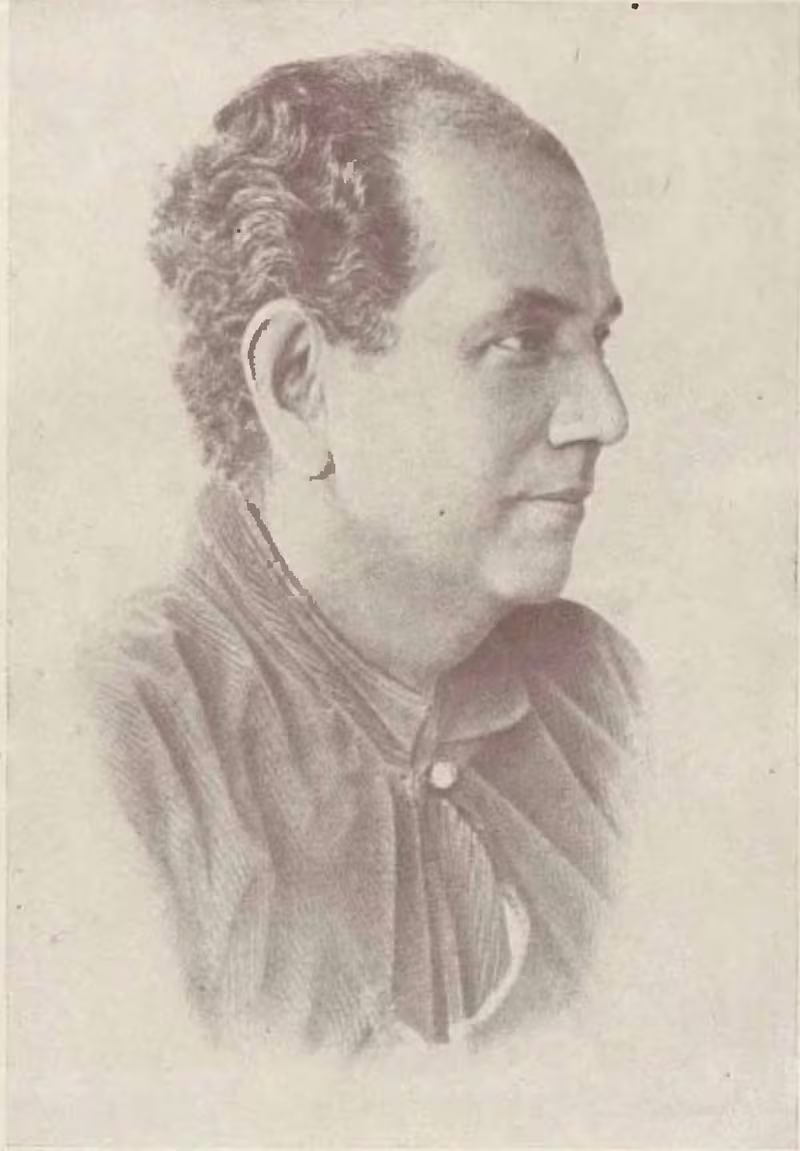
Overview: The Soul of a New Indian Art
In the grand theatre of India's struggle for independence, while politicians and revolutionaries fought on the streets and in the halls of power, a quiet but profound rebellion was taking place on canvas and paper. At the heart of this cultural awakening was Abanindranath Tagore (1871-1951), an artist, writer, and visionary who challenged the colonial gaze and taught a generation of artists to find inspiration not in the academies of Europe, but in the rich artistic heritage of their own land. As the principal founder of the Bengal School of Art, he spearheaded a movement that was as much about national identity as it was about aesthetics. Abanindranath's work was a gentle yet firm rejection of Western materialism, offering instead a delicate, mystical, and deeply Indian vision that would become the visual language of the Swadeshi movement and lay the foundation for modern Indian art.
Early Life and the Jorasanko Influence
Born on August 7, 1871, in the culturally vibrant household of Jorasanko in Calcutta (now Kolkata), Abanindranath was destined for a life steeped in arts and letters. He was a member of the illustrious Tagore family, a dynasty of intellectuals and creatives who were at the forefront of the Bengal Renaissance. He was the nephew of the great poet and Nobel laureate, Rabindranath Tagore, and grew up in an environment where creativity was not just encouraged but was the very air one breathed.
His early education was a mix of traditional and modern learning. He attended the Sanskrit College in Calcutta, which grounded him in classical Indian texts and philosophies. However, his artistic journey began in a surprisingly conventional manner. In the 1880s, he enrolled at the Calcutta School of Art, where he received formal training in the European academic style under Western tutors. His first teachers, the Italian artist Olinto Ghilardi and the British painter Charles Palmer, instructed him in the techniques of oil painting, life-drawing, and perspective. For a time, Abanindranath mastered this imported style, producing portraits and landscapes that adhered to the strict rules of Western realism.
But this was a path he was not meant to follow. A deep-seated dissatisfaction with the rigid, materialistic focus of academic art began to grow within him. He felt that the heavy oils and slavish imitation of reality failed to capture the spirit, the emotion, and the lyrical quality that he saw as the essence of art. His search for a more authentic mode of expression led him to study Mughal and Rajput miniature paintings, whose delicate lines, vibrant yet harmonious colours, and narrative depth resonated deeply with his evolving sensibilities.
The Bengal School: A Revolution in Aesthetics
The most pivotal moment in Abanindranath's career came with his meeting with Ernest Binfield Havell, the new principal of the Government College of Art, Calcutta, in 1896. Havell was an English art historian who, unlike his predecessors, was a passionate advocate for Indian art forms. He was appalled by the colonial curriculum that forced Indian students to copy Greek statues and ignore their own magnificent artistic traditions. In Abanindranath, Havell found the perfect collaborator—an Indian artist with the skill, vision, and lineage to lead an artistic revival.
Together, they embarked on a mission to reform art education and create a new school of painting. Abanindranath was appointed as the Vice-Principal of the college, and under Havell's encouragement, he began to forge a style that was a synthesis of diverse influences, yet uniquely his own. This new movement came to be known as the Bengal School of Art.
The core principles of the Bengal School were a direct counter-statement to the dominant Western style:
- Revival of Indian Themes: Artists were encouraged to draw inspiration from Indian mythology, classical literature like the Ramayana and Mahabharata, historical events, and the quiet beauty of rural life.
- Influence of Miniatures: The school adopted the elegance, lyrical lines, and narrative style of Mughal and Rajput miniature paintings.
- Pan-Asian Synthesis: Abanindranath did not limit his vision to India alone. He was deeply influenced by Japanese art, particularly after meeting the Japanese art historian Okakura Kakuzō. From Japanese artists like Yokoyama Taikan and Hishida Shunsō, he learned the ethereal wash technique. This involved applying translucent layers of watercolour onto paper and then washing it, creating a soft, misty, and atmospheric effect that stood in stark contrast to the heavy impasto of oil painting.
- Emphasis on 'Bhav' (Emotion): The goal was not to create a photographic replica of the world, but to evoke a mood, an emotion, or a spiritual feeling. The art was romantic, mystical, and often dreamlike.
In 1907, Abanindranath and his brother Gaganendranath Tagore, with the support of Havell and other influential figures like Sister Nivedita, founded the Indian Society of Oriental Art. This institution became the primary platform for the Bengal School, organizing exhibitions and publishing a journal that championed its ideals across India and internationally. As a teacher, Abanindranath was a gentle guide, nurturing a generation of artists who would carry his vision forward, including luminaries like Nandalal Bose, Asit Kumar Haldar, and Kshitindranath Majumdar.
Masterpieces of a New Vision
Abanindranath Tagore's paintings are testaments to his revolutionary aesthetic. Each work is a carefully composed piece of visual poetry, rich in symbolism and emotional depth.
The Passing of Shah Jahan (1902): One of his earliest masterpieces, this painting depicts the deposed Mughal emperor on his deathbed, gazing at the Taj Mahal, the monument to his beloved wife. Rendered in a style reminiscent of a Mughal miniature but infused with a palpable sense of melancholy, the work is a poignant meditation on love, loss, and the fading of glory. The muted colours and delicate composition marked a clear departure from the dramatic flair of European history painting.
Bharat Mata (Mother India) (1905): This is arguably his most famous and politically significant work. Painted in the wake of the controversial Partition of Bengal and at the height of the Swadeshi movement, Bharat Mata became an icon of cultural nationalism. Abanindranath reimagined the motherland not as a fierce, weapon-wielding goddess in the European tradition, but as a serene, saffron-clad ascetic figure. She has four arms, holding a manuscript (shiksha/education), sheaves of paddy (anna/food), a piece of white cloth (vastra/clothing), and a string of prayer beads (diksha/spiritual initiation). Her gentle, divine presence offered a spiritual and peaceful symbol for the independence movement. The Irish disciple of Swami Vivekananda, Sister Nivedita, praised the painting effusively, writing, "Here is a picture which is a representation of a thought... It is the first great masterpiece in a new style."
The Arabian Nights Series (1930): In his later career, Abanindranath created a magnificent series of paintings illustrating tales from the Arabian Nights. These works showcase his unparalleled mastery of colour, fantasy, and narrative. The paintings are jewel-like and intricate, transporting the viewer to a world of bustling bazaars, mystical djinns, and moonlit courtyards. This series demonstrated his ability to draw from a wider Oriental canvas, reinforcing his pan-Asian artistic vision.
The Writer and Thinker
Abanindranath's creative genius was not confined to painting. He was also a gifted writer, particularly for children, and a profound thinker on art and aesthetics. His literary works, written in a simple yet enchanting Bengali prose, are considered classics. Books like Budo Angla, Khirer Putul, and Rajkahini are beloved for their imaginative storytelling and whimsical charm, earning him the title of one of the founding fathers of modern Bengali children's literature.
Furthermore, his series of lectures on art, delivered at the University of Calcutta between 1921 and 1929, were compiled into a seminal text known as the Bageswari Shilpa Prabandhabali. In these lectures, he articulated a comprehensive philosophy of Indian aesthetics, delving into the principles of form, rhythm, and expression. He argued for an art that was born from inner experience and cultural memory, not from external imitation, providing the intellectual framework for the movement he had started.
Final Years and Legacy
In his later years, Abanindranath moved away from the structured world of painting and began creating whimsical sculptures and assemblages from found objects—twigs, roots, and other natural materials. He called these creations "Kutum Katam" (literally, "bits and pieces"). This final phase of his artistic life revealed a playful, almost childlike spirit, a desire to create art free from all conventions.
Abanindranath Tagore passed away on December 5, 1951, leaving behind an indelible legacy. He had successfully provided the first powerful and indigenous alternative to the colonial art establishment. While the romantic, revivalist style of the Bengal School was eventually challenged by the next wave of modernists who sought a more international and less narrative form of expression, its historical importance is undeniable. Abanindranath gave Indian artists the courage to reclaim their heritage and the language to express a modern Indian identity. He was more than just a painter; he was a 'shilpa-guru'—a master artist who taught a nation how to see itself once again, not through the eyes of its colonizers, but through the soul of its own rich and timeless traditions.