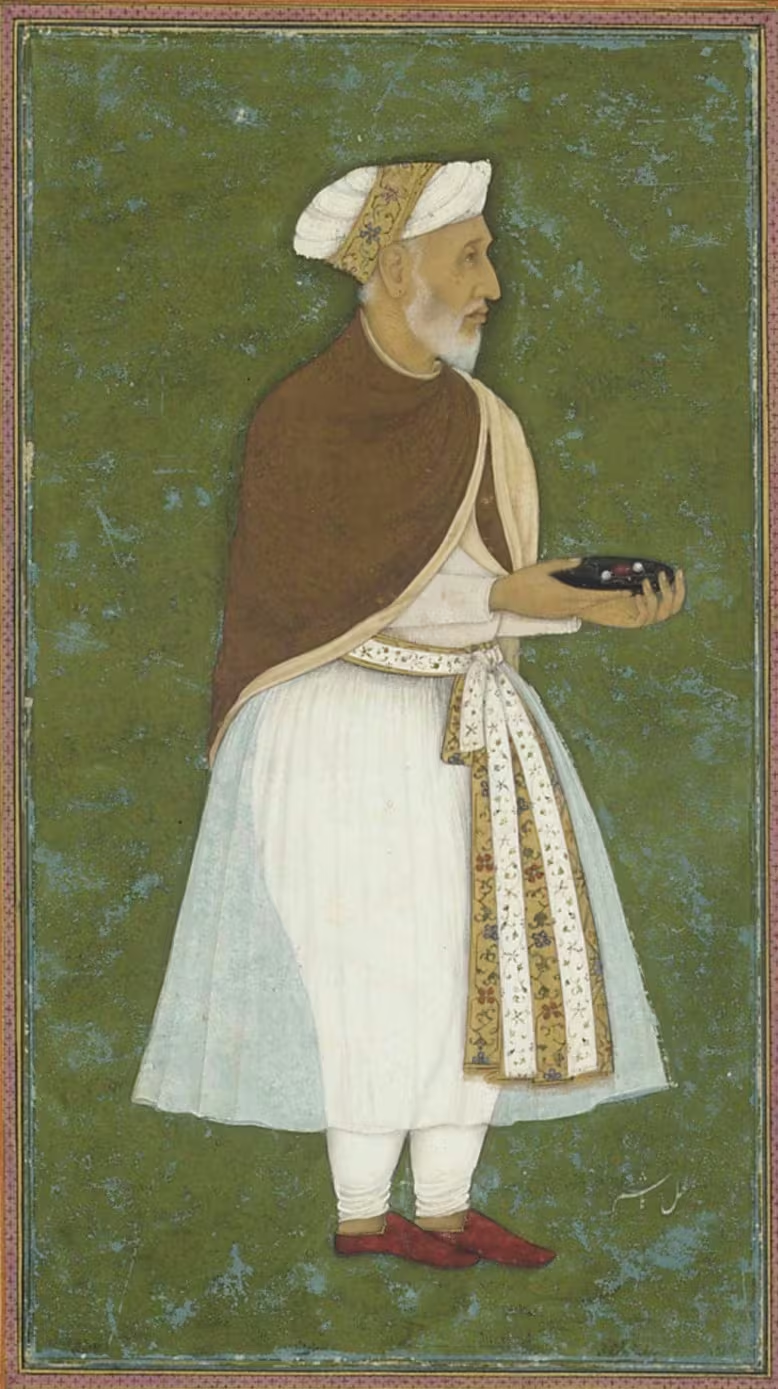
The Poet Prince: The Life and Legacy of Abdul Rahim Khan-i-Khanan
In the grand tapestry of the Mughal Empire, few threads are as vibrant and multifaceted as that of Khanzada Mirza Khan Abdul Rahim, known to history by his revered title, Khan-i-Khanan (the Khan of Khans), and to poetry lovers as simply, Rahim. He was a man who embodied the syncretic soul of his era—a formidable general on the battlefield, a sagacious statesman in the royal court, a masterful scholar of languages, and a poet whose words have resonated through the heart of India for over four centuries. His life, a dramatic arc from orphaned childhood to the zenith of imperial power, is a testament to the confluence of martial prowess and literary genius that defined the golden age of Akbar.
A Childhood Forged in Tragedy and Royal Favor
Abdul Rahim was born on December 17, 1556, in Lahore, into a world of immense power and prestige. His father was the formidable Bairam Khan, a Turkoman noble who was the regent, mentor (Ataliq), and commander-in-chief for the young Emperor Akbar. Bairam Khan was the architect of the Mughal Empire's second founding, securing the throne for Akbar at the Second Battle of Panipat. Rahim's mother was the daughter of Jamal Khan of Mewat, connecting him to the Indian Muslim nobility.
However, this world of privilege shattered when Rahim was merely four years old. Court intrigue and Akbar’s own desire to assume full control led to Bairam Khan's fall from grace. In 1561, while on a journey to Mecca after being dismissed from his duties, Bairam Khan was assassinated in Patan, Gujarat, by a group of Afghans seeking revenge for a past military defeat.
The young, orphaned Rahim and his mother were left in a perilous situation. But Emperor Akbar, ever mindful of his former regent's service, did not forsake the child. He had them brought safely from Ahmedabad to his court in Agra. In a gesture of profound loyalty and affection, Akbar took Rahim under his personal protection, effectively raising him as a son. He bestowed upon him the title 'Mirza Khan' and ensured he received an education befitting a Mughal prince.
This education was the crucible in which Rahim’s extraordinary intellect was shaped. He was tutored by the finest scholars of the age, mastering Persian, the language of the court, as well as Arabic, Chagatai Turkic (the language of his ancestors), and Sanskrit. Crucially, he also developed a deep and abiding love for the local Indian dialects, particularly Braj Bhasha and Awadhi, which he would later use to compose his most enduring literary works. His upbringing in the multicultural and intellectually vibrant court of Akbar exposed him to a dazzling array of ideas, philosophies, and artistic traditions, laying the foundation for the renaissance man he would become.
To further cement his place within the highest echelons of the nobility, Akbar arranged Rahim's marriage to Mah Banu Begum, the sister of Mirza Aziz Koka, another powerful noble and a foster-brother to the Emperor. This union tied Rahim directly to the inner circle of the Mughal imperium.
The Warrior-Statesman: Rise to Khan-i-Khanan
While his literary talents were blossoming, Rahim's primary role in the empire was that of a military commander and administrator. He proved that the pen and the sword could be wielded with equal dexterity. His military career was marked by a series of crucial campaigns that expanded and consolidated Mughal authority.
His crowning military achievement came in 1584. The former Sultan of Gujarat, Muzaffar Shah III, had escaped from confinement and raised a rebellion, threatening to sever the wealthy province from Mughal control. Akbar dispatched Rahim, then just 28 years old, to quell the uprising. Despite being heavily outnumbered, Rahim displayed brilliant tactical acumen and personal courage at the Battle of Sarkhej, near Ahmedabad. He delivered a crushing defeat to the rebel forces, securing Gujarat for the empire once and for all.
In recognition of this spectacular victory, a grateful Akbar bestowed upon him the highest title available to a noble: Khan-i-Khanan (Khan of Khans), a title once held by his own father. This elevated him to the very pinnacle of the Mughal hierarchy, a position he would hold through the reigns of Akbar and Jahangir.
As Khan-i-Khanan, Rahim served as a governor (Subahdar) in various provinces and led important military expeditions. He was instrumental in the campaigns to annex Sindh and subjugate Balochistan. Later, he spent many years commanding the difficult and protracted Mughal campaigns in the Deccan, a theatre of war that tested the mettle of the empire's greatest generals. His tenure in the Deccan was complex, marked by both successes and setbacks, and complicated by the shifting alliances and intense political rivalries that characterized Jahangir's reign.
The Heart of a Poet: Rahim's Literary Universe
While his military and political careers secured his fame and fortune, it is his literary legacy that has granted him immortality. Writing under the simple pen name 'Rahim', he crafted a body of work that bridged the elite, Persian-speaking world of the court with the rustic, Hindi-speaking world of the common people.
The Wisdom of the Dohas
Rahim's most beloved contributions are his dohas—two-line couplets written in Braj Bhasha and Awadhi. These verses are masterpieces of brevity and wisdom, encapsulating profound ethical teachings (niti), devotional sentiments (bhakti), and astute observations on human nature. Drawing metaphors from everyday life—a thread, a tree, water, a potter's wheel—he made complex ideas accessible and memorable. His dohas became part of the folk wisdom of North India, passed down through generations.
One of his most famous dohas speaks to the fragility of relationships:
रहिमन धागा प्रेम का, मत तोड़ो चटकाय। टूटे से फिर ना जुड़े, जुड़े गाँठ पड़ जाय॥ (Rahiman dhaga prem ka, mat todo chatkaye. Toote se phir na jude, jude gaanth pad jaye.)
Translation: Rahim says, do not snap the thread of love with a jerk. If it breaks, it cannot be joined again, and if it is, a knot will remain.
Another reflects on humility and the nature of greatness:
जो बड़ेन को लघु कहें, नहीं रहीम घटी जाँहि। गिरधर मुरलीधर कहें, कछु दुःख मानत नाँहि॥ (Jo baden ko laghu kahe, nahi Rahim ghati jahi. Girdhar Murlidhar kahe, kachu dukh manat nahi.)
Translation: Rahim says, if a small person calls a great one by a lesser name, the great one's stature is not diminished. Lord Krishna does not feel sorrow whether he is called 'Girdhar' (Uplifter of the Mountain) or 'Murlidhar' (The Flute Player).
His poetry was not confined to a single theme. He wrote on friendship, charity, self-respect, and the transient nature of life, all with a gentle, humane touch that continues to resonate with readers today.
Master of Translation and Scholarship
Beyond his original poetry, Rahim was a scholar of the highest order. His most significant contribution to Mughal history was his translation of the Baburnama—the memoirs of the first Mughal Emperor, Babur. Originally written in Chagatai Turkic, the book was largely inaccessible to the Persian-speaking Mughal court. Under a commission from Emperor Akbar, Rahim undertook the monumental task of translating this foundational text into elegant Persian.
This translation, completed around 1589-90, was not merely a linguistic exercise; it was an act of cultural preservation. It made the story of the dynasty's founder available to the entire imperial elite, solidifying a shared sense of history and identity. Rahim's translation remains a primary source for historians studying the life of Babur and the establishment of the Mughal Empire.
He was also a keen student of astrology, authoring two works on the subject: Khet Kautukam and Dwawishd Yogavali. His personal library was legendary, filled with priceless manuscripts, and his court was a vibrant center of patronage for other poets, artists, and scholars, mirroring the intellectual atmosphere of Akbar's imperial court.
Legacy in Stone and Verse
Abdul Rahim Khan-i-Khanan's life was long and eventful, spanning the reigns of Akbar and Jahangir. He witnessed the empire's glorious zenith and the beginnings of the courtly intrigues that would later weaken it. He passed away in 1627 in Delhi and was buried in a magnificent tomb he had built for his wife in 1598.
Located near Humayun's Tomb, Rahim's mausoleum is a landmark of Mughal architecture. Built of red sandstone and marble, it is one of the earliest examples of the garden-tomb style that would culminate in the Taj Mahal. Its grand double dome and intricate decorative patterns showcase the architectural ambitions of the era. For centuries, the tomb suffered from neglect and plunder, but a major restoration project completed in 2020 by the Aga Khan Trust for Culture has returned it to its former splendor, allowing it to stand as a fitting memorial to the man it houses.
Ultimately, Abdul Rahim Khan-i-Khanan's greatest legacy lies not in stone, but in his words. He is remembered as one of the Navratnas (Nine Jewels) of Akbar's court, a group of the most talented minds of the age. But more importantly, he is remembered as Rahim, the poet whose couplets are woven into the cultural fabric of India.
He was the quintessential Mughal noble: a man of Turkic ancestry, a master of Persian courtly culture, a powerful general, and yet, a poet whose heart spoke the language of the Indian soil. His life and work are a powerful symbol of the cultural synthesis and intellectual brilliance that flourished under the Mughals, leaving an indelible mark on the history and heritage of the subcontinent.