Aditya Chola I: The Sun of a Rising Empire
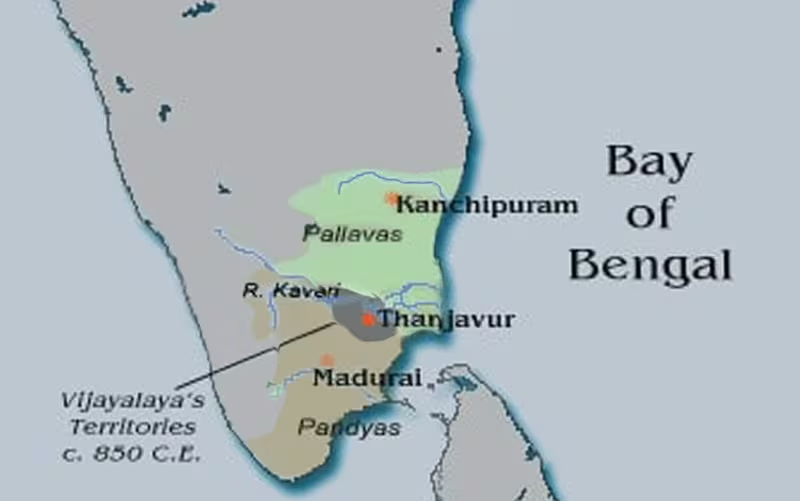
In the grand tapestry of South Indian history, the 9th century was a time of shifting sands. The ancient powers that had dominated the landscape for centuries—the Pallavas of Kanchi, the Pandyas of Madurai, and the Rashtrakutas of the Deccan—were locked in a complex, unending dance of alliance and warfare. Amidst this clash of titans, a minor dynasty, once glorious but long dormant, began to stir in the fertile delta of the river Kaveri. These were the Cholas, and their re-emergence under a chieftain named Vijayalaya was a quiet tremor. It was his son, Aditya I, who would transform that tremor into an earthquake, shattering the old order and laying the granite foundation for one of India's most magnificent empires.
Aditya Chola I (r. 871 – 907 CE) was not merely a conqueror; he was a visionary, a consolidator, and a pious builder. His reign marks the pivotal transition of the Cholas from a subordinate feudatory to an independent, sovereign power. With the strategic brilliance of a master strategist and the ferocity of a tiger, he expanded his small inheritance, decisively ended the centuries-long supremacy of the Pallavas, and inaugurated a golden age of temple architecture that would define the cultural and spiritual life of the Tamil country for generations.
Early Life & Background
Born into a lineage that claimed descent from the sun, Aditya’s early life was shaped by the precarious reality of his family's position. He was the son of Vijayalaya (c. 848–871 CE), the valiant warrior who had seized the city of Thanjavur from the Muttaraiyars, establishing a small but defiant Chola principality. While Vijayalaya lit the flame of Chola resurgence, the kingdom Aditya was set to inherit was a fledgling state, a small island of Chola authority surrounded by a sea of powerful adversaries.
His youth was spent not in the secure opulence of an established empire but in the tense atmosphere of a court constantly on a war footing. The Cholas, at this stage, were nominal vassals of the Pallavas, a position that demanded a delicate balance of loyalty and ambition. Aditya’s education would have been intensely practical, focused on the arts of war, statecraft, and diplomacy. He would have learned to wield a sword and command troops on the battlefield, but equally, he would have been schooled in the intricate politics of the southern peninsula, where an ally today could be an enemy tomorrow.
His formative experience came at the Battle of Sripurambiyam (c. 879 CE), a cataclysmic clash that would alter the destiny of the south. The Pandya king, Varagunavarman II, had amassed a large coalition and was marching north to crush the Pallavas. The reigning Pallava monarch, Aparajita, sought the aid of his allies, including the Western Ganga king Prithvipati I and his ambitious Chola feudatory, Aditya.
On the battlefield near modern-day Kumbakonam, a young Aditya fought with distinction under the Pallava banner. He witnessed firsthand the ferocity of Pandya aggression and the waning strength of his Pallava overlords. Though the Pallava-led coalition emerged victorious, the cost was immense. The Ganga king Prithvipati I was killed, and the Pandyas, though defeated, had severely weakened the Pallava realm. For his crucial role in the victory, Aditya was rewarded with new territories and increased autonomy. More importantly, Sripurambiyam taught him a vital lesson: the old powers were vulnerable. It was here, amidst the dust and blood of the battlefield, that the seeds of an independent Chola kingdom were likely sown in his mind.
Career & Major Contributions
Ascending to the throne around 871 CE, Aditya I inherited his father's courage and a kingdom ripe with potential. He was no longer content to be a mere subordinate. His reign was defined by a series of calculated military campaigns and a monumental patronage of religion and architecture.
The Sun Eclipses the Moon: The Conquest of the Pallavas
The defining moment of Aditya’s career was his audacious and successful war against his former overlord, Aparajita Pallava. For over a decade after Sripurambiyam, an uneasy peace existed between the two. Aditya steadily consolidated his power around the Kaveri, while the Pallava authority continued to erode. The ambitious Chola king, who had once fought to save the Pallavas, now saw them as the primary obstacle to his imperial dreams.
Around 897 CE, Aditya launched a full-scale invasion of Tondaimandalam, the traditional heartland of the Pallavas. The details of the campaign are sparse, but the outcome was decisive and brutal. In a climactic battle, Aditya I, described in later inscriptions as riding a war elephant, charged at Aparajita and killed him. With this single act, the Pallava dynasty, which had held sway over the Tamil country for more than six hundred years, was effectively extinguished as a sovereign power.
The Kanyakumari inscription of the later Chola king Virarajendra poetically records this event, stating that Aditya pounced upon and slew the Pallava king. This victory was a political earthquake. The Cholas immediately annexed the entire Pallava kingdom, and Aditya I became the undisputed master of the Tamil-speaking lands, a position no Chola king had held for centuries.
Consolidation and Diplomacy
Aditya was not merely a conqueror; he was a shrewd consolidator. Having defeated the Pallavas, he turned his attention to other regional powers. He waged a successful war against the Western Gangas, conquering their capital at Talakad. However, rather than simply subjugating them, he employed astute diplomacy to secure his western frontier. He forged a matrimonial alliance by arranging the marriage of his son and heir, Parantaka I, to a Ganga princess. This converted a potential rival into a stable, long-term ally.
His relationship with the Chera (Kerala) rulers on the western coast appears to have been amicable, ensuring peace on that front. While he did clash with the Pandyas to the south, his primary achievement was the complete absorption of the Pallava and Kongu territories, creating a large, contiguous, and powerful kingdom that served as the launchpad for future imperial expansion.
The Pious Builder: Shiva's Temples on the Kaveri
With his kingdom secured and its borders expanded, Aditya I turned his focus to an act of monumental piety that would become his most enduring legacy. The Tiruvalangadu copper plates, a vital Chola-era document, state that Aditya built a series of tall stone temples dedicated to Lord Shiva on both banks of the river Kaveri, stretching from the Sahyadri mountains (the Western Ghats) to the sea where the river meets the Bay of Bengal.
This was a revolutionary act. Before Aditya, most temples in the region were constructed from brick or were rock-cut cave temples pioneered by the Pallavas. Aditya I championed the construction of structural temples made entirely of stone (katrali). This shift not only ensured the longevity of these sacred structures but also marked the birth of the distinctive Early Chola architectural style—a graceful and powerful transition from the Pallava idiom.
While it is difficult to definitively attribute every temple from this period to his direct patronage, several stand as testaments to his vision:
- Nageswaraswamy Temple, Kumbakonam: A jewel of early Chola art, renowned for its exquisite life-sized sculptures and precise stonework.
- Brahmapureeswarar Temple, Pullamangai: Celebrated for its intricate miniature carvings and elegant vimana (tower).
- Adityesvara Temple, Tondaimanarrur: A
pallipadaior memorial shrine, built by his son Parantaka I over his father's mortal remains, setting a precedent for honoring royal ancestors.
These temples were more than just places of worship. They were centers of art, culture, and economic activity. They employed hundreds of artisans, priests, and administrators, and their vast land grants made them powerful institutions in the rural landscape. Aditya’s grand project of lining the sacred Kaveri with stone abodes for Shiva was a powerful statement of his sovereignty, piety, and commitment to building a lasting cultural legacy.
Legacy & Influence
Aditya Chola I passed away in 907 CE at Tondaimanarrur, earning the posthumous title Kōdaṇḍarāma (“Rama with the bow”), a testament to his martial prowess. His legacy, however, was far from over; it was just beginning.
The True Architect of the Chola Empire: While his father Vijayalaya is credited with founding the dynasty, it was Aditya who transformed it from a minor chiefdom into a formidable kingdom. He bequeathed to his son, Parantaka I, a vast, consolidated, and wealthy state. Without Aditya’s decisive victory over the Pallavas and his consolidation of Tondaimandalam, the imperial ambitions of later Chola titans like Rajaraja I and Rajendra I would have been impossible. He was the true architect who laid the unshakable foundation upon which the magnificent Chola imperial edifice was built.
A New Political Order: Aditya’s reign marks a definitive turning point in South Indian history. His annihilation of Pallava sovereignty ended an era and began another. The political center of gravity in the Tamil country shifted decisively from Kanchipuram to the Kaveri delta, with Thanjavur as its new heart. This Chola-centric order would dominate the peninsula for the next four centuries.
Patron Saint of Chola Architecture: His campaign to build stone temples along the Kaveri established a template for royal patronage that his successors would follow with ever-increasing grandeur. The early Chola style, characterized by its refined ornamentation, powerful sculptures, and well-proportioned structures, was born during his reign. The hundreds of temples that still dot the landscape of Tamil Nadu are a living testament to the architectural movement he unleashed.
Aditya Chola I is often overshadowed in popular memory by his more famous descendants. Yet, his reign was arguably the most crucial in the dynasty's history. He was the bridge between a humble beginning and an imperial future. A warrior who broke a centuries-old dynasty, a statesman who secured his kingdom with diplomacy, and a devotee who lined a sacred river with stone prayers, Aditya was the sun that truly heralded the dawn of the Chola empire.