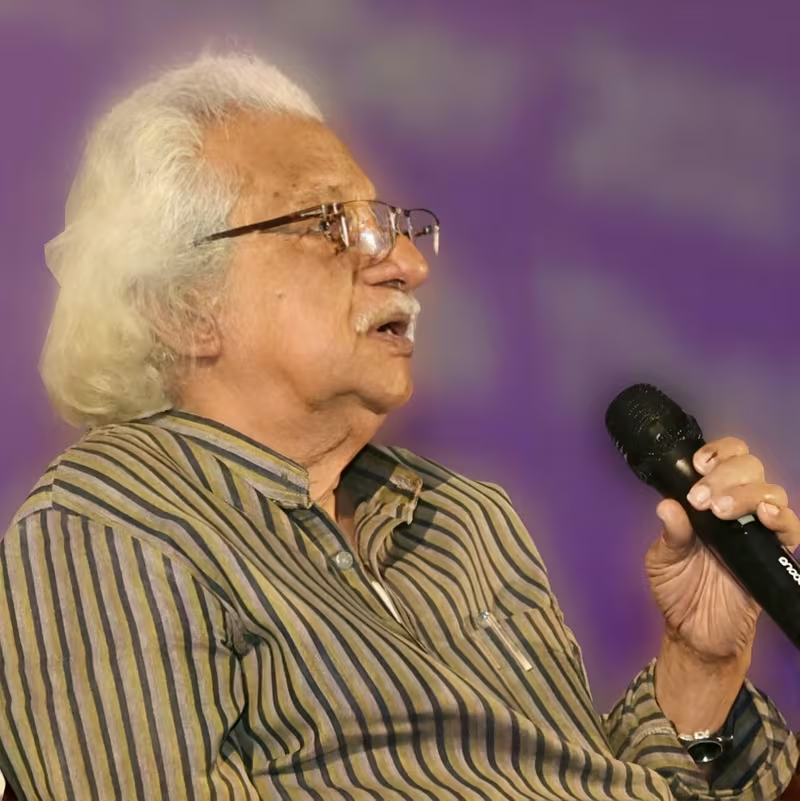
Adoor Gopalakrishnan - Pioneering Indian Filmmaker
In the grand tapestry of Indian cinema, few threads are woven with as much precision, intellectual rigor, and quiet power as the work of Adoor Gopalakrishnan. Born in the crucible of a newly independent India and artistically forged in the fires of the international New Wave, Gopalakrishnan emerged not merely as a filmmaker, but as a cinematic philosopher. His camera does not just observe; it meditates. With a career spanning over five decades and a relatively small but monumental oeuvre of twelve feature films, he has meticulously chronicled the subtle, often seismic, shifts in the Keralan psyche, creating a body of work that is deeply regional in its texture yet profoundly universal in its exploration of the human condition.
Early Life & Theatrical Roots
Mankada Kovilakathu Adoor Gopalakrishnan Unnithan was born on July 3, 1941, in Adoor, a town in the southern part of Kerala. His lineage was steeped in the arts; his family, the Madhavan Unnithan and Mouttathu Gouri Kunjamma, were patrons of Kathakali, the classical dance-drama form renowned for its elaborate costumes and intricate storytelling. This environment was his first school. From a young age, he was immersed in the world of performance, absorbing the rhythms, gestures, and narrative structures of traditional art. This early exposure to a highly stylized yet emotionally potent art form would later inform the formal precision and psychological depth of his cinema.
His artistic inclinations found an early outlet in theatre. By the age of eight, he was already acting, and his passion carried through his academic years. While pursuing a degree in Economics, Political Science, and Public Administration at Gandhigram Rural University in Tamil Nadu, he was a prolific playwright and director, producing over twenty plays. However, a government job as a statistical investigator in 1961 proved to be a brief and unfulfilling detour. The call of the arts was too strong to ignore. In a decisive move that would alter the course of Indian cinema, he resigned from his secure post and, in 1962, enrolled in the newly established Film and Television Institute of India (FTII) in Pune, specializing in screenplay writing and direction.
The Birth of a New Cinema
The FTII was a transformative space. It exposed Gopalakrishnan and his contemporaries, including Kumar Shahani and Mani Kaul, to the masters of world cinema—from the Italian neorealists like De Sica to auteurs like Ozu, Bresson, and Tarkovsky. He graduated in 1965, armed with a new vision for what cinema could be: not just entertainment, but a serious art form capable of profound social and psychological inquiry.
Returning to Kerala, he co-founded the Chitralekha Film Cooperative in 1965, India’s first film cooperative established by and for filmmakers. It was a revolutionary act of artistic independence, aimed at fostering an environment for producing and distributing non-commercial, 'serious' cinema, away from the pressures of the mainstream industry. For several years, the cooperative focused on producing documentaries and short films, honing the craft that would define Gopalakrishnan's feature work.
It took nearly seven years for his first feature film to materialize, but when it did, it marked a watershed moment. Swayamvaram (One's Own Choice, 1972) was a stark departure from the melodrama and song-and-dance sequences that dominated Malayalam cinema. The film follows a young couple, Viswam and Sita, who defy their families to live together, only to find their idealism slowly eroded by the harsh realities of unemployment and poverty. Filmed in a spare, observational style, it was a quiet but devastating critique of post-Nehruvian disillusionment. The film won four National Film Awards, including for Best Feature Film and Best Director, and officially launched the parallel cinema movement in Kerala.
The Auteur's Vision: Major Works
Following his debut, Gopalakrishnan worked at a deliberate, unhurried pace, with long gaps between films, allowing each project to gestate fully. His filmography became a series of masterfully crafted, introspective studies of individuals grappling with societal change, tradition, and their own inner turmoil.
Kodiyettam (Ascent, 1977) presented a different kind of protagonist. Its central character, Shankaran Kutty (played by Gopi, who won the National Award for Best Actor), is a simple-minded, aimless man-child. The film patiently charts his slow, almost imperceptible journey towards maturity and responsibility. It is a testament to Gopalakrishnan’s minimalist style, where character development unfolds not through dramatic events, but through subtle observation of behavior and routine.
His international breakthrough and perhaps most celebrated work came with Elippathayam (The Rat-Trap, 1981). The film is a haunting, atmospheric portrait of Unni, the last male heir of a decaying feudal family, who is unable to cope with the collapse of his world. He retreats into a state of debilitating paranoia, trapped within his ancestral home as if it were a cage. The film is a powerful allegory for the decline of Kerala’s feudal system, rendered with breathtaking visual precision. Its masterful composition and symbolic depth won it the prestigious Sutherland Trophy at the London Film Festival, placing Adoor firmly on the global cinematic map.
He continued to explore complex political and psychological themes with Mukhamukham (Face to Face, 1984), a controversial and deeply misunderstood film about the ideological decay of a communist leader, and Anantaram (Monologue, 1987), a brilliantly structured narrative that blurs the lines between memory, reality, and fantasy through the fragmented consciousness of its protagonist.
In the 1990s, his work took on a more literary quality. Mathilukal (The Walls, 1990), based on a biographical novel by the celebrated writer Vaikom Muhammad Basheer, tells the story of the author's imprisonment during the freedom struggle. Starring Mammootty, the film is a sublime meditation on freedom and confinement, centered on a poignant, unseen romance between Basheer and a female inmate in the adjacent prison, their entire relationship conducted through voices across a high wall. The film is a masterclass in the use of sound.
Vidheyan (The Servile, 1994) was another literary adaptation, this time from a story by Paul Zacharia. It is a brutal and unflinching examination of the master-servant dynamic and the corrosive nature of absolute power, following the tyrannical landlord Bhaskara Pattelar and his submissive servant, Thommi.
Later films like Kathapurushan (Man of the Story, 1995) traced the life of one man against the backdrop of four decades of tumultuous social and political change in Kerala, while Nizhalkkuthu (Shadow Kill, 2002) delved into the conscience of a hangman haunted by his duty. His more recent works, including the anthologies Naalu Pennungal (Four Women, 2007) and Oru Pennum Randaanum (A Climate for Crime, 2008), continued his focus on the lives of ordinary people, particularly women, navigating a patriarchal society.
Legacy & Enduring Influence
Adoor Gopalakrishnan’s impact on Indian cinema is immeasurable. He is celebrated as a true auteur, a filmmaker with a singular, uncompromising vision who has maintained complete artistic control over his work, from script to final cut. His legacy can be understood through several key contributions:
Architect of Malayalam New Wave: Alongside contemporaries like G. Aravindan, he fundamentally reshaped the landscape of Malayalam cinema, proving that films could be artistically rigorous, intellectually stimulating, and deeply personal. He created a cinematic language that was rooted in the specific culture of Kerala but spoke to universal human concerns.
A Master of Minimalism: His cinematic style is a study in restraint. He eschews melodrama in favor of psychological realism. His films are characterized by long, contemplative takes, a meticulous use of natural sound, and a narrative pace that allows the audience to inhabit the world of his characters. Plot is secondary to atmosphere and the exploration of a character's inner state.
Global Ambassador of Indian Cinema: Long before Indian commercial films found a global diaspora audience, Adoor Gopalakrishnan’s work was being celebrated at the world's most prestigious film festivals, including Cannes, Venice, Berlin, and Toronto. He demonstrated that Indian stories, told with artistic integrity, could resonate with international critics and cinephiles.
National Treasure: His contributions have been recognized with the highest honors in India. He is a recipient of the Dadasaheb Phalke Award (2004), the country’s highest cinematic honor, and the Padma Vibhushan (2006), India's second-highest civilian award. He has won the National Film Award for Best Direction five times, a testament to his consistent excellence.
Today, Adoor Gopalakrishnan remains a towering figure, a benchmark for artistic integrity in a world of commercial compromises. His films are not easy viewing; they demand patience and engagement from the viewer. But for those willing to enter his meticulously crafted worlds, the rewards are immense. His cinema is a profound, ongoing meditation on time, memory, and the intricate dance between the individual and history, solidifying his place as one of the most important filmmakers India has ever produced.