Ahilyabai Holkar - The Philosopher Queen of Malwa
In the tumultuous landscape of 18th-century India, a time of collapsing empires and rising warlords, the kingdom of Malwa found its anchor not in a conquering king, but in a woman of profound piety and unshakeable resolve. Rajmata Ahilyabai Holkar, who reigned from her capital in Maheshwar for nearly three decades, was a ruler unlike any other. She wielded no sword in conquest, yet her authority was absolute. She built no grand palaces for herself, yet her architectural legacy stretches from the icy Himalayas to the shores of Rameshwaram. In an era defined by political intrigue and brute force, she governed with Dharma as her constitution and the welfare of her people as her sole objective, earning her the posthumous title of 'The Philosopher Queen' from observers who marvelled at her enlightened rule.
Early Life & A Fateful Encounter
Ahilyabai was not born to royalty. She entered the world on 31 May 1725, in the quiet village of Chondi in present-day Ahmednagar, Maharashtra. Her father, Mankoji Shinde, was the village patil (chief), a man of respectable standing but far from the corridors of power. From the Dhangar (shepherd) community, Ahilyabai's origins were humble, a fact that makes her eventual ascent all the more extraordinary. Her father, recognizing her bright mind, provided her with an education, teaching her to read and write—a rarity for girls of that era.
Her destiny took a dramatic turn through a chance encounter. Malhar Rao Holkar, the celebrated Subedar of Malwa and one of the chief architects of Maratha power, was passing through Chondi on a military campaign. Stopping at the village temple, he observed a young girl of about eight, leading the service with a serene focus and devotion that belied her age. Impressed by her piety and strong character, the seasoned general saw in her the ideal bride for his beloved son, Khanderao Holkar. In 1733, the village girl Ahilyabai was married into one of the most powerful Maratha families, her life forever changed.
Under the tutelage of her formidable father-in-law, Ahilyabai received an education far beyond letters. Malhar Rao, recognizing her innate intelligence and administrative acumen, personally mentored her in matters of statecraft, revenue, and military strategy. He treated her not just as a daughter-in-law, but as a future leader, entrusting her with responsibilities and preparing her for a role she could never have imagined.
Trial by Fire: From Widowhood to Regency
Tragedy struck in 1754 during the siege of Kumher fort. Ahilyabai’s husband, Khanderao, was killed in battle, leaving her a widow at just 29. Devastated, she prepared to commit sati, the then-prevalent custom of self-immolation on a husband's funeral pyre. It was here that Malhar Rao Holkar made a decision that would alter the course of history. He rushed to the pyre and, in a poignant public plea, begged his daughter-in-law to live. He argued that she was not just a widow, but his only remaining hope, the true heir to his legacy, and the future of Malwa. He needed her wisdom and strength to manage the state. Ahilyabai relented, choosing the difficult path of life and duty over the custom of the day.
For the next twelve years, she worked alongside Malhar Rao, becoming his most trusted advisor. When he passed away in 1766, the throne passed to her young son, Male Rao Holkar. But fate dealt another cruel blow; Male Rao, reportedly suffering from mental illness, died within a year in 1767.
With the Holkar line seemingly at an end, the state was plunged into crisis. Nobles began to plot, and rival powers, including the Peshwa's uncle Raghunathrao, saw an opportunity to seize the vast Holkar treasury. It was in this moment of extreme vulnerability that Ahilyabai demonstrated her true mettle. She refused to be a passive pawn. Petitioning the Peshwa in Pune, she declared her intention to adopt an heir and personally administer the state as regent.
When Raghunathrao threatened to invade, she did not cower. Instead, she dispatched a letter that has become legendary for its diplomatic brilliance and steely courage. She warned him that if his armies attacked, he would face a legion of women soldiers she had personally assembled. “If you defeat me,” she wrote, “you will gain no glory, for you will have only defeated a helpless widow. But if you lose, your face will be blackened forever in the annals of history.” The bold gambit worked. Shamed and outmaneuvered, Raghunathrao retreated. The Peshwa, Madhavrao I, deeply impressed by her fortitude, formally sanctioned her rule. On 11 December 1767, Ahilyabai Holkar formally ascended the throne of Malwa.
The Reign of Dharma: Administration and Justice
Ahilyabai moved her administrative capital from Indore to Maheshwar, a serene town on the sacred banks of the Narmada River. From here, she presided over a reign that lasted for twenty-eight years, becoming a golden age for Malwa. Her philosophy of governance was simple and profound: she was not the owner of the kingdom but its chief custodian, and the state’s wealth belonged to its people.
Her daily routine began before dawn with prayers and religious rituals. This was followed by her public durbar, an open court where any subject, from the poorest farmer to the wealthiest merchant, could present their grievances directly to her. Her justice was known to be impartial, swift, and compassionate. She listened patiently to every case, personally overseeing the judicial process to ensure fairness.
Her economic policies were equally visionary. She understood that the prosperity of the state depended on the prosperity of its people. She reformed the tax system to make it equitable, encouraged trade, and invested in infrastructure. Roads were built, forts were strengthened for security, and wells and rest houses were constructed for travellers. She famously established Maheshwar as a centre for textile weaving, personally inviting weavers from other regions to settle there. This patronage gave birth to the exquisite Maheshwari sari, an industry that continues to thrive and empower local artisans to this day.
While she managed the civil and judicial administration from Maheshwar, she wisely separated the military command. She appointed Tukoji Rao Holkar I, a skilled and loyal commander from Malhar Rao's time, as the Commander-in-Chief of her armies. This brilliant division of labour—she as the administrator, he as the general—ensured that the state was both well-governed at home and well-defended abroad. Though a woman of peace, she was no pacifist. When required, she would personally lead her troops, directing battles from a howdah atop her elephant, a symbol of her unflinching resolve to protect her kingdom.
A Builder for Bharatavarsha
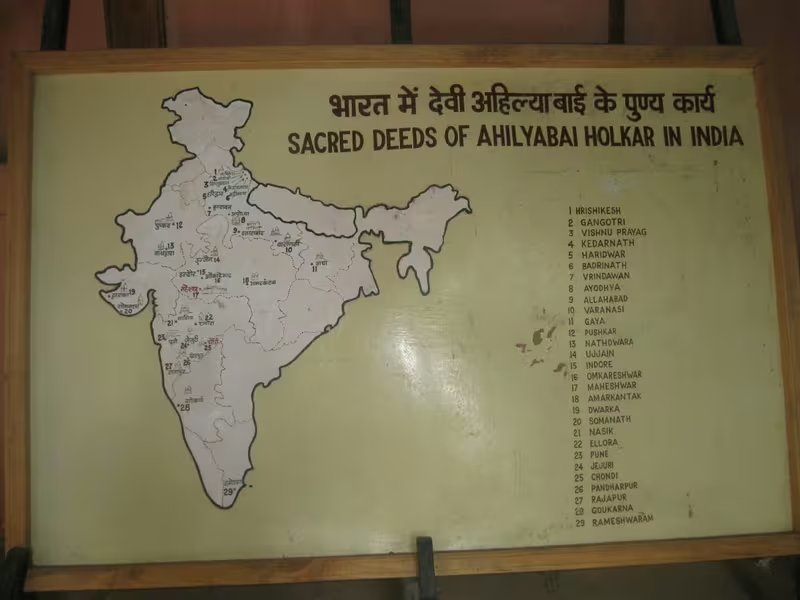
Ahilyabai’s most enduring legacy is her staggering architectural and religious patronage, which extended far beyond the borders of Malwa. Fuelled by deep faith and a sense of civilizational duty, she embarked on a mission to restore and build temples, ghats, dharamshalas (pilgrim rest houses), and water tanks across the Indian subcontinent.
Her projects were a testament to a unified cultural vision of India. She saw the sacred geography of the land as a single, interconnected entity. Her contributions are found in every corner of the country:
- Varanasi: Her most celebrated work is the reconstruction of the Kashi Vishwanath Temple in 1780, one of the most revered Jyotirlingas, which had been destroyed by Aurangzeb over a century earlier. The temple that stands today is largely her gift to the nation.
- Somnath: She sponsored the construction of a new temple near the ruins of the ancient Somnath temple in Gujarat, ensuring that worship could be restored at this sacred site.
- Gaya: She rebuilt the Vishnupad Temple, a major pilgrimage destination for Hindus performing ancestral rites.
- Across India: The list of her works is immense. She built or renovated ghats at Haridwar, Varanasi, and Maheshwar. She sponsored construction at holy sites like Badrinath in the Himalayas, Dwarka in the west, Puri in the east, and Rameshwaram in the south. From Omkareshwar to Pandharpur, her touch can be found in the stones of India’s most sacred places.
This was not merely charity; it was a conscious act of cultural restoration. In an age of political fragmentation, Ahilyabai’s work helped reinforce the spiritual and cultural unity of India, knitting together disparate regions through a shared network of sacred infrastructure.
Legacy of an Enlightened Queen
Ahilyabai Holkar passed away on 13 August 1795, at the age of 70. She had ruled for nearly three decades, outliving her husband, son, and daughter, bearing immense personal sorrow with quiet dignity. She left behind a prosperous and stable kingdom, a testament to her administrative genius and moral authority.
Her reign was so exemplary that it drew praise from even the British, who were then consolidating their power in India. The historian John Malcolm, in his A Memoir of Central India (1823), wrote glowingly of her, noting that “her memory is held in the highest veneration” and that “her name is sainted.” It was he who first called her a “philosopher-queen,” comparing her rule to the Platonic ideal.
Today, Ahilyabai Holkar is remembered not as a conqueror, but as a protector. She is revered as Punyashlok (one of sacred fame) and Devi (goddess). The airport and university in Indore bear her name. Her statues, often depicting her holding a Shiva Lingam, stand in cities across India. She remains a powerful symbol of a different kind of leadership—one rooted in service, justice, and a profound sense of duty. In the grand epic of Indian history, Rajmata Ahilyabai Holkar’s chapter is a quiet but luminous one, a timeless reminder that the greatest strength lies not in the power to command, but in the will to serve.