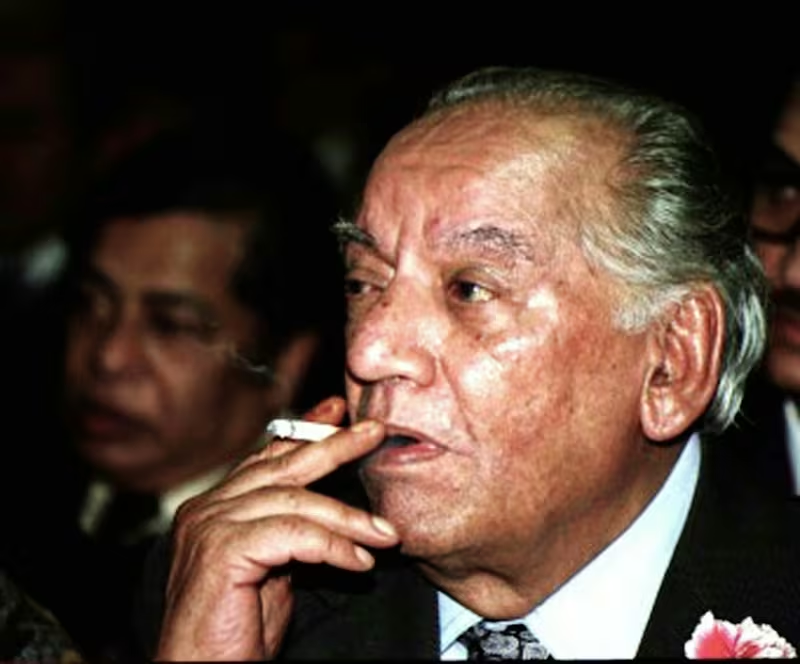
The Poet of Two Worlds: The Life and Legacy of Ahmad Faraz
In the vast, star-studded sky of 20th-century Urdu poetry, few luminaries shine with the dual brilliance of Syed Ahmad Shah, known to the world by his indelible pen name, Ahmad Faraz (1931-2008). He was a poet of two distinct, yet interconnected, worlds. In one, he was the master of the romantic ghazal, his verses capturing the delicate nuances of love and longing, whispered by lovers and sung by maestros across the Indian subcontinent. In the other, he was a fearless voice of dissent, a poet of resistance whose words became anthems of defiance against tyranny and oppression. His life was a testament to the power of a single voice to both enchant the heart and challenge the state, securing his place as one of the most significant literary figures of modern South Asian history.
Early Life & Background: Forging a Voice
Syed Ahmad Shah was born on 12 January 1931, in Kohat, a city in the North-West Frontier Province of British India (now Khyber Pakhtunkhwa, Pakistan). He belonged to a distinguished Pashtun Syed family, and the poetic arts were in his very lineage. His father, Syed Muhammad Shah Barq, was himself a respected poet, immersing the young Ahmad in a world of classical literature and linguistic beauty from an early age. This environment nurtured a profound love for language and expression that would define his life's work.
His formative years were spent in Peshawar, a city at the crossroads of cultures. He pursued his education at the prestigious Edwardes College, after which he enrolled at Peshawar University. It was here that he deepened his academic and literary foundations, earning Master's degrees in both Urdu and Persian. This formal training gave him a masterful command over the classical traditions of poetry, which he would later infuse with a distinctly modern sensibility.
During his university years, he was drawn to the ideals of the Progressive Writers' Movement, a powerful literary and political current that swept through South Asia. The movement advocated for using art and literature as tools for social reform and political awakening. This exposure instilled in him a deep-seated social conscience and a belief in the writer's duty to speak truth to power. It was during this period that he adopted the takhallus (pen name) 'Faraz', meaning 'height' or 'ascension', a name that would soon become synonymous with the highest echelons of Urdu poetry.
Career & Major Contributions: The Pen as a Sword
Ahmad Faraz began his professional life not as a full-time poet, but in academia and broadcasting. He worked as a scriptwriter for Radio Pakistan Peshawar before taking up a position as a lecturer at Peshawar University. However, his poetic calling was undeniable. The publication of his first collection, Tanha Tanha (Alone, Alone), immediately announced the arrival of a major new talent. His verses were marked by a lyrical simplicity, emotional directness, and an elegance that resonated deeply with readers.
His career saw him take on significant administrative roles that shaped the literary landscape of Pakistan. He served as the founding Director-General of the Pakistan Academy of Letters and later as the chairman of the National Book Foundation in Islamabad. Yet, despite these official positions, Faraz was never a poet of the establishment. His true allegiance was always to his principles and his people.
The Two Faces of Faraz: Romance and Resistance
Faraz's genius lay in his ability to master two seemingly disparate poetic registers.
On one hand, he was the undisputed poet of romance. His ghazals, such as the iconic "Suna hai log usse aankh bhar ke dekhte hain" (I hear people gaze at her to their heart's content) and "Ranjish hi sahi dil hi dukhane ke liye aa" (If only for animosity's sake, come back to break my heart again), became cultural touchstones. They were set to music by legendary singers like Mehdi Hassan and Jagjit Singh, ensuring their place in the popular imagination across India and Pakistan. His romantic poetry was accessible without being simplistic, capturing the universal experiences of love, separation, and heartache with a profound and timeless grace.
On the other hand, Faraz was a poet of unwavering resistance. He lived through multiple periods of military rule in Pakistan, and he used his pen as a weapon against authoritarianism. His most courageous stand came during the oppressive regime of General Zia-ul-Haq in the late 1970s and 1980s. At a time when dissent was brutally suppressed, Faraz recited his electrifying poem, "Mohasara" (The Siege), at a mushaira. The poem was a thinly veiled, scathing critique of the military dictatorship:
Mera qalam nahin kiraye ka,
Jo qaseede likhega fatah-o-zafar ke, Yeh aman ka safeer hai,
Jo bachon ke liye phool aur nazmein layega.
(My pen is not for hire,
It will not write odes to victory,
It is an ambassador of peace,
That will bring flowers and rhymes for the children.)
This act of defiance led to his arrest. Faced with increasing persecution, Faraz chose a path of self-imposed exile, spending nearly six years in Britain, Canada, and Europe. This period of separation from his homeland only sharpened his political voice, and he continued to write poetry that championed democracy, human rights, and freedom of expression.
A Man of Principle
Faraz's commitment to his ideals was not merely rhetorical. He was decorated with numerous awards, including the prestigious Sitara-i-Imtiaz and later the Hilal-e-Imtiaz, two of Pakistan's highest civilian honours. However, in 2006, in a powerful act of protest against the government of another military ruler, General Pervez Musharraf, he returned his Hilal-e-Imtiaz. He declared he could not accept an award from an undemocratic regime, cementing his legacy as an artist who valued his integrity above state recognition.
His vast body of work includes celebrated collections like Dard-e-Ashob (The Pain of Turmoil), Nayaft (The Unfound), Shab-e-Khoon (Night of Blood), and Janan Janan (My Beloved, My Beloved), each collection reflecting the evolution of his poetic and political consciousness.
Legacy & Influence: A Voice for the Ages
Ahmad Faraz passed away on 25 August 2008, in Islamabad, leaving behind a void in the world of Urdu literature. His death was mourned across South Asia, a testament to his ability to transcend national and political boundaries through the universal language of poetry.
His historical significance is immense. He stands in the proud tradition of 20th-century progressive Urdu poets like Faiz Ahmed Faiz and Habib Jalib, who seamlessly wove together the personal and the political, the romantic and the revolutionary. Faraz, however, carved his own unique niche. While Faiz's poetry was often layered with classical symbolism and complex metaphors, Faraz's strength was his directness. His language was clear, his emotions raw, and his message unambiguous, which made him a poet of the masses.
Today, Ahmad Faraz is remembered in two powerful ways. He is the beloved romantic whose couplets are still shared to express the deepest feelings of the heart. His verses on love are as relevant in the age of social media as they were in the era of handwritten letters. But he is also remembered as a symbol of courage and integrity—a public intellectual who refused to be silenced, who spoke for the voiceless, and who reminded a generation that true art could never be divorced from conscience.
In a world still grappling with conflicts between freedom and authority, love and loss, his poetry continues to resonate with profound relevance. Ahmad Faraz was more than just a poet; he was the conscience of his time, a voice that continues to inspire, console, and empower millions.