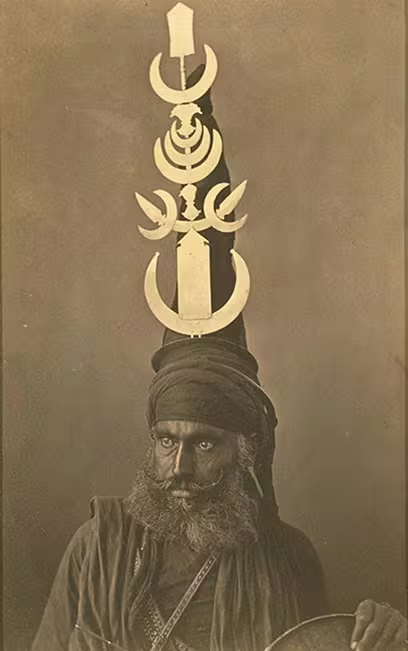
Akali Phula Singh Nihang: The Fearless Guardian of the Khalsa
In the grand tapestry of Sikh history, few figures loom as large or as formidable as Akali Phula Singh Nihang. He was a paradox in motion: a spiritual ascetic who was a whirlwind on the battlefield, the revered Jathedar of the Akal Takht who held temporal kings to account, and a warrior whose name alone could turn the tide of battle. Living from 1761 to 1823, his life bridged the turbulent era of the Sikh Misls and the golden age of Maharaja Ranjit Singh's Khalsa Raj. More than just a general, Akali Phula Singh was the living embodiment of the Sant-Sipahi (Saint-Soldier) ideal, a fierce, uncompromising guardian of Sikh sovereignty and tradition whose legacy is etched into the very soul of the Punjab.
Early Life & Forged in Faith
Akali Phula Singh was born in 1761 in the village of Shinh, located in the Amritsar district of Punjab. His father, Ishar Singh, was a warrior from a respected family who unfortunately passed away when Phula Singh was just a child. Following this loss, the young Phula Singh was entrusted to the care of the revered Nihang leader, Baba Naina Singh, at the Shaheedan Misl enclave in Anandpur Sahib.
Anandpur Sahib, the 'city of bliss' founded by Guru Tegh Bahadur, was the crucible of the Khalsa. It was here, under the tutelage of Baba Naina Singh and other veterans of the Sikh struggle, that the boy's destiny was forged. He was immersed in a rigorous regimen that defined the Nihang way of life. His days were spent mastering shastar vidya, the Sikh martial art, learning to wield the sword, spear, and the iconic chakkar (quoit) with deadly precision. Simultaneously, he devoted himself to the study of Gurbani, memorizing vast passages from the Guru Granth Sahib and internalizing the philosophical and ethical foundations of the Sikh faith.
This dual education in scripture and steel shaped him into a leader of immense spiritual authority and martial prowess. When Baba Naina Singh passed away, the mantle of leadership of his warrior band fell naturally upon the capable shoulders of Akali Phula Singh. Recognizing the shifting political landscape, he moved his headquarters to Amritsar, the spiritual and political heart of the Sikh Panth. Here, amidst the sacred precincts of the Harmandir Sahib (the Golden Temple), his influence began to grow, and his reputation as a fearless defender of the faith spread throughout Punjab.
Career & The Conscience of an Empire
Akali Phula Singh's career was marked by a dual authority that was unique even in his time. He was both the spiritual head of the community as the Jathedar of the Akal Takht and the operational commander of the fearsome Akali Fauj, the vanguard of the Sikh army.
Jathedar of the Akal Takht
The Akal Takht, the 'Throne of the Timeless One', stands opposite the Harmandir Sahib and represents the supreme seat of temporal and spiritual authority for Sikhs. As its Jathedar, Akali Phula Singh was not merely a custodian; he was the active conscience of the Khalsa. He upheld Sikh maryada (code of conduct) with an iron will, and his pronouncements were considered binding on all Sikhs, regardless of their station.
Perhaps the most famous incident showcasing his authority occurred around 1815. Maharaja Ranjit Singh, the powerful ruler of the Sikh Empire, had entered into a relationship with a Muslim dancing girl named Moran. This act was seen as a serious breach of the Khalsa code of conduct. Word reached Akali Phula Singh, who, without hesitation, summoned the Maharaja to appear before the Akal Takht to answer for his transgression.
The Maharaja, recognizing the supreme authority of the institution, humbly presented himself. Akali Phula Singh, acting as the voice of the Panth, declared the Maharaja tankhaiya (guilty of religious misconduct) and sentenced him to a public flogging. Ranjit Singh bared his back to receive the punishment, an act of supreme submission to the faith he represented. While some accounts state the punishment was symbolically waived after the Maharaja’s show of contrition, the event sent a powerful message: in the Khalsa Panth, no one, not even the sovereign, was above the law of the Guru. This act cemented Akali Phula Singh’s legacy as a leader who valued principle above power.
The Sword of the Khalsa Raj
While his spiritual authority was absolute, it was on the battlefield that Akali Phula Singh's legend was written in blood and steel. He commanded the Akali Fauj, a formidable force of Nihang warriors also known as the 'suicide squad' for their utter disregard for personal safety in battle. Clad in their distinctive dark blue robes and high turbans adorned with steel quoits, their thunderous war cry, “Bole So Nihal, Sat Sri Akal!”, struck terror into the hearts of their enemies.
The Battle of Kasur (1807): One of the first major tests of Ranjit Singh's nascent empire was the subjugation of the powerful Pathan chieftain Qutb-ud-Din Khan of Kasur. The fortress of Kasur was formidable, and the Sikh forces faced stiff resistance. At a critical moment in the siege, Akali Phula Singh and his Nihangs led a ferocious charge, smashing through the fortress gates and engaging the defenders in fierce hand-to-hand combat. Their unstoppable assault broke the back of the defense, leading to a decisive victory that secured a vital strategic region for the Sikh Empire.
The Conquest of Multan (1818): The fortress of Multan, ruled by the Afghan governor Muzaffar Khan Sadozai, was considered impregnable. The Sikh army laid siege to it for months, their cannons battering the massive walls with little effect. The campaign was costly and morale was waning. In this moment of desperation, Ranjit Singh turned to his most fearless warriors. Akali Phula Singh, though wounded in earlier skirmishes, led his Akalis in a final, all-out assault. With religious fervor, they stormed a breach in the wall, fighting with a ferocity that overwhelmed the defenders. The fort fell, but at a great cost. The victory was a monumental achievement, breaking Afghan power in southern Punjab and adding a rich province to the Sikh Empire.
The Annexation of Kashmir (1819): Akali Phula Singh and his forces also played a significant role in the campaign to liberate the Kashmir valley from the oppressive rule of the Afghan Barakzai governors. Their presence in the vanguard ensured the success of the expedition, bringing the beautiful and strategic valley under the control of the Khalsa Raj.
The Battle of Nowshera (1823): This was Akali Phula Singh's final and most glorious battle. The Afghan governor of Peshawar, Azim Khan Barakzai, had declared a jihad (holy war) against the Sikhs, gathering a massive army of Pashtun tribesmen on the plains of Nowshera, across the Kabul River. The Sikh army, led by Prince Sher Singh and General Hari Singh Nalwa, arrived to find the river swollen and the enemy occupying a strong position on the high ground at Tibbi Tehri.
A period of hesitation set in. The Sikh generals were reluctant to risk a treacherous river crossing in the face of such a large and well-positioned enemy. Akali Phula Singh, witnessing this delay, became incensed. Believing that any hesitation was an insult to the honor of the Khalsa, he refused to wait for orders. Addressing his Akalis, he declared that the Guru had commanded them to victory and that they would cross, with or without the rest of the army.
Spurring his horse into the raging river, he and his band of 500 Nihangs charged across. This audacious act of bravery shamed and inspired the rest of the Sikh army, who plunged in after them. On the far bank, Phula Singh and his warriors crashed into the heart of the enemy lines. He fought from elephant-back, a towering figure in the swirling melee. The battle was fierce, and the Afghans targeted the conspicuous leader. A musket ball struck his horse, and as he mounted another, a second shot found its mark, mortally wounding him. Even as he fell, Akali Phula Singh roared encouragement to his men, urging them to fight on to victory.
His martyrdom had a galvanizing effect. The Sikh army, enraged by the loss of their beloved leader, fought with renewed fury and utterly routed the Afghan forces. The Battle of Nowshera was a landmark victory, establishing Sikh dominion right up to the Khyber Pass and permanently securing the Peshawar valley. Akali Phula Singh had paid the ultimate price, but his sacrifice had secured the northwestern frontier of the Sikh Empire.
Legacy & The Immortal Nihang
Akali Phula Singh's death was not an end but a transformation into legend. His legacy is profound and multi-faceted, resonating to this day within Sikh culture and history.
His historical significance lies in his role as the unwavering moral and spiritual compass of the Sikh Empire. He ensured that the temporal power of Maharaja Ranjit Singh remained anchored to the spiritual authority of the Akal Takht and the principles of the Khalsa. He demonstrated that true sovereignty lay not in crowns and thrones, but in adherence to faith and righteousness.
As a military leader, his impact was immeasurable. His personal bravery and the ferocity of his Akali Fauj were instrumental in the key victories that defined the borders and secured the stability of the Khalsa Raj. He was the tip of the spear in the empire's most challenging conquests.
Today, Akali Phula Singh is remembered as the archetypal Nihang warrior—fearless, pious, disciplined, and utterly devoted to the Panth. His life is a testament to the Sant-Sipahi ideal, proving that profound spirituality and formidable martial skill could coexist within one individual. His samadh, or memorial shrine, stands at Pir Sabak near Nowshera in modern-day Pakistan, a testament to his final sacrifice. In Gurdwaras, historical texts, and the collective memory of the Sikh people, he remains an icon of courage and conviction—the fearless Jathedar who bowed to no king, only to his Guru.