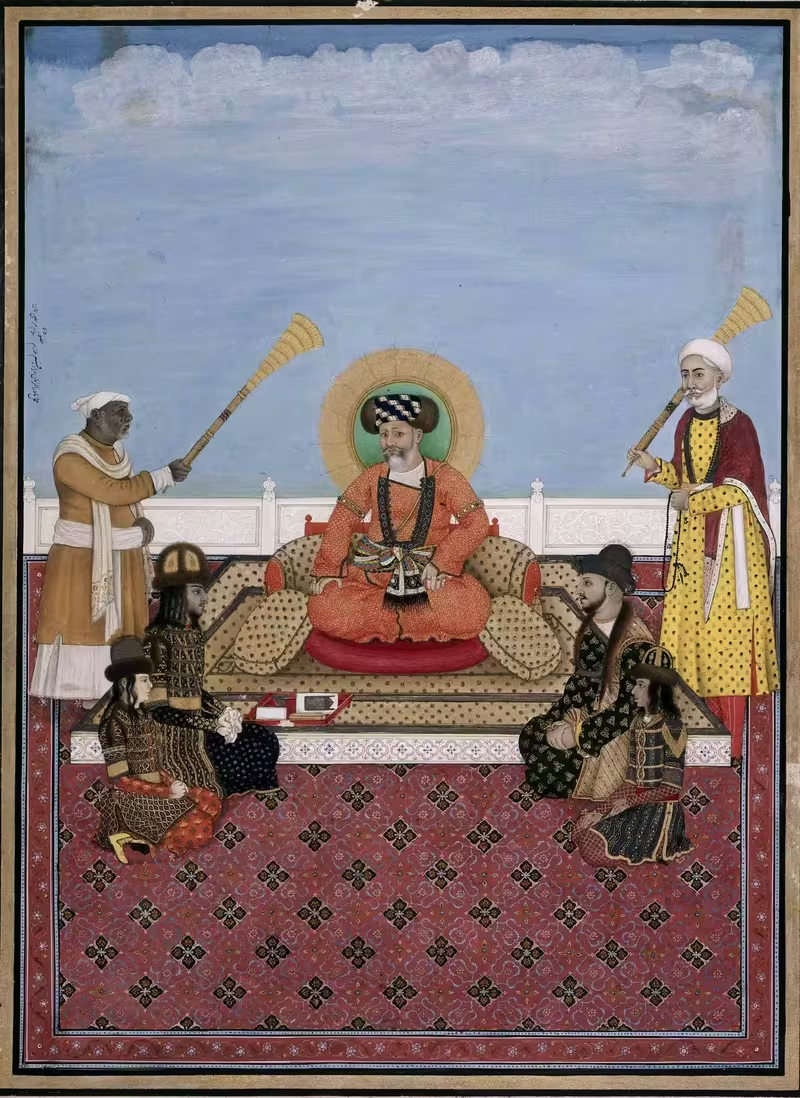
Akbar: The Great Mughal Emperor
In the grand tapestry of Indian history, few figures loom as large or as luminous as Jalal-ud-Din Muhammad Akbar. He was not merely a conqueror who expanded the Mughal domain to encompass nearly the entire Indian subcontinent; he was an architect of an empire, a visionary administrator, and a spiritual seeker whose intellectual curiosity reshaped the cultural and political landscape of his time. Ascending to a precarious throne as a boy of thirteen, Akbar's reign (1556-1605) was a masterclass in statecraft, transforming a fledgling kingdom into a stable, prosperous, and pluralistic empire that would endure for generations.
Early Life & Background
Akbar’s story began not in a grand palace but in the harsh wilderness of exile. He was born on October 15, 1542, in the Rajput fortress of Umarkot in Sindh, a testament to the fragile fortunes of his father, the second Mughal emperor, Humayun. Humayun had been driven from his throne in Delhi by the formidable Sher Shah Suri and was a wanderer seeking refuge. Akbar’s mother, Hamida Banu Begum, gave birth to a prince who had no kingdom to his name.
His early years were marked by constant instability. He was separated from his parents and raised in the rugged terrain of Afghanistan by his uncles, Askari Mirza and Kamran Mirza, who were often at odds with Humayun. This tumultuous upbringing forged in him a resilience and self-reliance that would define his character. Though he never learned to read or write—a fact modern historians often attribute to dyslexia—he possessed a prodigious memory and an insatiable thirst for knowledge. He would have texts on philosophy, religion, history, and science read to him daily, absorbing vast amounts of information and developing a deeply inquisitive mind.
Instead of formal schooling, his education was in the practical arts of survival and warfare. He became an exceptional horseman, a skilled hunter, and an expert in the use of arms. His most crucial mentor during this period was Bairam Khan, a loyal and brilliant Turkoman general who had stood by Humayun through his darkest days. It was Bairam Khan who would guide the young prince through the treacherous currents of court politics and groom him for the throne that was rightfully his.
The Ascent to the Throne and Consolidation of Power
In 1555, Humayun, with Bairam Khan’s help, managed to recapture Delhi. The restoration, however, was tragically brief. A year later, in January 1556, Humayun died after a fall from his library's stairs. At just thirteen years old, Akbar was proclaimed emperor in a makeshift ceremony at Kalanaur, Punjab. The Mughal foothold in India was tenuous at best, and a formidable challenger, Hemu—the Hindu general and chief minister of the Suri dynasty—marched on Delhi with a massive army, intent on crushing the young emperor.
The fate of the Mughal empire hung in the balance. On November 5, 1556, the two armies met at the historic Second Battle of Panipat. Though vastly outnumbered, the Mughal forces, under the strategic command of Bairam Khan, fought with fierce determination. The battle turned when a stray arrow struck Hemu in the eye, rendering him unconscious. His leaderless army fell into disarray, and the Mughals secured a decisive victory. Panipat did not just save the Mughal throne; it marked the true beginning of Akbar’s empire.
For the first four years of his reign, Akbar ruled under the regency of Bairam Khan, who ruthlessly consolidated Mughal authority. However, as Akbar matured, he grew weary of his regent's overbearing influence. In 1560, at the age of eighteen, he skillfully engineered Bairam Khan's dismissal, asserting his own authority. This move signaled his transition from a boy-king to an absolute monarch, ready to carve his own destiny.
Career & Major Contributions
Akbar’s reign was one of relentless activity, marked by military expansion, groundbreaking administrative reforms, and an unparalleled patronage of culture.
Military Conquests and Expansion
Akbar was a brilliant military strategist who understood that a stable empire required secure borders and unchallenged authority. He embarked on a systematic campaign of conquest, annexing strategic territories through a combination of overwhelming force and shrewd diplomacy. His campaigns brought Malwa, Gondwana, Gujarat (securing vital sea trade routes), Bengal, Kashmir, and Sindh into the Mughal fold.
His policy towards the proud and martial Rajput clans was a masterstroke. Instead of seeking their total subjugation, he offered them a partnership. He entered into matrimonial alliances with several prominent Rajput houses—most famously marrying Harkha Bai (often referred to as Jodha Bai), the princess of Amer. These alliances integrated Rajput nobles into the highest echelons of the Mughal aristocracy and military, turning potential foes into loyal allies. For those who resisted, however, like the kingdom of Mewar, Akbar was an implacable foe, as demonstrated by the brutal siege of Chittorgarh in 1567-68.
Administrative and Revenue Reforms
The true genius of Akbar lay in his ability to govern. To manage his vast, diverse empire, he established a sophisticated administrative framework. The cornerstone of this was the Mansabdari System. This was a hierarchical system that ranked all government officials—both military and civil. Each official, or mansabdar, was assigned a rank (zat) that determined their status and salary, and a corresponding number of horsemen (sawar) they were required to maintain for the imperial army. This system replaced the old feudal structure with a centralized bureaucracy directly loyal to the emperor, ensuring efficiency and control.
Complementing this was a revolutionary revenue system developed by his brilliant finance minister, Raja Todar Mal. Known as the Zabt or Dahsala system, it involved meticulous land surveys and measurement. Revenue was fixed based on the average crop yield and prices over the preceding ten years, payable in cash. This created a stable and predictable source of income for the state while providing peasants with a degree of security, as the tax rate was not arbitrary.
Religious Policy and Sulh-i-Kul
Perhaps Akbar’s most enduring legacy is his policy of religious tolerance. His personal spiritual journey was remarkable. Born an orthodox Sunni Muslim, his intellectual curiosity led him to question dogma and seek universal truths. In 1563, he abolished the tax on Hindu pilgrims, and in 1564, he took the monumental step of abolishing the jizya, the poll tax levied on non-Muslim subjects. These acts won him the loyalty and admiration of the vast Hindu majority.
To further his spiritual quest, in 1575 he built the Ibadat Khana (House of Worship) in his new capital, Fatehpur Sikri. Here, he would host intense debates between scholars of different faiths: Sunni and Shia Muslims, Hindus, Jains, Zoroastrians, and even Jesuit priests from Goa. These discussions convinced him that no single religion held a monopoly on truth. This led him to formulate the philosophy of Sulh-i-Kul, or "universal peace." It was a policy of tolerance and mutual respect among all subjects, irrespective of their faith.
In 1582, he promulgated a syncretic set of ethical principles called the Din-i Ilahi (Divine Faith). It was not a new religion but a personal creed for his inner circle, combining elements of Islam, Hinduism, and Zoroastrianism, with the emperor as its spiritual guide. While it attracted few followers and faded after his death, it was the ultimate expression of his vision for a harmonious, unified state.
Patronage of Art and Architecture
Akbar's reign was a golden age of culture. He was a prodigious builder, and his architectural vision was a sublime fusion of Persian, Central Asian, and indigenous Indian styles. His grandest project was the city of Fatehpur Sikri. Built between 1571 and 1585, this magnificent red-sandstone capital served as the empire's heart for over a decade. Its structures, from the towering Buland Darwaza to the ethereal Panch Mahal and the Diwan-i-Khas with its intricate central pillar, stand today as a breathtaking testament to his syncretic vision.
He also established an imperial karkhana (workshop) for painters, where masters like Daswanth and Basawan blended the delicate finesse of Persian miniatures with the vibrant energy of Indian art, creating the distinctive Mughal school of painting. Under his patronage, great literary works were produced, including the official chronicle of his reign, the Akbarnama, penned by his close friend and court historian, Abul Fazl. He also commissioned the translation of Sanskrit epics like the Mahabharata (as the Razmnama, or Book of Wars) and the Ramayana into Persian, fostering a cross-cultural intellectual dialogue.
Legacy & Influence
When Akbar died in 1605, he left behind an empire that was one of the wealthiest and most powerful in the world. His legacy is not just in the territories he conquered but in the very idea of India he helped to shape.
His administrative and revenue systems were so robust that they formed the bedrock of the Mughal Empire for over a century and were later adopted in part by the British Raj. He created a framework for a multi-ethnic, multi-religious state that, for its time, was remarkably inclusive.
Akbar's policy of Sulh-i-Kul became a cornerstone of the Indo-Islamic civilization that flourished under his successors. The cultural synthesis he championed is his most visible legacy, evident in the art, architecture, music, and cuisine of the subcontinent. He is remembered not as a foreign conqueror but as an Indian ruler who deeply engaged with the land and its people.
Today, Jalal-ud-Din Muhammad Akbar is universally known as Akbar the Great. In the popular imagination, fueled by the folk tales of his wit and wisdom alongside his advisor Birbal, he is the archetypal just and benevolent king. In modern discourse, he remains a powerful symbol of secularism and pluralism, a ruler whose vision of a united and tolerant India continues to resonate centuries after his death.