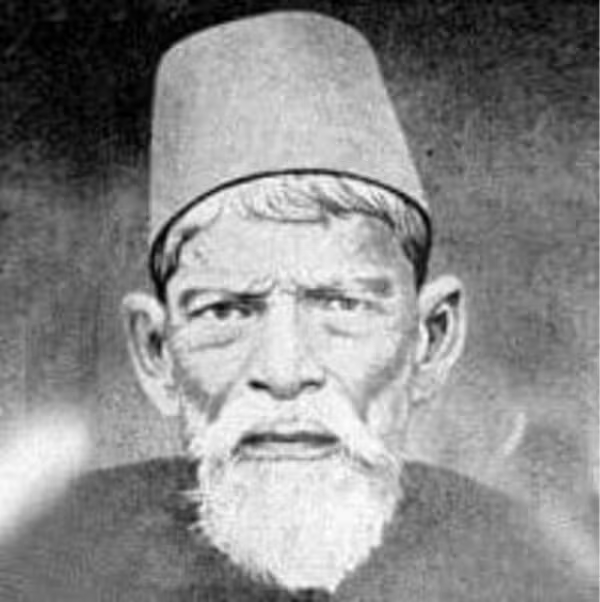
The Judge Who Held a Mirror to an Empire: Akbar Allahabadi
In the grand theatre of late 19th and early 20th century India, a time of profound and often painful transformation, one voice rose above the din with a chuckle, a sigh, and a devastatingly sharp observation. This was the voice of Syed Akbar Hussain, known to the world as Akbar Allahabadi. He was not a revolutionary firebrand or a political statesman, but a Sessions Judge in the British colonial administration. Yet, from behind the facade of his judicial career, Akbar wielded his pen like a scalpel, dissecting the anxieties and absurdities of a society caught between the allure of Western modernity and the pull of its ancient traditions. Honoured with the title Lisan-ul-Asr (The Voice of the Age), he became the most significant satirical poet of his time, and his witty couplets echo to this day, serving as a poignant and humorous commentary on the enduring cultural dilemmas of the subcontinent.
Early Life & Background
Syed Akbar Hussain was born on November 16, 1846, in the town of Bara, not far from the city of Allahabad (now Prayagraj), a major administrative and intellectual hub of the United Provinces under the British Raj. His father, Syed Tafazzul Hussain, served as a naib tehsildar in the colonial administration, placing the family within the class of educated Indians who navigated the complex world of British governance.
Akbar's early education was traditional, steeped in the classical languages of Persian and Arabic. However, the cataclysmic events of the 1857 Uprising disrupted his formal schooling. The world he had been born into was irrevocably changing, and the path to a respectable career now lay through the language and legal systems of the British. Recognizing this shift, the young Akbar embarked on a course of self-study, mastering English and eventually passing the law examination.
This educational journey was formative. It placed him at the confluence of two powerful streams: the rich literary and cultural heritage of Indo-Persian tradition and the pragmatic, powerful, and culturally alien world of English law and administration. This duality would become the central tension and the creative wellspring of his entire poetic life. He was not an outsider looking in; he was an insider, a successful product of the very system he would go on to critique with such piercing insight.
Career & Major Contributions
Akbar's professional life was one of steady ascent within the British judicial system. Beginning his career in 1866, he took on various roles, starting as a Munsif (a subordinate judicial officer) and gradually rising through the ranks. His diligence and legal acumen earned him respect, and he ultimately achieved the prestigious position of a Sessions Judge, a remarkable feat for an Indian in that era. He served the British Crown with distinction until his retirement in 1903.
His judicial career provided him with a unique vantage point. Day after day, he witnessed the collision of Indian society with British law. He saw the new class of anglicized Indians—the lawyers, clerks, and bureaucrats—adopting Western dress, manners, and speech, often with a sense of comical or tragic servility. This daily parade of colonial mimicry and social aspiration provided the raw material for his poetry. While the judge Syed Akbar Hussain passed sentences in the courtroom, the poet Akbar Allahabadi passed his own witty judgments on society in the evenings.
His poetry, collected in his Kulliyat (collected works), was not a rebellion against the British, but a profound cultural critique aimed at his own people. He used humor not for mere entertainment, but as a powerful tool for social commentary. His major contributions can be understood through the recurring themes in his work:
The Critique of Westernization
This was Akbar's most potent and enduring theme. He was deeply skeptical of the unthinking imitation of Western culture (Maghribi Tehzeeb) at the expense of indigenous values. He saw many of his contemporaries, particularly the youth emerging from new institutions like the Aligarh College, as being culturally adrift. He satirized their obsession with Western attire, their broken English-laced Urdu, and their detachment from their own heritage. In one of his most famous couplets, he mocks the new professional class created by the British:
Paidā huā vakīl to shaitān ne kahā
Lo aaj ham bhī sāhib-e-aulād ho gaye
(When a lawyer was born, Satan exclaimed with glee,
"Behold, today I too have been blessed with progeny!")
He often used English words in his Urdu poetry, a brilliant linguistic innovation that not only created a humorous effect but also perfectly mirrored the hybrid, and often absurd, language of the anglicized class he was targeting.
Education and Identity
Akbar was not against education, but he was deeply critical of an educational system that, in his view, produced clerks for the empire rather than well-rounded individuals rooted in their own culture. He feared that this education was creating a generation that was intellectually colonized, alienated from its own history, faith, and social fabric. He lamented:
Ham aisī sab kitābeñ qābil-e-zabtī samajhte haiñ
Ki jin ko paḌh ke laḌke baap ko khabtī samajhte haiñ
(I consider all such books worthy of being confiscated,
Which, upon reading, make sons think their fathers are demented.)
His critique was a counterpoint to the reformist movement of Sir Syed Ahmed Khan, who championed Western education as the path to salvation for Muslims. While Sir Syed saw it as a necessity for survival and progress, Akbar saw the cultural cost and warned against losing one's soul in the bargain.
Social and Political Commentary
Akbar also turned his satirical gaze towards politics and social mores. He was wary of the superficiality he perceived in the burgeoning nationalist movements, often mocking the culture of petitions and resolutions. He believed that true freedom came from cultural self-respect and inner strength, not just political agitation.
A particularly nuanced area of his commentary was on the changing role of women. He is often painted as a conservative who opposed women's freedom and education, particularly criticizing the abandonment of the purdah (veil). While many of his verses express this view, his most famous couplet on the subject is a masterclass in satire that turns the criticism on its head:
Be-parda kal jo nazar ā.īñ chand bībiyāñ
'Akbar' zamīñ meñ ġhairat-e-qaumī se gaḌ gayā
Pūchhā jo maiñ ne aap kā parda vo kyā huā
Kahne lagīñ ki aql pe mardoñ kī paḌ gayā
(Yesterday, when some unveiled ladies came into sight,
'Akbar' was buried in the ground with communal shame and fright.
When I asked them, "Your veil, whatever became of it?"
They replied, "It has fallen upon the minds of men.")
This verse, while starting as a conservative lament, ends with a sharp critique of male hypocrisy and intellectual blindness, demonstrating the sophisticated, multi-layered nature of his satire.
Legacy & Influence
Akbar Allahabadi passed away on September 9, 1921, but his voice has only grown more resonant with time. His legacy is not that of a mere court jester, but of a profound cultural diagnostician.
The Voice of an Age: The title Lisan-ul-Asr was not an exaggeration. Akbar perfectly captured the cognitive dissonance of his era. He articulated the unease of a generation grappling with a crisis of identity under the overwhelming political and cultural dominance of a foreign power. His poetry is an invaluable historical document, offering a window into the social psychology of colonial India.
Pioneer of Modern Urdu Satire: While humorous poetry existed before him, Akbar elevated satire into a high art form in Urdu. He created a unique style—simple, conversational, and direct, yet capable of profound philosophical insight. His use of wit as a weapon of social critique influenced generations of satirists in Urdu and other South Asian languages.
A Lasting Cultural Touchstone: Akbar's couplets have seeped into the popular lexicon, becoming proverbs and witty retorts used in everyday conversation. He is remembered as a humorist with a deeply serious purpose. His work continues to be relevant because the tensions he wrote about—between tradition and modernity, globalization and cultural identity, authenticity and imitation—are still very much alive in post-colonial societies.
Today, Akbar Allahabadi is remembered as a complex figure. Was he a reactionary traditionalist resisting the tide of progress, or a clear-eyed sage warning against the perils of soulless modernization? Perhaps he was both. He was a man of his time who loved his culture and felt the pain of its dilution. Through his laughter, he expressed a deep-seated sorrow, and in his sharpest critiques, he revealed a profound desire for his people to navigate the treacherous waters of change with dignity, self-respect, and a sense of humour.