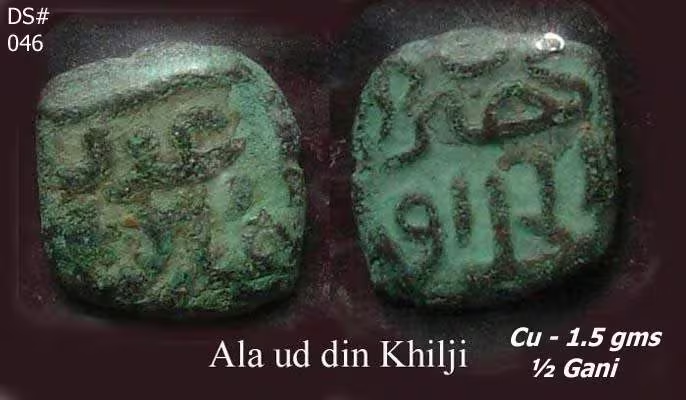
The Iron Sultan: Alauddin Khalji's Reign of Fire, Steel, and Order
In the turbulent theatre of 13th-century India, a new power was forged in the crucible of ambition and bloodshed. His name was Alauddin Khalji, a man whose story is a maelstrom of conquest, ruthless statecraft, and visionary, if brutal, reform. Ascending the throne of Delhi over the body of his own uncle, Alauddin would go on to repel the seemingly invincible Mongol hordes, extend the Sultanate's reach into the deep south, and re-engineer the very economic fabric of his empire. He was a tyrant and a genius, a usurper and a saviour, whose reign remains one of the most significant and controversial chapters in the history of medieval India.
Early Life & The Forging of Ambition
Born as Ali Gurshasp around 1266, the future Sultan was the nephew of Jalaluddin Khalji, the founder of the Khalji dynasty. After Jalaluddin ascended the throne of Delhi in 1290, Ali Gurshasp's fortunes rose. He was appointed Amir-i-Tuzuk (Master of Ceremonies) and was granted the governorship (iqta) of Kara, a strategic province near modern-day Allahabad.
While this was a position of considerable power, it was not enough to satisfy his burgeoning ambition. His personal life was reportedly strained; his marriage to Jalaluddin's daughter was unhappy, and he felt constantly slighted by the court's established nobility. In Kara, far from the prying eyes of the Delhi court, Ali Gurshasp began to cultivate his own power base. He gathered a loyal following, amassed resources, and dreamed of a destiny far greater than that of a provincial governor. It was here that he began to plan an audacious act that would catapult him onto the centre stage of Indian history.
Career & Major Contributions
Alauddin's reign can be defined by three monumental pillars: his treacherous rise to power, his relentless military expansion, and his revolutionary administrative and economic reforms.
The Audacious Path to the Throne
In 1296, Alauddin undertook one of the most daring military gambles in Indian history. Without the Sultan's permission, he led a force of eight thousand cavalry on a secret, arduous journey south, crossing the formidable Vindhya mountains to attack Devagiri, the fabulously wealthy capital of the Yadava kingdom. The Yadava king, Ramachandra, was caught completely off guard. Alauddin's swift and ruthless attack forced the king to sue for peace, handing over an unimaginable quantity of gold, silver, pearls, and elephants.
Laden with this immense treasure, Alauddin returned not as a loyal governor but as a kingmaker. He lured his trusting uncle, the 70-year-old Sultan Jalaluddin, to Kara under the false pretext of presenting this enormous bounty. As the unsuspecting Sultan embraced his nephew, Alauddin gave the signal. Jalaluddin was brutally assassinated, and his head was paraded on a spear. Alauddin Khalji was proclaimed the new Sultan of Delhi in 1296. He used the plundered wealth of Devagiri to win over the army and the nobility, securing a throne seized through betrayal and blood.
The Unstoppable Conqueror
Once in power, Alauddin unleashed a wave of military campaigns that would reshape the map of India.
Consolidation and Western Conquests: His first priority was to secure his rule. He eliminated the remnants of Jalaluddin's family and then turned his attention outwards. In 1299, his generals Ulugh Khan and Nusrat Khan led a massive army into Gujarat. The region was annexed, its cities were sacked, and its temples, including the revered Somnath temple, were desecrated. It was during this campaign that the army acquired a young eunuch slave named Malik Kafur, who would later rise to become Alauddin's most trusted general and the architect of his southern conquests.
The Subjugation of Rajasthan: Alauddin then set his sights on the formidable Rajput kingdoms of Rajasthan, who had long defied the authority of Delhi.
- Ranthambore (1301): After a long and difficult siege, the fort was captured from the defiant Hammiradeva. The campaign was notable for the first recorded instance of jauhar in a conflict against the Delhi Sultanate, where the Rajput women committed mass self-immolation to avoid capture.
- Chittor (1303): The siege of the legendary fort of Chittor is perhaps his most famous campaign. While the 16th-century epic poem Padmavat by Malik Muhammad Jayasi weaves a romantic tale of Alauddin's desire for the beautiful queen Padmini, contemporary historical records simply state that the Sultan besieged and conquered the fort from Rana Ratan Singh. The historical reality was a brutal military victory that solidified Khalji dominance.
Over the next decade, the forts of Mandu, Siwana, and Jalore also fell, bringing almost all of Rajasthan under the Sultanate's control.
The Southern Expeditions: Alauddin's greatest military achievement was extending the Sultanate's power south of the Vindhyas, a feat no Delhi Sultan had accomplished before. These campaigns, masterfully led by Malik Kafur, were not for annexation but for establishing suzerainty and acquiring wealth.
- Devagiri (1308): The Yadava kingdom was attacked again for failing to pay tribute.
- Warangal (1310): The Kakatiya kingdom was forced to surrender a vast treasure, which, according to some traditions, included the legendary Koh-i-Noor diamond.
- Dwarasamudra and Madurai (1311): Kafur's army marched further south, sacking the Hoysala capital and raiding the Pandya kingdom in the deep south. He returned to Delhi with hundreds of elephants, thousands of horses, and chests overflowing with gold and jewels, solidifying Delhi's status as the wealthiest and most powerful city in the subcontinent.
The Shield Against the Mongols
While Alauddin was expanding his empire, a grave threat loomed on the northwestern frontier. The Mongol hordes of the Chagatai Khanate launched a series of massive invasions aimed at conquering India. Alauddin's response to this existential threat is a cornerstone of his legacy.
Between 1297 and 1306, the Mongols launched at least five major invasions. Twice, in 1299 and 1303, they reached the outskirts of Delhi itself, besieging the capital. Alauddin responded with a comprehensive and ruthless strategy. He:
- Built a Massive Standing Army: He created a large, professional, and directly paid standing army, a departure from the previous system of relying on feudal levies.
- Fortified the Frontier: He repaired old forts and built new ones along the invasion routes, garrisoning them with his best troops.
- Appointed Capable Generals: He put battle-hardened commanders like Zafar Khan (whose ferocity in battle reportedly became a cause of fear for the Mongols) and Ghazi Malik (the future Ghiyas-ud-din Tughlaq) in charge of the frontier.
- Adopted a Brutal Policy: Defeated Mongols were executed en masse. In one instance, after a conspiracy involving Mongol converts settled in Delhi was uncovered, Alauddin ordered the massacre of thousands of these "New Muslims."
His scorched-earth tactics and military genius ultimately broke the back of the Mongol threat. After 1306, the Mongol invasions ceased to be a major danger, and India was spared the devastation that had befallen Central Asia and the Middle East.
The Great Economic Reformer
To fund his massive army and prevent rebellions fueled by wealth, Alauddin instituted a series of radical economic and administrative reforms that were unprecedented in their scope.
- Market Controls (Diwan-i-Riyasat): His most famous policy was the fixing of prices for all essential commodities in Delhi—from grain, cloth, and sugar to horses, cattle, and slaves. This was done to ensure his soldiers could live on their modest salaries.
- Strict Enforcement: A new department, the Diwan-i-Riyasat, was created to oversee the markets. A network of spies (munhiyans) reported directly to the Sultan. Merchants who cheated on weights or charged more than the fixed price were punished severely; it was said that for any shortfall in weight, an equal amount of flesh would be cut from the merchant's body.
- Revenue Reforms: Alauddin revolutionized the land revenue system. He ordered a comprehensive measurement of all cultivable land and fixed the state's share (kharaj) at a steep 50% of the produce. He eliminated the traditional intermediaries (khots and muqaddams), collecting revenue directly and curbing their power. He also imposed a grazing tax (charai) and a house tax (ghari).
- Centralization of Power: Through these reforms and a pervasive spy network that monitored everyone from high-ranking nobles to commoners, Alauddin centralized power in the hands of the Sultan to an extraordinary degree. He confiscated land grants, banned private parties and marriage alliances among nobles without his permission, and prohibited alcohol, all in an effort to stamp out any potential source of rebellion.
Legacy & Influence
Alauddin Khalji died in 1316, leaving behind a complex and enduring legacy. His final years were marred by illness and court intrigue, with his trusted general Malik Kafur wielding immense power.
Historical Significance: Alauddin transformed the Delhi Sultanate. He was the first true emperor of the Sultanate period, creating a vast, centralized empire that stretched across most of the Indian subcontinent. His successful defence against the Mongols was a monumental achievement that secured the cultural and political future of India. His administrative and economic systems, though driven by military necessity and enforced with tyranny, were revolutionary and influenced later rulers.
Architectural Contributions: Alauddin was also a great builder. He constructed the second city of Delhi at Siri and a vast reservoir, the Hauz-i-Alai (now Hauz Khas). His most celebrated contribution is the Alai Darwaza, the magnificent southern gateway to the Qutb complex, a masterpiece of Indo-Islamic architecture renowned for its perfect proportions and exquisite craftsmanship. He also began work on the Alai Minar, a colossal tower intended to be twice the height of the Qutb Minar, but it was left unfinished at his death.
How He Is Remembered: Alauddin Khalji remains a towering figure in Indian history, remembered as much for his brilliance as for his brutality. He was a military genius, a shrewd administrator, and a ruthless autocrat who tolerated no dissent. He was a usurper who murdered his own family to gain power, yet he was also the saviour who protected his kingdom from one of the greatest threats it had ever faced. In popular culture, his image has often been defined by the legendary (but not historical) tale of Padmini, casting him as a cruel and obsessive villain. But the historical Alauddin was far more complex: a pragmatic and iron-willed ruler who, for better or worse, reshaped the destiny of India.