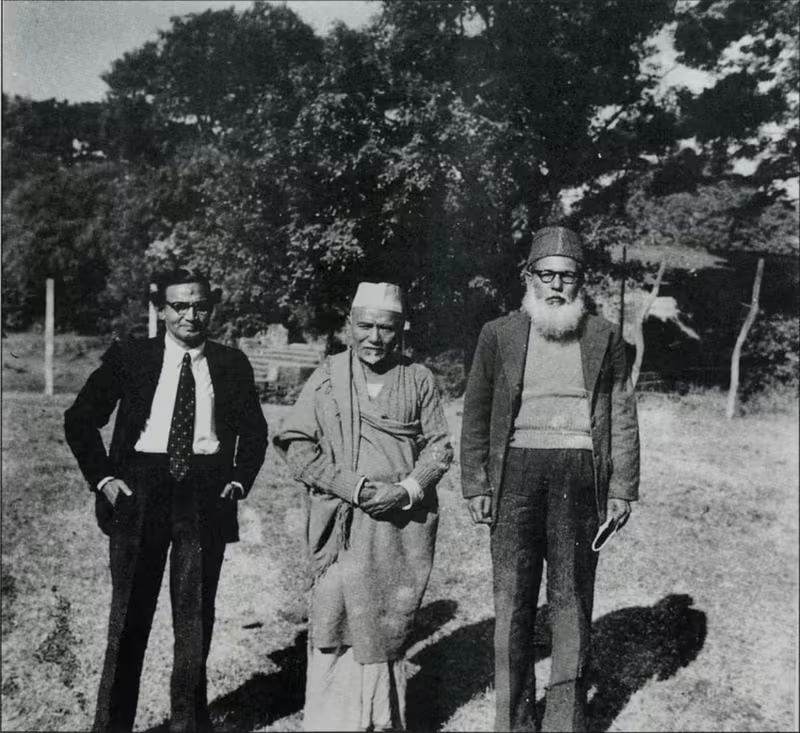
Ali Akbar Khan - Sarod Maestro and Educator
In the grand pantheon of Indian classical music, few figures command as much reverence as Ustad Ali Akbar Khan. He was not merely a musician; he was a force of nature, a storyteller whose instrument, the sarod, spoke a language of profound emotion that transcended cultural and geographical boundaries. Known affectionately as Khansahib by his legions of students and admirers, he was a virtuoso performer, an innovative composer, and, most enduringly, a dedicated guru who carried the sacred flame of his musical lineage to the far corners of the world. His life, spanning from the twilight of the British Raj to the digital age, is a testament to the timeless power of an art form preserved through discipline, devotion, and an unwavering commitment to its spiritual core.
Early Life & The Crucible of the Maihar Gharana
Ali Akbar Khan was born on April 14, 1922, in the village of Shibpur, Brahmanbaria, in what was then British India (now Bangladesh). He was born into musical royalty. His father was the formidable Acharya Baba Allauddin Khan, a colossal figure in 20th-century Indian music and the architect of the Senia-Maihar gharana. Baba, as he was universally known, was a multi-instrumentalist saint and a guru of legendary intensity, serving as the court musician to the Maharaja of Maihar.
From the age of three, Ali Akbar’s life was music. His training, or talim, began not with an instrument, but with the voice. Baba Allauddin Khan believed that a musician must first learn to sing to truly understand melody. The young Ali Akbar was then guided through a dizzying array of instruments—tabla, pakhawaj, sitar, violin—to build a comprehensive foundation. This rigorous, holistic approach was a hallmark of the Maihar gharana.
His father’s teaching methods were notoriously severe, a reflection of an older, uncompromising world of artistic discipline. The stories of his tutelage are legendary. Ali Akbar Khan would practice for up to 18 hours a day, often tied by his father to a tree to prevent him from running away to play. The training was a trial by fire, designed to break the ego and distill music to its purest, most spiritual essence. It was an education forged in relentless repetition, physical hardship, and an overwhelming love for the art. As Khansahib would later recall, his father gave him one choice: “You will play music, or I will kill you.” But beneath the severity was a profound paternal love and a desperate desire to pass on a treasure he considered sacred.
Ultimately, Baba decreed that Ali Akbar’s destiny was intertwined with the sarod, a fretless stringed instrument that his father had himself modified and mastered. Under his father’s exacting gaze, Ali Akbar Khan didn’t just learn to play the sarod; he became its voice. He mastered the intricate rhythmic cycles (tala) and the complex melodic structures (raga), but more importantly, he imbibed the gayaki ang—the art of making the instrument “sing” like the human voice. His sarod could weep, plead, exult, and meditate, all within the span of a single performance.
The Making of a Maestro: Career & Contributions
After more than two decades of near-monastic training, Ali Akbar Khan emerged as a musician of breathtaking skill and emotional depth. His first public performance in Allahabad at the age of thirteen was a sign of the greatness to come. By 1943, at just 21, he was appointed court musician for the Maharaja of Jodhpur, Hanwant Singh, who bestowed upon him the title of Ustad (Master), a rare honor for one so young.
His career in India flourished. He was a sought-after performer, a regular voice on All India Radio, and an innovative composer. He ventured into the world of cinema, creating haunting, timeless scores for films like Tapan Sinha’s Kshudhita Pashan (1960) and, most famously, Satyajit Ray’s masterpiece Devi (1960). His film music was not a commercial diversion but an extension of his classical artistry, using ragas to evoke complex psychological states and historical moods.
However, it was his journey to the West that would cement his global legacy. In 1955, the celebrated violinist Yehudi Menuhin, deeply impressed by a recording of Khansahib, invited him to the United States. This visit was a watershed moment. At the Museum of Modern Art in New York, he gave a landmark performance that introduced an unsuspecting American audience to the profound depths of Indian classical music. That same year, he recorded Music of India: Morning and Evening Ragas, the first-ever long-playing (LP) record of Indian classical music released in the West. This was years before the cultural explosion of the 1960s; Ali Akbar Khan was a pioneer, laying the very foundation for the international appreciation of the art form.
His artistry was characterized by a perfect synthesis of technical wizardry (layakari) and profound emotionality (rasa). He could navigate the most complex rhythmic patterns with astonishing precision, yet his playing was always centered on the emotional core of the raga. His mastery of meend (the sliding glissando between notes) allowed him to coax from the sarod’s metal fingerboard a vocal-like fluidity that was his signature. A performance by Khansahib was not an exhibition of skill but an act of collective meditation, a journey into the soul of a raga.
His collaborations are the stuff of legend. His jugalbandis (duets) with his brother-in-law, the sitar maestro Ravi Shankar, were iconic events, showcasing a dynamic interplay of rivalry and deep mutual respect. Their performance at the Concert for Bangladesh in 1971 at Madison Square Garden, organized by George Harrison, brought Indian classical music to a massive global rock audience and remains a touchstone of cross-cultural musical history.
The Guru: A Legacy of Education
While his fame as a performer was global, Ali Akbar Khan’s most enduring legacy may be his work as an educator. Having experienced the rigors of his own training, he was determined to preserve his father’s musical lineage but to share it with a compassion and patience he was rarely afforded. He believed that this music was a universal gift that should be accessible to any sincere student, regardless of their background.
In 1956, he founded the Ali Akbar College of Music in Calcutta (now Kolkata). But his vision was larger. After a successful teaching residency in Berkeley, California, he saw the immense hunger for authentic instruction in the West. In 1967, he established the Ali Akbar College of Music (AACM) in Berkeley, which later moved to its permanent home in San Rafael, California. This was a revolutionary act. The AACM became the premier institution outside of India for the serious study of North Indian classical music, a gurukul transplanted to American soil.
Khansahib was a devoted and meticulous teacher. He personally taught classes at every level, from beginner to advanced, often for eight hours a day. He developed a system of notation to help his Western students grasp the subtleties of ragas, but he always insisted that the true learning came from listening and absorption. He taught thousands of students over four decades, creating a global community of musicians and connoisseurs dedicated to the preservation and practice of the Maihar gharana. A branch of the college was later established in Basel, Switzerland, further extending his educational reach.
Legacy & Influence
Ustad Ali Akbar Khan passed away on June 18, 2009, in San Anselmo, California, leaving behind an immeasurable void. His life and work transformed the landscape of world music. He was showered with accolades, including India’s highest civilian honors, the Padma Bhushan (1967) and the Padma Vibhushan (1989). In 1991, he was awarded the prestigious MacArthur Fellowship, the so-called “genius grant,” recognizing his unique creative and cultural contributions. He also received the National Heritage Fellowship from the National Endowment for the Arts in 1997, the highest honor in the United States for traditional arts.
He is remembered not just for his five Grammy nominations or his sold-out concerts, but for his fundamental impact on the sarod. He expanded its technical and emotional vocabulary, solidifying its place as one of the preeminent instruments of Indian classical music. Every contemporary sarod player performs in the shadow of his genius.
Together with Ravi Shankar, he served as a primary cultural ambassador for India, presenting its most profound artistic traditions to the world not as an exotic curiosity, but as a classical art form of immense sophistication and spiritual depth. While Shankar was often the more public-facing figure, Khansahib was revered by musicians as the “musician’s musician,” the ultimate master of the craft. The New York Times once wrote he was “perhaps the greatest musician in the world.”
Today, the sound of his sarod lives on through his countless recordings and, more importantly, through the hands of his students, including his son, sarodist Aashish Khan. The Ali Akbar College of Music continues to thrive, a living monument to his vision. Ustad Ali Akbar Khan’s story is that of a bridge-builder—between the ancient and the modern, between East and West, and between the divine and the human. He was a keeper of a sacred tradition, and in sharing it with the world, he ensured its flame would burn brightly for generations to come.