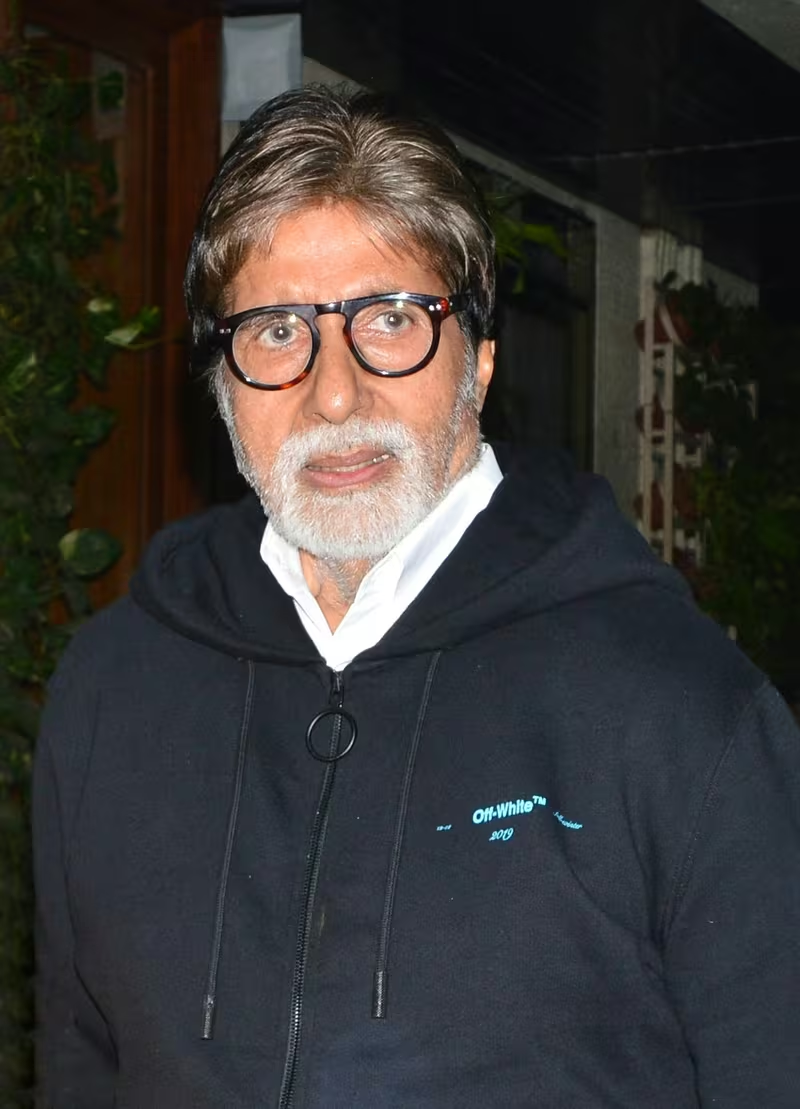
Amitabh Bachchan - Superstar of Bollywood
In the grand theatre of Indian history, few figures from the world of arts have cast as long a shadow as Amitabh Harivansh Bachchan. He is more than an actor; he is an institution, a cultural phenomenon whose journey mirrors the socio-political shifts of post-independence India. From the smouldering rage of the 'Angry Young Man' in the 1970s to the revered patriarch of the 21st century, his baritone voice has narrated the story of a nation, and his on-screen persona has given voice to the aspirations and frustrations of a billion people. Known affectionately as the 'Shahenshah of Bollywood,' 'Big B,' and the 'Star of the Millennium,' his is a story of extraordinary talent, crushing failure, and a spectacular, unprecedented comeback.
Early Life & Background
Amitabh Bachchan was born on October 11, 1942, in the city of Allahabad (now Prayagraj), Uttar Pradesh, into a family of literary and social distinction. His father, Dr. Harivansh Rai Bachchan, was a towering figure in Hindi literature, a celebrated poet of the Nayi Kavita literary movement, and a professor of English. It was from his father that Amitabh inherited a deep appreciation for the cadence and power of the Hindi language. His mother, Teji Bachchan, a woman of Sikh heritage from Lyallpur (in present-day Pakistan), was a social activist and a powerful influence on his upbringing, instilling in him a sense of discipline and worldly grace.
Interestingly, he was originally named 'Inquilaab' (Revolution), inspired by the freedom struggle slogan 'Inquilaab Zindabad,' which was popular in the years leading up to India's independence. However, at the suggestion of his father's friend, the poet Sumitranandan Pant, his name was changed to Amitabh, meaning "the light that will never die." The family's surname was Shrivastava, but Harivansh Rai adopted his pen name, 'Bachchan,' as the family's public name.
Bachchan's formative years were spent away from home at Sherwood College, a prestigious boarding school in the Himalayan hill station of Nainital. It was here that he first discovered a passion for the stage. He later moved to Delhi to attend Kirori Mal College, University of Delhi, where he completed his Bachelor of Science degree. After graduating, he moved to Calcutta (now Kolkata) and worked as a freight broker for the shipping firm Bird and Co., a phase of his life far removed from the glamour that would later define him. Yet, the dream of cinema persisted. In 1969, he moved to Bombay (now Mumbai) to chase that dream, armed with little more than his ambition and a distinctive, deep voice that, ironically, had been rejected by All India Radio.
Career & Major Contributions
The Initial Struggle and a Glimmer of Hope
Bachchan's entry into the Hindi film industry was not a triumphant one. His tall, lanky frame and unconventional looks did not fit the mould of the conventional romantic hero of the era, dominated by the likes of Rajesh Khanna. His career began not with his face, but with his voice, as a narrator in Mrinal Sen's National Award-winning film Bhuvan Shome (1969). His acting debut came later that year in Saat Hindustani, where he played one of seven protagonists. The film was not a commercial success, but his performance was noted.
A string of commercially unsuccessful films followed, and the path to stardom seemed distant. The breakthrough came in a supporting role. In Anand (1971), starring the reigning superstar Rajesh Khanna, Bachchan played Dr. Bhaskar Banerjee, a cynical, brooding doctor transformed by his terminally ill patient. His restrained, intense performance was a stark contrast to Khanna's effervescent charm and earned him his first Filmfare Award for Best Supporting Actor. The industry had taken notice.
The Rise of the 'Angry Young Man'
The year 1973 was the watershed moment. Director Prakash Mehra cast him in Zanjeer as Inspector Vijay Khanna, an honest cop shackled by a corrupt system. The film was a radical departure from the romantic melodramas of the time. Vijay was not a lover; he was a simmering volcano of rage, a man of few words and decisive, often violent, action. This character resonated profoundly with the national mood. The early 1970s in India were a period of great social unrest, marked by economic stagnation, rising unemployment, and widespread corruption. Bachchan’s Vijay became a vessel for the public's frustrations, an anti-establishment hero who took justice into his own hands.
The 'Angry Young Man' was born, an archetype crafted to perfection by the legendary screenwriting duo Salim-Javed. This collaboration produced some of the most iconic films in Indian history. In Deewaar (1975), directed by Yash Chopra, Bachchan delivered a tour-de-force performance as Vijay Verma, a dockworker-turned-smuggler. His confrontation with his righteous policeman brother (Shashi Kapoor) yielded one of Indian cinema's most famous lines: "Mere paas maa hai" ("I have mother"). The film was a cinematic and cultural landmark.
The same year, he starred in Sholay (1975), the definitive Indian blockbuster. As the stoic, sharp-witted Jai, his camaraderie with Dharmendra's Veeru became the gold standard for on-screen friendship. Throughout the late 1970s and early 1980s, Bachchan was not just a star; he was a one-man industry. He showcased incredible versatility, excelling in action (Don, 1978), comedy (Amar Akbar Anthony, 1977), romance (Kabhi Kabhie, 1976), and drama (Muqaddar Ka Sikandar, 1978).
Tragedy, Politics, and a Faltering Career
On July 26, 1982, the nation came to a standstill. While filming a fight scene for the movie Coolie in Bangalore, Bachchan suffered a near-fatal intestinal injury. He was airlifted to Mumbai, where he battled for his life for months. The country united in prayer; fans held vigils outside his hospital, and the incident cemented his status as a national icon. His recovery was seen as a miracle, and when Coolie was finally released in 1983, it was a stupendous success.
Following the accident, he took a sabbatical and, at the behest of his friend, Prime Minister Rajiv Gandhi, entered politics in 1984. He contested the Lok Sabha seat from his hometown of Allahabad and won by a historic margin. However, his political career was short-lived. Disillusioned by the controversies surrounding the Bofors scandal, he resigned his seat in 1987, famously calling politics a "cesspool."
His return to cinema in the late 1980s and 1990s was a period of decline. The 'Angry Young Man' persona had aged, and a new generation of romantic heroes was on the rise. In 1996, he founded the Amitabh Bachchan Corporation Ltd. (ABCL), an ambitious venture in entertainment production and management. However, due to financial mismanagement, the company collapsed, leaving Bachchan on the verge of bankruptcy.
The Second Coming: An Unprecedented Reinvention
At the turn of the millennium, with his career at its lowest ebb and facing monumental debt, Bachchan made a decision that would forever change the landscape of Indian entertainment. In 2000, he agreed to host the Indian adaptation of the game show Who Wants to Be a Millionaire?, titled Kaun Banega Crorepati (KBC). At the time, television was considered a step down for a film superstar. Yet, KBC became a cultural phenomenon. Bachchan's warm, dignified, and empathetic hosting style connected him with families in every corner of India. The show revived his career, erased his debts, and launched one of the most remarkable second acts in entertainment history.
Simultaneously, he reinvented himself on the silver screen. In Mohabbatein (2000), he played a stern, unyielding patriarch, a role that signaled his graceful transition to character-driven parts. This new phase saw him deliver some of his most critically acclaimed performances in films like the psychological thriller Aankhen (2002), the gritty cop drama Khakee (2004), and most notably, Sanjay Leela Bhansali's Black (2005), where his portrayal of a teacher to a deaf-blind girl won him universal praise and a National Film Award.
He has remained a prolific and vital force in cinema, collaborating with new generations of filmmakers in films like Paa (2009), where he played a 12-year-old boy with progeria, the slice-of-life drama Piku (2015), and the courtroom drama Pink (2016). He even made a brief appearance in the Hollywood film The Great Gatsby (2013), a testament to his global stature.
Legacy & Influence
Amitabh Bachchan's legacy is immense and multifaceted. He is not just a film star but a historical figure who has shaped modern Indian culture.
His 'Angry Young Man' persona was a perfect reflection of the zeitgeist of 1970s India, giving a cinematic voice to a generation's anxieties. He redefined the concept of a Hindi film hero, proving that audiences would embrace a brooding, flawed protagonist over a simplistic, clean-cut one.
He became the "one-man industry," a colossus whose name on a poster was enough to guarantee a film's success. He set new benchmarks for stardom, endorsements, and influence that remain unparalleled. His style, dialogues, and mannerisms have permeated the fabric of Indian society, becoming a part of the nation's collective consciousness.
Perhaps his most significant legacy is his incredible resilience. His journey from the pinnacle of stardom to near-bankruptcy and back is a masterclass in reinvention. By embracing television with KBC, he shattered the glass ceiling between the big and small screens, paving the way for other film stars to follow. He demonstrated an extraordinary ability to adapt with the times, transitioning from a larger-than-life hero to a respected character actor, earning critical acclaim and a new generation of admirers.
Today, Amitabh Bachchan stands as a living legend, an elder statesman of Indian cinema, and a global ambassador for Indian culture. His disciplined work ethic, his command of language, and his enduring presence continue to inspire artists and audiences alike. His life story is not just a chapter in the history of Indian cinema; it is a vital part of the history of modern India itself.