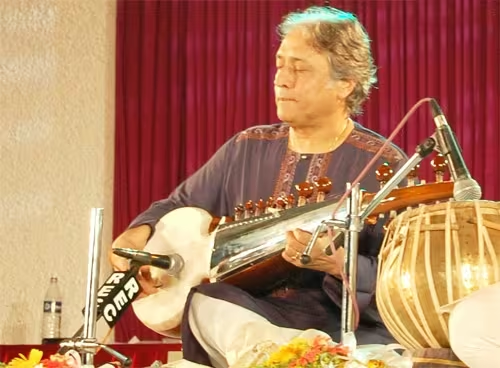
Amjad Ali Khan - Sarod Maestro
In the hallowed halls of Indian classical music, few names resonate with the same blend of aristocratic lineage and revolutionary innovation as Ustad Amjad Ali Khan. He is not merely a musician; he is a living institution, a conduit through which the ancient soul of the Sarod speaks in a distinctly modern, profoundly personal voice. Born into a family that has shaped the very identity of the instrument for generations, the Ustad has carried this formidable legacy not as a burden, but as a foundation upon which to build a new edifice of sound. His music, a seamless river of melody and emotion, has transcended geographical and cultural borders, establishing him as one of the most significant Indian classical musicians of the 20th and 21st centuries.
Early Life & Background
Amjad Ali Khan was born on 25 October 1945, in the historic city of Gwalior, a place steeped in the traditions of North Indian classical music and famously associated with the legendary musician Tansen. His birth was not just an event in a family, but a continuation of a celebrated musical dynasty—the Bangash lineage. He was the youngest son of the great Sarod virtuoso Ustad Hafiz Ali Khan, the court musician to the royal family of Gwalior.
His was a world where music was as natural as breathing. The family traces its ancestry to Ghulam Bandagi Khan Bangash, a soldier and horse trader from Afghanistan who came to India in the 18th century. It is this lineage that is credited with a pivotal moment in musical history: the modification of the Afghan folk instrument, the Rabab, into the more refined and resonant instrument known today as the Sarod. Young Amjad was thus the sixth-generation inheritor of this tradition, born with the sound of the Sarod in his very being.
His tutelage began at an age when most children are learning their first alphabets. His father, a stern disciplinarian and a purist, was his one and only Guru. The training was relentless and immersive. Hafiz Ali Khan believed that music was a form of prayer and demanded absolute surrender to the art form. Formal schooling took a backseat to the rigorous daily practice, or riyaaz. While Amjad Ali Khan did attend Modern School in New Delhi for a time, his true classroom was the baithak where his father would unravel the intricate tapestries of ragas for hours on end. He gave his first solo recital at the tender age of six, a clear indication of the prodigious talent that was being carefully nurtured.
Growing up in Gwalior, he was surrounded by the ethos of the Gwalior Gharana of vocal music, one of the oldest and most influential schools of Khayal singing. Though he was an instrumentalist, this pervasive vocal influence would later become the cornerstone of his revolutionary contribution to the Sarod.
Career & Major Contributions
Ustad Amjad Ali Khan’s career is a testament to his twin commitments: a deep reverence for tradition and an unceasing quest for innovation. As he matured as an artist, he began to forge a unique path, one that would redefine the sound and technique of the Sarod.
His most significant contribution is the development of a playing style that mirrors the nuances of the human voice. He pioneered the gayaki ang (vocal style) on the Sarod, a radical departure from the instrument-centric gatkari style prevalent at the time. To achieve this, he modified his technique, using the tips of his left-hand fingernails to press and glide along the fretless metal fingerboard. This allowed for the creation of delicate glissandos (meend) and subtle vocal inflections, making the Sarod 'sing' in a way it never had before. His instrument became an extension of his own voice, capable of expressing the most profound emotions, from deep pathos to ecstatic joy.
His international career began early. In 1963, at just eighteen, he performed in the United States, marking the beginning of a lifelong journey as a cultural ambassador for India. He has since performed at virtually every prestigious venue across the globe, including Carnegie Hall in New York, the Royal Albert Hall in London, the Sydney Opera House, and the Kennedy Center in Washington D.C. He brought the Sarod to new audiences, collaborating with a diverse range of artists and orchestras, including the Hong Kong Philharmonic Orchestra and the Scottish Chamber Orchestra, with whom he recorded the celebrated album Samaagam.
Beyond performance, the Ustad is also a gifted composer. He is credited with creating several new ragas, each a unique melodic framework. Among his most notable creations are Raga Priyadarshini, named in homage to the late Prime Minister Indira Gandhi, and Raga Kamalshree, dedicated to the cultural visionary Kamaladevi Chattopadhyay.
His immense contributions have been recognized with India’s highest civilian honors. He received the Padma Shri in 1975, the Padma Bhushan in 1991, and the Padma Vibhushan in 2001. He was also awarded the Sangeet Natak Akademi Award in 1989 and prestigious international accolades like the Fukuoka Asian Culture Prize in 2004. A particularly poignant moment of global recognition came in 2014, when he, along with his two sons, performed the Raga of Peace at the Nobel Peace Prize Concert in Oslo.
Legacy & Influence
Ustad Amjad Ali Khan's legacy is multi-faceted. He is, first and foremost, the man who gave the Sarod a new voice. By infusing his playing with the lyrical emotionality of the gayaki ang, he transformed the perception of the instrument from a vehicle of rhythmic and melodic virtuosity to a profound medium of emotional expression. This innovation has influenced virtually every Sarod player who has followed him.
He stands as a monumental figure in the global dissemination of Indian classical music. Following in the pioneering footsteps of stalwarts like Pandit Ravi Shankar and his own contemporary, Ustad Ali Akbar Khan, he carved a unique niche for himself and his instrument. His approachability, articulate explanations of his art, and serene stage presence have demystified the complexities of Indian music for international audiences, winning countless new admirers for the tradition.
His commitment to preserving his heritage is embodied in Sarod Ghar, the museum of musical heritage he established in their ancestral home in Gwalior. The museum houses a priceless collection of old and rare musical instruments, including the original Rabab of his ancestors, providing a tangible link to the history he so proudly represents. It is a tribute to the great masters of the past and an educational resource for future generations.
As a guru, he has passed on his formidable knowledge and philosophy to his two sons, Amaan Ali Bangash and Ayaan Ali Bangash, who are now accomplished Sarod players in their own right. They represent the seventh generation of the Bangash lineage, carrying their father's legacy forward while forging their own artistic identities. Beyond his family, he has taught at esteemed institutions like Stanford University and the University of New Mexico, generously sharing his art with students around the world.
Today, Ustad Amjad Ali Khan is revered as a living legend. He is remembered not just for his technical mastery or his innovative genius, but for the spiritual depth and tranquility that pervades his music. His life and work are a powerful message of peace and unity, a belief that music is a universal language that can connect humanity and heal divisions. In the hands of the Maestro, the twenty-five strings of the Sarod do not just produce notes; they tell the story of a civilization, a family, and a soul dedicated to the pursuit of pure, unadulterated beauty.