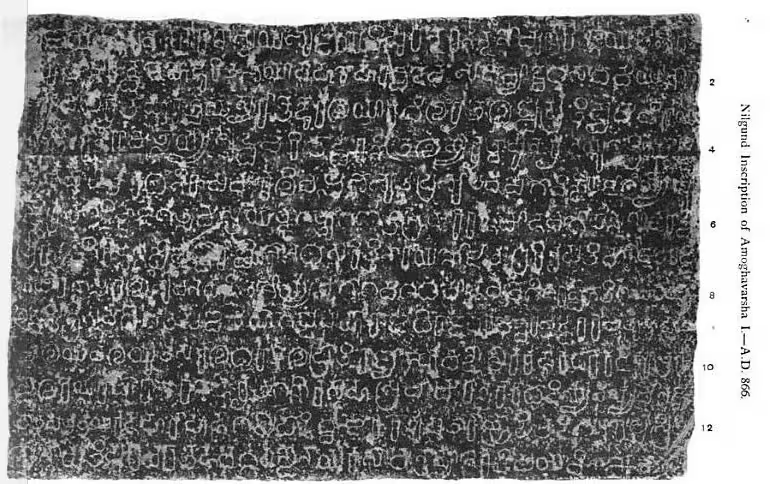
Amoghavarsha I: The Philosopher King of the Rashtrakutas
In the sprawling canvas of 9th-century India, while the Pala dynasty held sway in the east and the Gurjara-Pratiharas dominated the north, the Deccan plateau was the heartland of a formidable power: the Rashtrakuta Empire. It was an era of colossal armies, intricate court politics, and a spectacular efflorescence of art and literature. At the helm of this empire, for an astonishing sixty-four years, sat a ruler who was as much a sage as he was a sovereign, a poet as much as a patron. This was Amoghavarsha Nrupatunga I (r. 814–878 CE), a monarch whose long and stable reign would define a golden age for his kingdom and leave an indelible mark on the cultural history of India.
His fame was not confined to the subcontinent. The Arab merchant and traveler, Sulaiman, visiting India during his reign, was so impressed that he named the Rashtrakuta emperor as one of the four greatest kings in the world, placing him in the exalted company of the Caliph of Baghdad, the Emperor of China, and the Emperor of Constantinople (Byzantium). For Sulaiman, the Rashtrakuta realm was a land of power, stability, and immense wealth. But for the people of the Deccan, Amoghavarsha was something more—he was Nrupatunga, the 'Exalted among Kings,' a ruler who wielded the sceptre with one hand and a scholar's pen with the other.
The Turbulent Ascent of a Young Prince
Amoghavarsha was born Sharva in 800 CE, not in the comfort of a royal palace, but in a military camp at Sribhavan on the banks of the Narmada River. His father, the mighty Emperor Govinda III, was in the midst of his triumphant northern campaigns, expanding the borders of the Rashtrakuta Empire to their farthest extent. The boy was thus born into a world of imperial ambition and military conquest, a legacy he was destined to inherit.
His father’s reign was brilliant but brief. When Govinda III died in 814 CE, the throne passed to a fourteen-year-old Sharva, who adopted the regnal name Amoghavarsha, meaning 'Unfailing Rain'—a title that embodied the hope for prosperity he was expected to bring.
However, the accession of a teenage emperor was a signal for chaos. In the ruthless political theatre of medieval India, a young ruler was seen as a weak one. Almost immediately, a formidable rebellion erupted, threatening to tear the vast empire apart. A confederacy of feudatories, ministers, and ambitious relatives, likely led by his uncle Stambha, saw an opportunity to seize power. The empire that Govinda III had so masterfully consolidated was on the brink of collapse.
It was during this baptism by fire that the young emperor found a crucial ally in his cousin, Karka Suvarnavarsha, the head of the Gujarat branch of the Rashtrakutas. Acting as regent and guardian, the loyal Karka marshalled the imperial forces and systematically crushed the rebellion. By 821 CE, the internal threats were neutralized, and Amoghavarsha, now a young man forged in the crucible of conflict, took firm control of his inheritance. These early struggles instilled in him a profound understanding of the fragility of power and the necessity of blending military might with diplomatic wisdom—a lesson that would shape his entire reign.
While specific details of his education are scarce, his later accomplishments reveal a mind steeped in Sanskrit and Kannada literature, trained in statecraft, and deeply influenced by the philosophical currents of his time, particularly Jainism. His court would become a haven for scholars, and his reign would prove that his education was not merely academic but a guiding principle for his rule.
The Reign of Nrupatunga: War, Peace, and Culture
Amoghavarsha’s 64-year reign can be seen as a grand balancing act between the duties of an emperor—defending borders and managing feudatories—and the passions of a scholar—patronizing religion, art, and literature.
The Imperial Sword
Though often remembered for his peaceful inclinations, Amoghavarsha was no stranger to the battlefield. The Rashtrakuta Empire was a sprawling entity, and holding it together required a firm, and often martial, hand.
His most persistent military challenge came from the Eastern Chalukyas of Vengi. This rivalry was a long and bloody affair, with fortunes shifting between the two powers. Amoghavarsha dispatched his able general, Bankesha, who won significant victories, but the Chalukyan ruler Vijayaditya II proved to be a resilient foe. The conflict ebbed and flowed for years, a constant drain on the empire's resources, but Amoghavarsha successfully prevented the Chalukyas from posing an existential threat.
He was more decisive in his dealings with the Western Ganga Dynasty of Talakad, a powerful feudatory to the south. After subduing their rebellious tendencies, he cemented his authority through a classic Indian political strategy: a matrimonial alliance. His daughter, the princess Chandrabbalabbe, was married to the Ganga prince Butuga I, transforming a potential rival into a loyal relative and securing the southern frontier.
His influence extended far beyond his immediate neighbors. The Sanjan plates, a copper-plate inscription from his reign, boast that the rulers of Anga, Vanga, and Magadha (in the east) and the Pallavas of Kanchi (in the south) paid him homage. While such claims in royal inscriptions were often exaggerated, they reflect the undeniable fact that the Rashtrakuta emperor was the paramount sovereign of the Deccan, a power that even distant kings had to acknowledge.
The City of Manyakheta
A lasting contribution of Amoghavarsha's reign was the establishment of a new imperial capital. He moved the administrative heart of the empire from Mayurkhandi to Manyakheta (modern-day Malkhed in Karnataka). Under his patronage, Manyakheta grew from a military outpost into a magnificent metropolis, designed on a grand scale to rival the legendary capitals of ancient India. It became a vibrant hub of commerce, culture, and intellectual exchange, attracting merchants, poets, and philosophers from across the land. It was this prosperous and well-ordered city that so impressed foreign visitors and became synonymous with Rashtrakuta glory.
The Patron Saint of Letters
It is in the realm of culture that Amoghavarsha’s legacy truly shines. He presided over a court that was a crucible of intellectual and artistic innovation.
A Devout Jain: Amoghavarsha was a devoted follower of Jainism, and his patronage helped it flourish throughout the Deccan. His spiritual preceptor was the great Digambara monk Jinasenacharya. Under the emperor’s sponsorship, Jinasena and his student Gunabhadra composed parts of the Mahapurana, a monumental work detailing the lives of the 63 great figures of Jain tradition. The emperor's court was also home to the brilliant mathematician Mahaviracharya, whose work Ganita-sara-sangraha is a landmark text in the history of Indian mathematics, and the grammarian Sakatayana, who wrote a commentary on Sanskrit grammar known as the Amoghavritti.
His personal piety was legendary. The Sanjan plates relate a dramatic, though perhaps symbolic, story. When a devastating epidemic swept through the land, the emperor, in an act of supreme sacrifice for his people, is said to have offered a finger from his left hand to the goddess Mahalakshmi of Kolhapur to appease her and end the calamity. Whether literal or allegorical, the account paints a powerful picture of a king who saw himself as the ultimate protector of his subjects, willing to endure personal suffering for their well-being.
The Birth of Kannada Poetics: Amoghavarsha's most celebrated contribution is the Kavirajamarga ('The Royal Path for Poets'). This seminal work, the earliest extant text on poetics and rhetoric in the Kannada language, is a cornerstone of Kannada literature. While some modern scholars argue it may have been written by a court poet like Srivijaya under the king's patronage, tradition has firmly attributed its authorship or co-authorship to Amoghavarsha himself.
The Kavirajamarga did more than just lay down the rules of grammar and composition. It was a cultural manifesto. It meticulously defined the geographical boundaries of the Kannada-speaking people, a region stretching from the Kaveri River in the south to the Godavari River in the north. It celebrated the Kannada language and its people, describing them as discerning in taste and naturally gifted in poetry. By standardizing literary Kannada, the work provided a blueprint for all subsequent poets, paving the way for the classical age of Kannada literature and fostering a distinct regional identity.
He is also credited with writing the Prashnottara Ratnamalika, a short, deeply spiritual work in Sanskrit. Written as a series of questions and answers on ethics and renunciation, it reveals the soul of a monarch who, even amidst the grandeur of his court, was profoundly engaged with the pursuit of inner peace and enlightenment.
The Enduring Legacy of a Philosopher King
Amoghavarsha Nrupatunga I passed away in 878 CE, having voluntarily abdicated the throne to pursue his religious aspirations in his final years. He left behind an empire that was not only politically stable and prosperous but also culturally vibrant and intellectually rich.
His unprecedented 64-year reign provided a long period of peace and continuity that was rare in the tumultuous history of medieval India. This stability allowed for the deep rooting of institutions and the sustained flourishing of arts and sciences.
His cultural impact is immeasurable. The Kavirajamarga became the foundational text for Kannada literature, shaping its trajectory for centuries. His unwavering support for Jainism ensured its continued prominence in the Deccan, leading to the creation of magnificent temples, sculptures, and philosophical texts. He transformed the role of the monarch from being just a conqueror to being the chief patron of his kingdom's intellectual and spiritual life.
Amoghavarsha is remembered today not for the ferocity of his armies, but for the brilliance of his court; not for the territories he conquered, but for the culture he nurtured. He embodies the Indian ideal of the Rajarishi—a king who rules with the wisdom and detachment of a sage. His titles, Nrupatunga ('Exalted among Kings'), Atishayadhavala ('Exceedingly Pure'), and Veeranarayana, were not empty flatteries but reflections of a monarch who successfully harmonized the immense power of an emperor with the deep humility of a scholar and a devotee. He was, in every sense, the 'Unfailing Rain' that his name promised—a ruler who nourished the soil of his kingdom, allowing its culture to blossom in full glory.