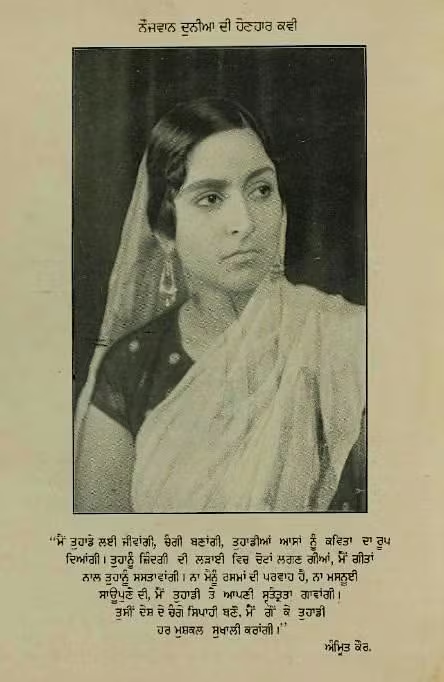
Amrita Pritam: The Fearless Voice of Punjabi Literature
In the tumultuous landscape of 20th-century India, a voice arose from the heart of Punjab—a voice that was at once lyrical and defiant, tender and rebellious. This was the voice of Amrita Pritam, a poet and novelist who charted the unwritten territories of the female psyche and gave utterance to the collective anguish of a nation torn asunder. More than just a writer, she was a cultural phenomenon, a woman who lived and wrote with an unapologetic honesty that challenged the patriarchal bedrock of her time. Her legacy is not merely in the ink of her books but in the courage she inspired, crafting a space for women's experiences in the grand narrative of Indian literature.
Early Life & A Precocious Beginning
Amrita Pritam was born on August 31, 1919, in Gujranwala, Punjab, in what is now Pakistan. The world she entered was one steeped in literary and spiritual traditions. Her father, Kartar Singh Hitkari, was a significant influence; he was a respected scholar, a poet of the Braj Bhasha tradition, and the editor of a literary journal. As a pracharak (preacher) of the Sikh faith, he imbued his household with a deep appreciation for words and their power. This environment became Amrita’s first classroom, a space where literature was not just an art form but a way of life.
This idyllic, book-filled childhood was tragically cut short. When Amrita was just eleven, her mother, Raj Bibi, passed away. The loss was profound, thrusting upon her the responsibilities of an adult and a deep, gnawing loneliness. It was in this crucible of grief that she turned to writing, seeking solace and expression on the blank page. She later recalled this as the moment her childhood ended and her journey as a writer began.
Her literary talent blossomed early. In 1936, at the tender age of sixteen, she published her first collection of poems, Amrit Lehran (Immortal Waves). In the same year, she was married to Pritam Singh, an editor to whom she had been betrothed in childhood. Following the custom, she adopted his name, becoming Amrita Pritam. While her early works were largely romantic and spiritual, the constraints of a conventional life and an emotionally unfulfilling marriage would soon fuel the embers of a rebellion that would define her later masterpieces.
A Voice Forged in the Fires of Partition
The single most transformative event in Amrita Pritam’s life and work was the Partition of India in 1947. The drawing of a line across her beloved Punjab unleashed a maelstrom of violence, displacement, and unspeakable brutality. As a refugee, she made the painful journey from her home in Lahore to the relative safety of Delhi, a journey that millions were undertaking amidst chaos and bloodshed.
What she witnessed—the massacres, the abductions, the sheer scale of human suffering, particularly inflicted upon women—seared itself into her consciousness. This collective trauma demanded a voice, and Amrita Pritam gave it one. On a train journey from Dehradun to Delhi, overwhelmed by grief and despair, she penned the poem that would make her immortal: “Ajj Aakhaan Waris Shah Nu” (Today, I Invoke Waris Shah).
The poem is a heart-rending elegy, an anguished address to the 18th-century Sufi poet Waris Shah, who had immortalized the tragic love of Heer and Ranjha, a symbol of Punjab’s composite culture. Pritam implores him to rise from his grave and witness the state of his land:
“Uth darmandaan deya dardi’ya, uth takk apna Punjab Aj bele laashaan vichhiyaan te lahu di bhari Chenab”
(Arise, O empathizer of the grieving; arise and see your Punjab Today, corpses are strewn across the fields, and the river Chenab is filled with blood)
In this powerful verse, she lamented that the land of Heer had seen a million daughters weep. The poem instantly became an anthem for the shared sorrow of Punjabis on both sides of the new border. It transcended politics and religion, capturing the universal pain of a people whose world had been irrevocably shattered. With this one poem, Amrita Pritam became the definitive literary voice of the Partition.
The Rebel and the Novelist: Exploring the Female Psyche
The fire of Partition transformed her writing. The romanticism of her youth gave way to a stark, potent realism. She became a leading figure in the Progressive Writers' Movement, using her pen to dissect social injustices and question age-old orthodoxies. Her most powerful prose was dedicated to exploring the inner lives of women—their desires, their oppression, and their resilient search for identity.
Her 1950 novel, Pinjar (The Skeleton), remains a landmark in Partition literature. It tells the story of Puro, a young Hindu woman who is abducted by a Muslim man, Rashid, just before the violence erupts. When she finally manages to escape and return to her family, they refuse to accept her, deeming her “polluted.” Abandoned by her own community, she is forced to confront her fate. Pinjar was revolutionary for its time. It refused to engage in the blame games of religious nationalism, focusing instead on the singular tragedy of women whose bodies became territories for men to conquer and whose lives were destroyed by the codes of patriarchal honor. The novel’s unflinching humanity and its critique of societal hypocrisy were later brought to a wider audience through a critically acclaimed film adaptation in 2003.
In 1976, she published her celebrated autobiography, Raseedi Ticket (The Revenue Stamp). The title was a sharp, witty retort to the writer Khushwant Singh, who had once remarked that her life story was so uneventful it could be written on the back of a revenue stamp. In response, she laid her life bare with breathtaking candor. The book was a frank exploration of her spiritual journey, her creative struggles, and her unconventional relationships. It scandalized conservative society but became a touchstone for women seeking a language to articulate their own truths.
Beyond her own writing, Amrita Pritam became a mentor for a new generation. From 1966 to 2002, she and her partner, Imroz, edited “Nagmani,” a monthly Punjabi literary magazine. It was a vital platform that nurtured emerging poets and writers, ensuring that the flame of Punjabi literature continued to burn brightly.
A Life of Unconventional Love
Amrita Pritam lived as she wrote: on her own terms. Her personal life was a testament to her belief in living an authentic existence, free from societal judgment. She left her unhappy marriage to Pritam Singh in 1960, a courageous act for a woman of her time.
Her life was marked by two profound relationships. The first was her passionate but unfulfilled love for the celebrated Urdu poet and lyricist Sahir Ludhianvi. Theirs was a meeting of creative minds, an intense connection that fueled some of her most poignant poetry. In Raseedi Ticket, she famously wrote of sitting with him in silence, and after he left, she would smoke the cigarette butts he had discarded, just to feel close to him. Though their love story never found its worldly culmination, it became a part of literary folklore.
Her second, and most enduring, relationship was with the artist and writer Inderjeet, whom she called Imroz. They met in the late 1950s and forged a partnership that lasted for over four decades until her death. Theirs was a union of equals, built on mutual respect, creative collaboration, and a love that transcended convention. They never married. Imroz was her constant companion, designing the covers for many of her books and dedicating his life to her. Their love story, unconventional and profound, remains an inspiration.
Legacy & Enduring Influence
Amrita Pritam’s contributions to literature earned her immense recognition. In 1956, she became the first woman to win the Sahitya Akademi Award for her poetry collection Sunehade (Messages). In 1982, she was honored with the Bharatiya Jnanpith Award, one of India's most prestigious literary honors, for Kagaz Te Canvas (Paper and Canvas). The nation also recognized her with the Padma Shri in 1969 and the Padma Vibhushan, India’s second-highest civilian award, in 2004. From 1986 to 1992, she served as a member of the Rajya Sabha, the upper house of the Indian Parliament.
Her historical significance is immense. She is widely regarded as the first preeminent female voice in Punjabi literature, a pioneer who broke through the formidable walls of a male-dominated literary tradition. Her work provided a crucial, human-centric counter-narrative to the political histories of Partition, ensuring that the stories of its deepest victims were not forgotten.
After a long illness, Amrita Pritam passed away on October 31, 2005, in Delhi. But her voice remains—in the mournful stanzas of “Ajj Aakhaan Waris Shah Nu,” in the quiet defiance of Puro in Pinjar, and in the fearless honesty of Raseedi Ticket. She remains a feminist icon, a literary titan, and an eternal symbol of a spirit that refused to be silenced, a voice that continues to speak truth to power, long after it has fallen silent.