A Soul in Two Worlds: The Luminous Legacy of Amrita Sher-Gil
In the grand tapestry of 20th-century art, few figures burn as brightly or as briefly as Amrita Sher-Gil. In a career that spanned less than a decade, she forged a revolutionary artistic language that was both deeply personal and profoundly Indian, leaving an indelible mark on the cultural landscape of a nation on the cusp of change. A firebrand of colour and conviction, Sher-Gil was a bridge between two worlds—East and West, tradition and modernity—and her work remains a testament to her restless search for an authentic identity, both for herself and for Indian art.
Her life, cut short at the tender age of 28, has become the stuff of legend. Yet, beyond the myth lies the tangible, powerful legacy of her canvases: portraits and scenes imbued with a deep empathy, a quiet melancholy, and a bold, modern sensibility that continues to captivate and inspire generations.
Early Life & Background: A Synthesis of Cultures
Amrita Sher-Gil was born on January 30, 1913, in Budapest, Hungary, a product of a unique and cosmopolitan union. Her father, Umrao Singh Sher-Gil Majithia, was a Sikh aristocrat from Punjab, a scholar of Sanskrit and Persian with a passion for philosophy and photography. Her mother, Marie Antoinette Gottesmann, was a Hungarian-Jewish opera singer from a well-to-do bourgeois family. This dual heritage would become the central creative tension of Amrita’s life and art, placing her at the confluence of vastly different cultural streams.
Her early years were spent between Hungary and the family’s summer home in the village of Dunaharaszti. Amrita and her younger sister, Indira, were immersed in a world of art, music, and intellectual discourse. Her artistic talent was evident from a young age, and her mother, recognizing her daughter’s precocious gift, actively encouraged it. In 1921, the Sher-Gil family moved to India, settling in the picturesque hill station of Shimla. The vibrant, chaotic, and profoundly different world of India made a lasting impression on the eight-year-old Amrita.
Her formal artistic education, however, would take her back to Europe. In 1929, at the age of sixteen, she moved to Paris, the undisputed epicentre of the art world. She first enrolled at the Académie de la Grande Chaumière and later, in 1930, joined the prestigious École des Beaux-Arts, under the tutelage of the respected academic painter Lucien Simon. Here, she mastered the rigours of academic realism, honing her skills in anatomy, perspective, and composition. Her early works from this period, painted in a distinctly European style, demonstrate a remarkable technical proficiency. She was deeply influenced by European modernists, particularly the Post-Impressionists like Paul Cézanne, Amedeo Modigliani, and especially Paul Gauguin, whose bold use of colour and exploration of ‘primitive’ subjects resonated with her own burgeoning artistic identity.
In 1932, her painting Young Girls earned her an associate membership of the Grand Salon in Paris—a significant honour for a young artist, and the first Indian to receive it. Despite this early success in the West, Sher-Gil felt an increasingly powerful pull towards India. She confessed in letters that she felt a creative stagnation in Europe and believed her true artistic destiny lay in her father's homeland. She wrote of a profound, almost spiritual, need to return, stating, "I can only paint in India. Europe belongs to Picasso, Matisse… India belongs only to me."
Career & Major Contributions: Forging a Modern Indian Vision
Amrita Sher-Gil returned to India in late 1934, a decision that marked the most significant turning point in her life and career. She was now armed with the technical mastery of the West but driven by a mission to interpret the soul of India. She embarked on a journey to discover the artistic traditions of her homeland, seeking a visual language that could express the realities of Indian life as she saw it.
She was initially critical of the prevailing art of the time, particularly the Bengal School of Art led by Abanindranath Tagore. While she respected its attempt to break from Western academicism, she found its style overly sentimental, romanticised, and lacking in the formal strength she had come to admire in European modernism. Her quest was for an art that was not merely revivalist but authentically modern and rooted in the Indian soil.
Her breakthrough came after a transformative journey through Southern India in 1937. Here, she encountered the ancient mural paintings of the Ajanta and Ellora caves and was deeply moved by the vigour and humanity of the art. She was also captivated by the rich traditions of Mughal and Pahari miniature painting. These influences catalysed a radical shift in her style. She abandoned the chiaroscuro and modelling of her European training in favour of flattened perspectives, simplified forms, and large, vibrant fields of colour, reminiscent of Indian murals and miniatures.
This new, powerful synthesis gave birth to what is often called her "South Indian Trilogy," a set of three masterpieces that announced the arrival of a truly modern Indian artist:
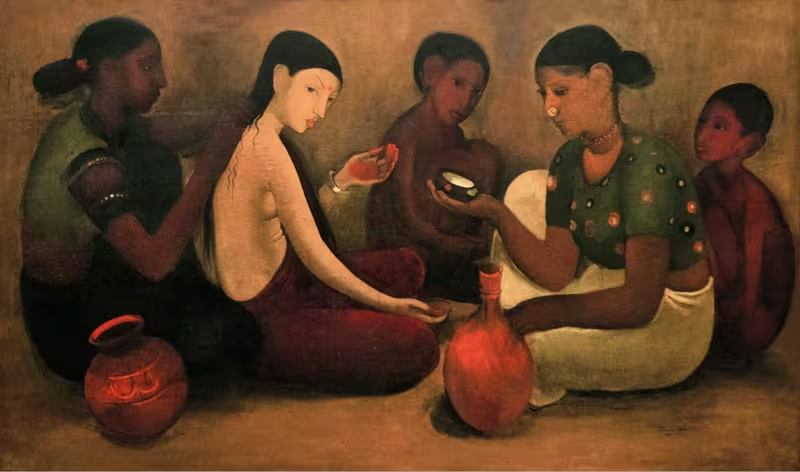
Bride's Toilet (1937): This luminous work depicts a bride being attended to, but Sher-Gil strips the scene of overt celebration. Instead, she infuses it with a deep sense of introspection and melancholy. The rich reds and browns, the gentle, languid forms, and the sombre expressions of the women create a powerful emotional atmosphere that speaks to the quiet interior lives of her subjects.
Brahmacharis (1937): In this painting, she portrays a group of young religious students from a South Indian seminary. Their dark, slender bodies are set against a stark white background, their postures conveying a sense of solemn discipline and contemplation. The composition is bold and rhythmic, demonstrating her ability to blend classical Indian sculptural forms with a modern compositional eye.
South Indian Villagers Going to Market (1937): This canvas captures the grace and dignity of rural life. A procession of figures moves across the canvas, their forms simplified but full of life. The work is a testament to her deep empathy for the common people of India, whom she saw as possessing a silent, profound resilience.
These works, along with others from this period like Group of Three Girls (1935) and The Story Teller (1940), established her unique artistic voice. She focused on the lives of ordinary Indians, especially women and the rural poor, portraying them not as exotic subjects but with a deep, empathetic understanding. Her figures are often imbued with a pervasive sense of sadness and stillness, a reflection, perhaps, of her perception of their difficult lives. She painted their silent existence with an honesty and gravity that was unprecedented in Indian art.
Legacy & Influence: A National Treasure
Amrita Sher-Gil’s life was tragically cut short on December 5, 1941, in Lahore, where she had moved with her husband, Dr. Victor Egan. She fell gravely ill and passed away at the age of 28, just days before the opening of her first major solo exhibition in the city. The exact cause of her death remains undocumented, adding to the enigmatic aura that surrounds her.
Though her career was brief, her impact was monumental. Sher-Gil is universally regarded as a pioneer of modern art in India, a foundational figure whose work created a paradigm shift. Her historical significance lies in her successful synthesis of Western modernist principles with the aesthetics and spirit of traditional Indian art. She demonstrated that an Indian artist could be modern without being derivative, and traditional without being revivalist.
Her lasting influence is multi-faceted:
A New Visual Language: She provided a powerful alternative to both the academic realism taught in British art schools and the romanticism of the Bengal School. Her bold use of colour, flattened forms, and emotionally resonant subject matter opened up new expressive possibilities for Indian artists.
Inspiration for a Generation: Her work served as a crucial source of inspiration for the next generation of Indian artists, including the influential Progressive Artists' Group, which formed in Bombay (now Mumbai) a few years after her death. Artists like M.F. Husain and Tyeb Mehta acknowledged her profound influence.
A Focus on the Indian Subject: By turning her gaze to the villages and the lives of the poor, she brought a new social and humanistic consciousness to Indian art. She painted the India she saw—its poverty, its resilience, and its quiet dignity—with an unflinching and compassionate eye.
Today, Amrita Sher-Gil is remembered as one of India's most important artists of the 20th century. In 1976, her works were declared National Art Treasures by the Government of India, ensuring that the vast majority of her oeuvre remains within the country. The National Gallery of Modern Art (NGMA) in New Delhi houses the single largest collection of her paintings, a permanent tribute to her genius.
Often referred to as India’s “Frida Kahlo” for her striking self-portraits, unconventional lifestyle, and revolutionary artistic vision, Amrita Sher-Gil’s legacy transcends her art. She represents the spirit of a modern, independent-minded woman who dared to forge her own path. Her life and work are a powerful narrative of identity, belonging, and the relentless pursuit of an artistic truth that could speak to, and for, a nation.