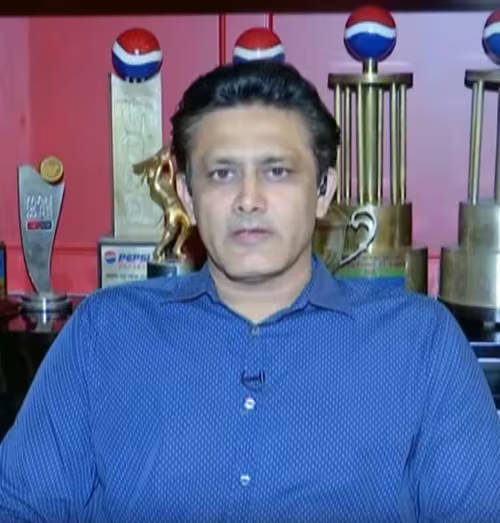
Anil Kumble: The Jumbo Heart of Indian Cricket
In the grand pantheon of Indian cricket, few figures command as much reverence and affection as Anil Kumble. He was not a classical artist in the mould of a Bishan Singh Bedi, nor did he possess the beguiling mystery of a Shane Warne. Kumble was something else entirely: an engineer of victory, a relentless practitioner of precision, and a warrior whose spirit was as unbreakable as the will of a nation. As India's highest-ever wicket-taker in both Test and One Day International cricket, his legacy is etched in staggering numbers. Yet, to define him by statistics alone would be to miss the essence of a man who, for nearly two decades, was the lion-hearted soul of India's bowling attack.
Early Life & The Making of a Cerebral Cricketer
Anil Kumble was born on October 17, 1970, in Bengaluru, Karnataka, to Krishna Swamy and Saroja. His father was a chemical engineer, and the household environment fostered a deep appreciation for discipline, education, and methodical thinking. This upbringing would prove to be a cornerstone of his cricketing persona. Unlike many of his peers who pursued cricket from a very young age to the exclusion of all else, Kumble balanced his passion with a rigorous academic schedule.
He attended Holy Saint English School and later National College Basavanagudi. His formative years were spent on the streets of Bengaluru, where he first started as a medium-pacer. It was only in his teens that he made the switch to leg-spin, a decision that would alter the course of Indian cricket history. He went on to earn a degree in Mechanical Engineering from Rashtreeya Vidyalaya College of Engineering (RVCE) in 1992. This background gave him a unique, analytical approach to the art of spin bowling. He was less a magician, more a strategist, meticulously plotting a batsman's downfall with angles, variations in pace, and unerring accuracy.
His teammates affectionately nicknamed him "Jumbo," not just for his surprisingly quick deliveries that seemed to 'take off' like a jumbo jet, but also, as some have noted, for his large feet. The name stuck, becoming a term of endearment for a giant of the game.
Career & Major Contributions: An Architect of Victories
Kumble's first-class debut for Karnataka in 1989 was impressive, and it wasn't long before the national selectors took notice. He made his ODI debut against Sri Lanka in April 1990 and his Test debut against England in Manchester later that year. In his early years, he was often criticized for not being a big turner of the ball. Pundits and purists questioned his style. But Kumble, with his engineer's mind, turned his perceived limitations into his greatest strengths.
Instead of prodigious spin, he relied on pace, bounce, and a deadly arsenal of variations—the top-spinner that hurried onto the batsman, the flipper that skidded through low, and a well-disguised googly. He proved that one did not need to be a classical leg-spinner to be a world-beating one.
The Hero of Eden Gardens (1993)
One of his earliest moments of glory came in the final of the Hero Cup at Eden Gardens, Kolkata, on November 27, 1993. Playing against the West Indies, India had posted a modest total. The visitors seemed to be cruising until Kumble was brought into the attack. In a sensational spell of bowling, he dismantled the West Indian middle and lower order, finishing with the incredible figures of 6 wickets for just 12 runs. It was an Indian record that stood for over two decades and announced his arrival as a genuine match-winner on the international stage.
The Perfect 10: A Feat for the Ages (1999)
The single greatest achievement of Anil Kumble's career, and one of the most iconic moments in cricket history, occurred at the Feroz Shah Kotla ground in Delhi. On February 7, 1999, during the second Test against arch-rivals Pakistan, Kumble achieved the seemingly impossible. He took all ten wickets in a single Test innings.
Pakistan, chasing 420 to win, had started solidly with an opening partnership of 101. The match seemed to be drifting towards a draw. Then, Kumble was introduced. He first trapped Shahid Afridi lbw. Then Ijaz Ahmed. The wickets began to tumble in a mesmerising procession. With each dismissal, the roar of the Delhi crowd grew louder, and a palpable sense of history began to build. As he reached his eighth and ninth wickets, his teammates, particularly Sadagoppan Ramesh at silly point, were almost comically cautious not to take a catch off another bowler. The entire nation held its breath. The final wicket, that of captain Wasim Akram, was sealed with a catch by VVS Laxman. Kumble finished with figures of 10 for 74, becoming only the second man in history, after England's Jim Laker, to achieve a 'Perfect 10'. It was a moment that transcended sport, a testament to his skill, perseverance, and the magic of Test cricket.
The Warrior with a Broken Jaw (2002)
If the 'Perfect 10' showcased his skill, an incident in Antigua in 2002 defined his character. During the fourth Test against the West Indies, Kumble was struck by a vicious bouncer from Mervyn Dillon while batting. He spat out blood but continued to bat for another 20 minutes. It was later revealed his jaw was fractured. With the match evenly poised, a lesser man would have retired to the hospital. But Kumble was not a lesser man.
To everyone's astonishment, he emerged from the dressing room with his head heavily bandaged, ready to bowl. For 14 consecutive overs, he bowled with immense pain, his face a mask of determination. In a moment of pure cricketing theatre, he produced a delivery that trapped the legendary Brian Lara plumb in front. The image of Kumble, jaw broken but spirit intact, appealing for the wicket is one of the most enduring symbols of courage in sporting history. He had proven that his heart was even bigger than his talent.
Captaincy and the Sydney Stand (2008)
Kumble was appointed India's Test captain late in his career, in 2007. His leadership was immediately tested during the fractious and controversial tour of Australia in 2007-08. The second Test in Sydney was marred by a series of poor umpiring decisions and the infamous "Monkeygate" scandal involving Harbhajan Singh and Andrew Symonds.
With his team feeling wronged and demoralised, Kumble stood up as a statesman. In the post-match press conference, he delivered a line that resonated across the cricketing world: "Only one team was playing in the spirit of the game." His calm, dignified, and firm handling of the situation earned him global respect and held the team together. He then led them to a stunning, morale-boosting victory in the next Test at Perth, breaking Australia's 16-match winning streak. It was a masterclass in leadership under fire.
His career was a crescendo of milestones: he surpassed Kapil Dev to become India's leading Test wicket-taker in 2005, became the first Indian and third bowler ever to claim 600 Test wickets in 2008, and even scored a gritty maiden Test century against England at The Oval in 2007. He retired from international cricket in 2008, fittingly at his home ground in Delhi, leaving behind a void that seemed impossible to fill.
Legacy & Influence: The Gentleman Fighter
Anil Kumble's legacy is multifaceted. Statistically, he is an all-time great. With 619 Test wickets and 337 ODI wickets, he remains India's most successful bowler by a staggering margin. He was the anchor of the Indian bowling attack for over a decade, a reliable workhorse who could bowl tirelessly on unresponsive pitches and a lethal predator on wearing fourth and fifth-day surfaces.
Beyond the numbers, his influence lies in how he redefined his craft. He demonstrated that success in spin bowling was not solely dependent on a classical action or ripping turn. It could be achieved through intelligence, relentless accuracy, subtle variations, and an indomitable will. He was the thinking man's cricketer, constantly plotting and setting up batsmen, earning their wickets through attrition and guile.
Post-retirement, his contributions to the game have continued. He served as the President of the Karnataka State Cricket Association and as the chairman of the ICC Cricket Committee, shaping the laws and spirit of the game globally. He also had a successful, though brief, tenure as the head coach of the Indian national team from 2016 to 2017, during which the team achieved the number one Test ranking.
Today, Anil Kumble is remembered as the ultimate team man, a gentleman who played the game hard but fair, and a fighter who never knew when he was beaten. He is the embodiment of perseverance—the engineer who applied logic to his art, the warrior who bowled with a broken jaw, and the captain who stood for integrity. In the story of Indian cricket, he is not just a chapter; he is a foundational pillar, a symbol of the quiet, unyielding strength that defines a true champion.