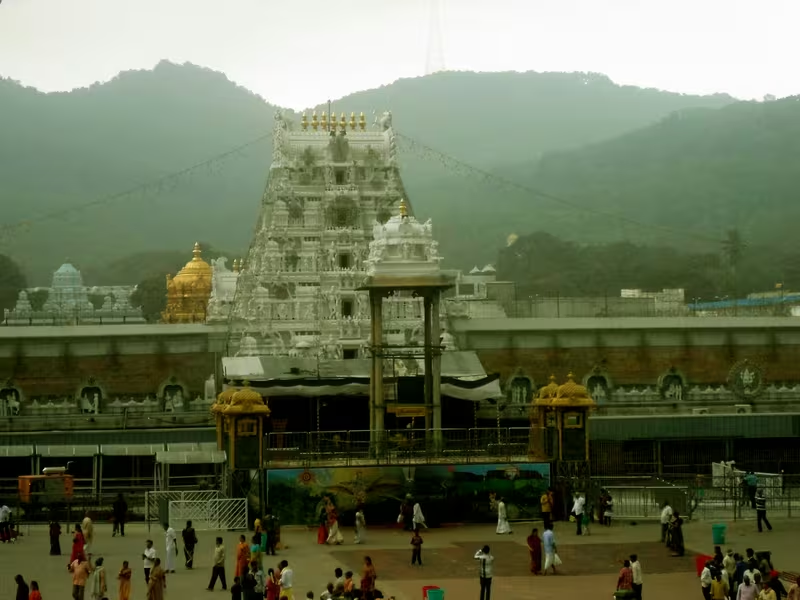
In the rich tapestry of India's Bhakti movement, few threads shine with the luminosity and enduring grace of Tallapaka Annamacharya. A 15th-century mystic, poet, and composer, he was a divine conduit whose life was a singular, unwavering song of devotion to his chosen deity, Lord Venkateswara of Tirumala. Living for an astonishing 95 years (1408-1503 CE), he composed a staggering corpus of devotional songs, or sankirtanas, that not only defined an era of Telugu literature but also laid a foundational stone for the grand edifice of Carnatic music. Revered as the Pada Kavita Pitamaha (Grandsire of song-poetry), Annamacharya’s legacy is not merely a historical footnote; it is a living, breathing tradition that echoes daily on the sacred Seven Hills and in the hearts of millions.
The Dawn of a Divine Voice: Early Life and Calling
Annamacharya was born in 1408 CE in the village of Tallapaka, in what is now the Kadapa district of Andhra Pradesh, to a scholarly Nandavarika Brahmin family. His parents, Narayana Suri and Lakkamamba, are said to have been devout followers of Lord Vishnu. Hagiographical accounts, which form the bulk of our understanding of his early life, suggest that his birth was no ordinary event. Tradition holds that he was an incarnation of Nandaka, the divine sword of Lord Vishnu, sent to earth to sing the glories of the Lord in an age of waning faith.
From his earliest years, the boy exhibited a profound disinterest in worldly affairs and an overwhelming spiritual inclination. He was a gifted child, absorbing the scriptures and philosophical texts with remarkable ease. However, his heart was not in dry scholarship but in ecstatic devotion. The pivotal moment of his young life, according to tradition, came in the form of a divine vision. While still a boy, he is said to have been visited by Goddess Alamelu Manga, the consort of Lord Venkateswara, who blessed him and instructed him to dedicate his life to composing songs in praise of her Lord on the Tirumala hills.
This divine command set him on his path. At the young age of 16, he left his home and embarked on a pilgrimage to Tirumala, a journey that would define the rest of his existence. Legend holds that upon reaching the foothills, weary and lost, he was guided by the Goddess Alamelu Manga herself, who appeared as an old woman. She fed him and revealed a hidden path, urging him to continue his ascent. Upon reaching the sacred temple, another famous legend recounts that he found the doors shut for the night. Unfazed, the young devotee sat before the closed gates and spontaneously composed his first song, a heartfelt plea to the Lord. As his voice soared, the heavy temple doors are said to have swung open on their own, granting him his first divine audience.
The Poet of the Seven Hills: A Life of Devotion and Composition
Annamacharya's arrival at Tirumala marked the beginning of his life's true work. He was formally initiated into the Sri Vaishnava tradition by the great sage Adivan Sathakopa Yatheendra of the Ahobila Matham, a pivotal event that provided him with a firm philosophical grounding for his devotional expressions. He spent the vast majority of his long life at Tirumala, serving the deity not with rituals or priestly duties, but through a continuous stream of musical and poetic offerings—a practice known as sankeertana yagnam (worship through song).
His discipline was as remarkable as his talent. It is believed that he composed at least one sankirtana every single day, a vow he maintained throughout his life. This relentless creative energy resulted in an oeuvre of epic proportions. His grandson, Tallapaka Chinnanna, documented in the biography Annamacharya Charitramu that Annamacharya composed over 32,000 sankirtanas, in addition to other literary works like the Sringara Manjari, Venkateswara Mahatmyam, and a translation of the Ramayana in the form of a dwipada (couplet) poem.
His service at Tirumala was not merely personal; he institutionalized musical worship within the temple. He established a system where his songs were integrated into the daily and weekly rituals (sevas) for the Lord, a tradition that continues to this day. His compositions became the official soundtrack to the divine proceedings, sung during moments of awakening the deity, offering food, and lulling the Lord to rest.
A famous anecdote illustrates the purity of his devotion. His fame reached the ears of Saluva Narasimha Deva Raya, the ruler of the region and a patron of the Tirumala temple. Deeply moved by Annamacharya's compositions, the king invited him to his court and requested that the poet compose a song in his praise. Annamacharya politely but firmly refused, stating, "The tongue that has sung the praises of the supreme Lord will not stoop to praise a mortal man." This unwavering commitment to his divine subject over any earthly power cemented his status as a true saint, whose art was a sacred offering, not a commodity for patronage.
The Anatomy of a Sankirtana: Annamacharya's Literary and Musical Genius
Annamacharya's most significant contribution was the sankirtana. He is considered a pioneer of this musical form, which he structured with a pallavi (refrain) followed by one or more charanams (stanzas). This structure, simple yet elegant, became the prototype for the later kriti form, which was perfected by the Trinity of Carnatic music—Tyagaraja, Muthuswami Dikshitar, and Syama Sastri—three centuries later.
He masterfully classified his thousands of compositions into two distinct categories, reflecting the dual paths of devotion:
Adhyatma Sankirtanalu (Spiritual Compositions): These songs are deeply philosophical, exploring themes of bhakti (devotion), vairagya (detachment), morality, and the soul's yearning for the divine. They are filled with profound truths from the Upanishads and Puranas, yet articulated in a language so simple and direct that it could be understood by anyone. In songs like Brahmamokkate Para Brahmamokkate, he championed social equality, declaring that the divine essence is the same in all beings, regardless of caste or creed.
Sringara Sankirtanalu (Romantic Compositions): These compositions explore the theme of madhura bhakti (devotion through the metaphor of romantic love). In these songs, Annamacharya casts himself in the role of the nayika (the female beloved, often identified with Goddess Alamelu Manga), pining for her divine lover, the nayaka (Lord Venkateswara). This genre allowed him to express the most intimate and passionate aspects of devotion—longing, jealousy, union, and separation—in a rich, lyrical, and emotionally resonant style.
His choice of language was revolutionary. While he was a master of Sanskrit, the scholarly language of the elite, he chose to compose the vast majority of his songs in colloquial Telugu, the language of the common person. This conscious decision democratized spirituality, making the highest philosophical and devotional sentiments accessible to all. His Telugu is fluid, idiomatic, and filled with the rhythms of everyday speech, transforming profound theology into heartfelt poetry.
A Legacy Etched in Copper: Rediscovery and Enduring Influence
For nearly 400 years after his death in 1503, the sheer scale of Annamacharya's work was lost to the world. While a few of his songs survived in oral tradition, the vast majority were believed to be gone forever. His son, Pedda Tirumalacharya, and grandson, Chinna Tirumalacharya, had taken the extraordinary step of having his compositions painstakingly inscribed onto thick copper plates. These plates were then stored and sealed within a small, hidden chamber opposite the Hundi (offering pot) in the Tirumala temple, a room known as the Sankirtana Bhandaram.
In a moment of monumental historical and cultural significance, this hidden treasure was rediscovered in 1922. When the chamber was opened, researchers found stacks upon stacks of these copper plates, containing nearly 12,000 of his original 32,000 compositions. It was one of the most important literary discoveries in modern Indian history.
The rediscovery sparked a renaissance of interest in Annamacharya's work. The Tirumala Tirupati Devasthanams (TTD), the governing body of the temple, established the Annamacharya Project in 1978 to preserve, study, and propagate his legacy. Since the original tunes for the songs were lost over the centuries, the TTD commissioned eminent musicians and scholars, such as Dr. M. Balamuralikrishna, Nedunuri Krishnamurthy, and Kadayanallur Venkatasubramaniam, to set the lyrics to classical Carnatic ragas. This monumental effort brought Annamacharya's poetry back to life, making his sankirtanas a central part of the modern Carnatic concert repertoire.
Today, Annamacharya's influence is pervasive:
- In Music: His compositions are sung by leading Carnatic vocalists and are a staple of music festivals and concerts worldwide. The melodic settings, though modern, have become inseparable from his lyrics, creating a new, yet authentic, tradition.
- In Worship: His songs remain an integral part of the daily rituals at the Tirumala temple, from the Suprabhatam that awakens the Lord to the Pavalimpu Seva that lulls him to sleep.
- In Culture: He is celebrated as a cultural icon in the Telugu-speaking world and beyond. His birth anniversary, or Jayanti, is celebrated with great fervor, and his statues adorn the sacred grounds of Tirumala, a constant reminder of the saint who saw God not as a distant monarch, but as an intimate companion.
Tallapaka Annamacharya was more than a composer; he was a visionary who saw music as the most direct path to the divine. His life was a testament to the power of a single, focused devotion. Through his simple words and profound emotions, he built a timeless bridge of song between the human and the divine—a bridge that continues to carry millions of souls to the feet of the Lord of the Seven Hills.