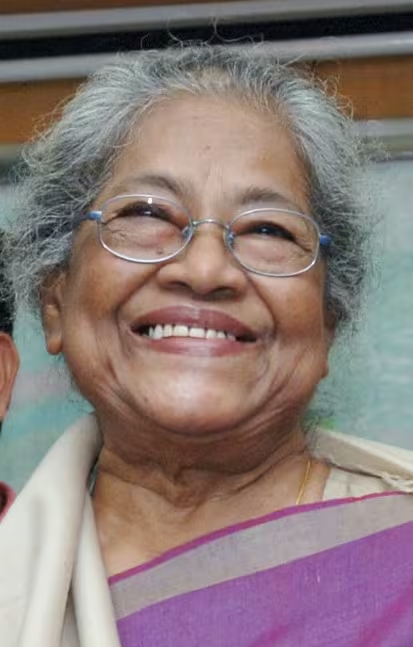
Arpita Singh: A Universe on Canvas
In the grand tapestry of modern Indian art, few threads are as vibrant, intricate, and deeply personal as those woven by Arpita Singh. A storyteller who eschews words for the dense, lyrical language of paint, Singh has spent over six decades creating a universe entirely her own. Her canvases are not mere windows into a scene but sprawling, map-like topographies of the human, and specifically the female, psyche. They are bustling, dream-like worlds where the mundane collides with the mythic, where teacups and flowers share space with guns and floating figures, chronicling the joys, anxieties, and resilient spirit of women in a changing India. Arpita Singh is more than a painter; she is a cartographer of the interior life, and her work remains a powerful, enduring testament to the richness of everyday existence.
The Shadow of History: Early Life and Formation
Born in 1937 in Baranagar, a suburb of Calcutta in West Bengal, Arpita Singh’s childhood was framed by the seismic shifts of Indian history. The looming clouds of Partition cast a long shadow over her formative years. In 1946, as communal tensions escalated, her family left their home for Calcutta, and a year later, the cataclysm of 1947 forced them to migrate once more, this time to Delhi. This experience of displacement, of losing a home and being uprooted, instilled in her a profound sense of observation and an understanding of the precariousness of stability—themes that would later surface in her art, often cloaked in allegory and personal symbolism.
Delhi, the newly anointed capital of an independent India, became her home. It was a city brimming with the energy of nation-building, a crucible of artistic and intellectual ferment. It was here that Singh's artistic inclinations found fertile ground. From 1954 to 1959, she enrolled at the School of Art, Delhi Polytechnic (now the College of Art, New Delhi). The institution was a hub for some of the most influential figures in Indian modernism, and she studied under artists like B.C. Sanyal and Sailoz Mookherjea. This was a period of rigorous training and exploration, where she absorbed the tenets of Western modernism while remaining deeply connected to the visual traditions of her own culture.
Upon graduating, Singh did not immediately pursue a career as a full-time painter. Instead, she took a position that would prove unexpectedly influential: she joined the Weaver's Service Centre, a government initiative under the legendary Pupul Jayakar, aimed at reviving and modernizing India's handloom industry. Working as a textile designer, she immersed herself in the world of patterns, textures, and traditional motifs. This experience honed her sense of design and composition, instilling a deep appreciation for the decorative and the narrative power of folk art. The intricate kantha embroidery of Bengal, with its running stitches creating stories on cloth, and other indigenous textile traditions would echo in the richly detailed, patterned surfaces of her later paintings.
Weaving a New Language: Career and Artistic Evolution
In the early 1960s, Arpita Singh, along with fellow Delhi Polytechnic alumni including Paramjit Singh and Manjit Bawa, formed a short-lived but significant artists' collective called 'The Unknowns'. It was a declaration of intent—a group of young artists seeking to forge their own path, distinct from the established schools of Bombay or Bengal. While the group was not defined by a single manifesto, it represented a shared desire for artistic independence and mutual support.
A pivotal shift in Singh’s artistic journey occurred in the early 1970s. After a period of working in a more abstract vein, she turned decisively towards figuration. This was not a return to academic realism but the birth of a unique figurative language that would become her signature. Her first solo exhibition, held in 1972 at the Kunika Chemould Gallery in New Delhi, marked her arrival as a distinct and compelling new voice.
The Signature Style: Mapping the Interior World
Arpita Singh’s canvases from this period onwards defy simple categorization. They are immediately recognizable for several key characteristics:
- A Topographical Perspective: She often employs a flattened, bird's-eye view, as if looking down upon a map. This eliminates conventional perspective, allowing her to arrange figures, objects, and landscapes with a dream-like freedom. The canvas becomes a field of activity where multiple narratives can unfold simultaneously.
- Horror Vacui (Fear of Empty Space): Her compositions are characteristically dense and teeming with detail. Every inch of the surface is activated with figures, patterns, text, and decorative motifs. This creates a vibrant, pulsating energy, suggesting a world overflowing with life, memory, and thought.
- A Luminous Palette: Singh is a master of color. She is particularly known for her use of brilliant, buoyant pinks and blues, which suffuse her paintings with a sense of both whimsy and melancholy. Her palette is not merely decorative; it is emotional, setting the psychological tone of each piece.
- A Personal Lexicon of Motifs: Her work is populated by a recurring cast of characters and symbols. Central to this world is the figure of the woman—often middle-aged, engaged in domestic chores, dreaming, or simply existing. Around her orbit everyday objects: chairs, tables, teacups, clocks, and cars. These are juxtaposed with more ominous symbols like guns and airplanes, as well as elements from nature like flowers and trees. This blend of the domestic and the potentially violent creates a palpable tension, reflecting the complexities of life.
Major Works and Enduring Themes
Throughout her career, Singh has focused on the world of women, particularly the experiences of the middle-class urban woman. Her paintings are intimate diaries that explore domesticity not as a site of confinement, but as a rich stage for emotional and psychological drama. She portrays the daily rituals, the private thoughts, the sensuality, the process of aging, and the quiet resilience of her female subjects.
One of her most celebrated works, My Mother (1993), is a deeply moving and unsentimental portrait of aging and memory. It depicts her mother, surrounded by the objects of her life, rendered with a tenderness that is both poignant and powerful. The work transcends the personal to become a universal meditation on matriarchal figures and the passage of time.
Her monumental triptych, Wish Dream (2001), is a magnum opus that encapsulates her artistic vision. Spanning over thirteen feet, it is a sprawling, panoramic narrative that weaves together personal and collective histories. Figures of women, cars, planes, and mythological beings float across a vibrant blue background, creating a phantasmagorical landscape of modern life. In 2010, this work set a new auction record for a modern Indian female artist, cementing her status in the art market and bringing her work to wider international attention.
While her focus is often on the interior world, Singh is not detached from external realities. Her work often responds to the social and political climate. Following a tragic incident, she painted a series dedicated to Ayesha Kidwai, a young woman who was a victim of violence. These works show her capacity to channel collective grief and outrage through her deeply personal visual language, transforming a public tragedy into a powerful, empathetic statement.
A Canvas of Her Own: Legacy and Influence
Arpita Singh's legacy is that of a quiet revolutionary. In a mid-20th century Indian art scene dominated by the grand, often masculine, narratives of the Progressive Artists' Group and other collectives, she carved a path that was resolutely her own. She did not align herself with any major 'ism' but instead developed a style that drew from a diverse well of influences—from Bengali folk painting and kantha embroidery to the works of Western modernists like Marc Chagall—and synthesized them into something entirely new.
Her most profound contribution has been the centering of the female experience. She brought the domestic, the everyday, and the interior lives of women from the periphery to the very heart of her artistic practice. She painted women not as idealized muses but as complex, thinking, feeling individuals, navigating the joys and sorrows of their lives. In doing so, she gave a powerful visual voice to a perspective that had long been marginalized in the canon of Indian art.
Her influence can be seen in the work of subsequent generations of Indian artists who have embraced figuration, narrative, and a more personal, introspective approach to art-making. She demonstrated that the small, intimate details of life could be the subject of profound and monumental art.
Over the decades, Arpita Singh has received widespread recognition for her contributions. She has been honored with prestigious awards, including the Kalidas Samman in 1998 and the Padma Bhushan, India's third-highest civilian honor, in 2011. Her work is held in the permanent collections of major institutions worldwide, including the National Gallery of Modern Art in New Delhi, the Victoria and Albert Museum in London, and the Kiran Nadar Museum of Art in Delhi.
Still actively painting in her eighties, Arpita Singh remains one of India's most revered living artists. Her work is a vibrant, ongoing conversation about life, memory, and the enduring power of the human spirit. Each canvas is an invitation into a world that is at once familiar and fantastical, a meticulously crafted map of what it means to see, to feel, and to dream.