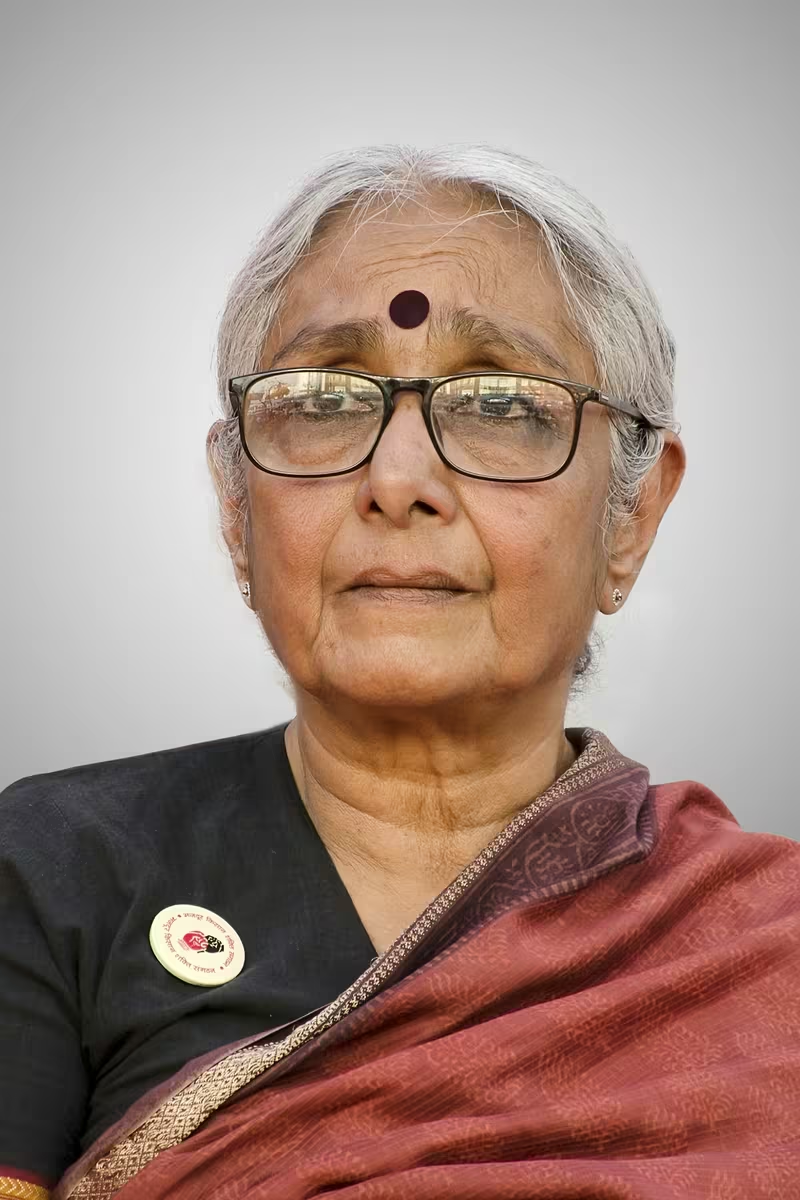
Aruna Roy: The Conscience of a Nation
In the grand tapestry of modern Indian history, some figures stand out not for the political power they wielded, but for the power they returned to the people. Aruna Roy is one such towering figure. A former officer of the elite Indian Administrative Service (IAS), she famously traded a life of bureaucratic privilege for the dusty lanes of rural Rajasthan, dedicating her life to empowering the most marginalized. Her journey is a testament to the idea that true change often begins not in the corridors of power, but in the collective voice of a village square. She is, above all, the architect of a movement that fundamentally altered the relationship between the Indian citizen and the state, arming them with their most potent tool for accountability: the Right to Information.
Early Life and Education
Aruna Jayaram was born on May 26, 1946, in Chennai (then Madras) into a family deeply engaged with the intellectual and political currents of the time. Her parents, Hema and H.D. Jayaram, were progressive thinkers. Her father, a lawyer and government servant, had been involved in the independence movement, instilling in his children a sense of public service and social justice from a young age.
Her upbringing was cosmopolitan and intellectually stimulating. She received her early education at Kalakshetra in Chennai and later at the Aurobindo Ashram in Pondicherry, environments that nurtured both creativity and a deep philosophical grounding. She went on to study English Literature at Indraprastha College, Delhi University, graduating in 1967. Surrounded by the idealism and debates of a newly independent India, Aruna, like many of her generation's brightest, saw a future in serving the nation through its highest echelons.
A Civil Servant's Awakening: From IAS to Activism
In 1968, Aruna Roy achieved what was then—and still is—a remarkable feat: she passed the civil services examination and joined the Indian Administrative Service (IAS). The IAS was considered the "steel frame" of India, the machinery through which the government's vision would be translated into reality. For a young, idealistic woman, it was the ultimate platform to effect change.
However, her seven years in the service (1968-1974) were a period of profound awakening and growing disillusionment. Stationed in various posts, she witnessed firsthand the immense chasm between policy-making in air-conditioned offices and the harsh realities of life for the rural poor. She saw how the bureaucratic system, with its rigid hierarchies and procedural red tape, often became an obstacle rather than a facilitator of justice. The very structure designed to serve the people seemed insulated from their needs and deaf to their voices.
This experience led to a fundamental crisis of conscience. Could she truly serve the people from within a system that seemed so disconnected and, at times, apathetic? In 1974, she made a decision that shocked her peers and set the course for the rest of her life: she resigned from the IAS. It was a conscious and deliberate choice to step outside the framework of state power and work directly with the people she had intended to serve.
Her first step into this new world was joining the Social Work and Research Centre (SWRC) in Tilonia, Rajasthan, a groundbreaking organization founded by her husband, Sanjit 'Bunker' Roy. At the SWRC, which would later become known as the Barefoot College, she gained invaluable experience in grassroots development, working with rural communities to find sustainable, local solutions to their problems. This period solidified her belief that true empowerment comes not from top-down government schemes, but from strengthening the capacity of people to control their own destinies.
The Birth of Mazdoor Kisan Shakti Sangathan (MKSS)
After several years in Tilonia, Aruna Roy felt a pull to engage more directly with issues of justice and political rights. In 1987, along with her colleagues Nikhil Dey and Shankar Singh, she moved to the small, impoverished village of Devdungri in Rajasthan’s Rajsamand district. They lived among the people, sharing their struggles and earning their trust.
It was here, in 1990, that they formally established the Mazdoor Kisan Shakti Sangathan (MKSS), which translates to the "Workers and Peasants Strength Union." The MKSS was not a conventional NGO; it was a people's organization, a collective platform for the poor to fight for their rights. Its core philosophy was simple but revolutionary: ordinary people possess the wisdom and the right to govern themselves, and their collective strength is the most powerful force for change.
The initial battles of the MKSS were centered on a seemingly mundane issue: the non-payment of minimum wages to workers on government-run public works projects. These projects, meant to provide drought relief, were rife with corruption. Contractors and officials would list fake names ("ghost workers") on muster rolls, siphon off funds, and pay villagers far less than the legally mandated wage. When the MKSS tried to protest, they were met with a wall of bureaucratic denial. Officials would wave files and ledgers at them, claiming the records were accurate. The villagers knew they were being cheated, but they had no way to prove it. The official documents that held the truth of the corruption were kept secret, locked away in government offices.
The Fight for Transparency: The Right to Information Movement
This struggle over muster rolls sparked a profound realization within the MKSS. They understood that the fight for fair wages, for food, for dignity, was fundamentally a fight for information. The government's secrecy was the shield behind which corruption thrived. If they could get access to those official records—the bills, the vouchers, the muster rolls—they could expose the lies. This simple, powerful idea gave birth to one of modern India's most significant social movements and a slogan that would echo across the country: "Hamara Paisa, Hamara Hisab" (Our Money, Our Accounts).
To break through the wall of secrecy, the MKSS pioneered a revolutionary tool of democratic action: the Jan Sunwai, or Public Hearing. The process was brilliant in its simplicity. Through a combination of public pressure, persistence, and help from sympathetic insiders, the MKSS would manage to get copies or certified extracts of official records for a particular public works project. They would then call a village-wide gathering.
In the middle of the village square, an MKSS activist would read the official records aloud: the names of the people listed as workers, the amount they were supposedly paid, the materials that were supposedly purchased. The effect was electric. Villagers would stand up and expose the fraud in real-time. "I am on this list, but I only received half this amount!" one would cry. "My name is on this list, but I was out of the village for a month!" another would shout. "This bill says they bought 100 bags of cement, but we only saw 20!" a third would attest.
The Jan Sunwai transformed abstract corruption into a tangible, public reality. It was a social audit conducted by the people themselves. The public shaming was a powerful deterrent for corrupt officials, and in many cases, it led to the return of siphoned money. More importantly, it was an electrifying experience of empowerment for communities that had long been voiceless.
This grassroots movement quickly gained momentum. The demand for transparency was no longer just about muster rolls; it was about the right of every citizen to know how they are being governed. In 1996, the MKSS organized a historic 40-day dharna (sit-in protest) in the city of Beawar, demanding a state-level Right to Information law. The protest drew national attention and galvanized civil society across India. That same year, Aruna Roy, along with other prominent activists and intellectuals, helped form the National Campaign for the People's Right to Information (NCPRI) to spearhead the fight at the national level.
The relentless pressure from the ground up began to yield results. In 2000, Rajasthan became one of the first states to pass an RTI law. The movement continued to build, and Aruna Roy, as a member of the National Advisory Council (NAC) under the UPA government, played a pivotal role in drafting and advocating for a strong central law. Finally, after nearly a decade of struggle, the Parliament of India passed the historic Right to Information Act in 2005. It was a monumental victory for democracy, a law born not in a committee room but in the villages of Rajasthan, a direct outcome of the MKSS's struggle.
Other Notable Work and Campaigns
Aruna Roy's work did not stop with the RTI. She saw transparency as a foundational right that enables the realization of other crucial socio-economic rights. Her work on the National Advisory Council was instrumental in the formulation and passage of another landmark piece of legislation: the Mahatma Gandhi National Rural Employment Guarantee Act (MGNREGA) in 2005. This Act guaranteed 100 days of wage employment to every rural household, creating a social safety net of unprecedented scale. For Roy, RTI and NREGA were two sides of the same coin: NREGA provided the right to work, and RTI provided the tools to ensure the work was delivered without corruption.
She has also been a leading voice in several other people's movements, including the Right to Food Campaign and the Pension Parishad, which campaigns for a universal, non-contributory pension for the elderly. Her activism is always rooted in the principle of ensuring a life of dignity for the most vulnerable.
Her commitment to her principles has often put her at odds with the government she once served. In 2013, she resigned from the NAC to protest the UPA government's failure to implement fair minimum wages for NREGA workers, demonstrating that her allegiance lies not with any political party, but with the people's movements she represents.
Awards and Recognition
Aruna Roy's immense contributions have been recognized globally. In 2000, she was awarded the prestigious Ramon Magsaysay Award for Community Leadership, often considered Asia's Nobel Prize. The citation celebrated her for "empowering Indian villagers to claim what is rightfully theirs by law." In 2010, she received the Lal Bahadur Shastri National Award for Excellence in Public Administration. In 2011, Time magazine named her one of the 100 most influential people in the world.
True to her principles, she has also been known to refuse state honors. She politely declined the Padma Vibhushan, one of India's highest civilian awards, stating that as an activist in a people's movement, she could not accept an award from the state whose actions she and her colleagues often had to contest.
Legacy and Continuing Influence
Aruna Roy's legacy is etched into the very fabric of Indian democracy. The Right to Information Act has been used by millions of citizens—from journalists uncovering multi-billion dollar scams to villagers demanding their ration cards—to hold power accountable. It has fostered a culture of questioning and transformed the citizen from a passive recipient of governance to an active participant.
Her life's work with the MKSS serves as an enduring model for grassroots mobilization, proving that sustained, non-violent, and collective action can force even the most powerful institutions to bend to the will of the people. She has consistently championed the idea of collective leadership, always emphasizing that movements are built by the tireless efforts of many, not the charisma of a single individual.
Today, Aruna Roy remains one of India's most respected and fearless public intellectuals. She continues to be a vocal advocate for democratic rights, social justice, and the protection of dissent. In an era of growing centralization of power, her voice serves as a powerful reminder that the ultimate sovereign in a democracy is not the state, but the people. Her journey from an IAS officer to a people's activist is a profound and inspiring chapter in India's story—a story of a woman who helped give a nation its voice.