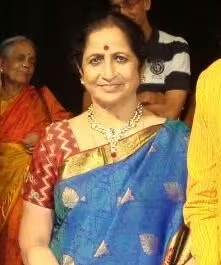
Aruna Sairam: The Voice of Tradition and Innovation
In the hallowed halls of Carnatic music, few voices resonate with the power, emotional depth, and innovative spirit of Aruna Sairam. A musician who embodies the very soul of the tradition while fearlessly exploring its global frontiers, she is more than a vocalist; she is a cultural phenomenon. Born on October 30, 1952, in the bustling metropolis of Bombay (now Mumbai), Aruna Sairam's life has been a symphony of rigorous training, intellectual curiosity, and an unshakeable belief in the universal language of music. As a recipient of India's highest artistic honors, including the Padma Shri and the Sangita Kalanidhi, she stands today as a living legend, a cultural ambassador whose voice has carried the intricate beauty of Carnatic music to every corner of the world.
Early Life & Background: A Crucible of Music
Aruna Sairam's journey into music was not a choice but an inheritance, a destiny woven into the fabric of her childhood. She was born into a family steeped in music and culture. Her father, Sethuraman, was a dedicated connoisseur, while her mother, Rajalakshmi Sethuraman, was a gifted vocalist and her first guru. A student of the legendary Alathur Brothers and Thanjavur Sankara Iyer, Rajalakshmi instilled in her daughter the foundational principles of Carnatic music with both love and discipline.
The Sethuraman household in Matunga, Bombay, was a vibrant cultural hub, a meeting point for the titans of Indian classical music. It was a home where the air hummed with melody, where giants like Ariyakudi Ramanuja Iyengar, Madurai Mani Iyer, and Flute T. R. Mahalingam were not just distant icons but frequent guests. For young Aruna, these encounters were her formative education. She absorbed the nuances of different banis (styles), listened to impassioned discussions on aesthetics, and witnessed firsthand the dedication required to achieve musical greatness. This immersive environment was her playground and her classroom, shaping her musical sensibilities long before her formal training intensified.
While her mother laid the groundwork, Aruna's formal tutelage was a mosaic of influences from some of the most respected gurus of the 20th century. This eclectic training would become a cornerstone of her unique style. She came under the masterful guidance of Sangita Kalanidhi T. Brinda, a formidable doyenne of the Veena Dhanammal school. From T. Brinda, Aruna imbibed the subtle, graceful, and deeply emotive art of rendering padams and javalis—compositions that demand not just technical skill but profound emotional intelligence. This training gave her music a rare lyrical depth and introspective quality.
Her quest for knowledge led her to other great masters. She trained with S. Ramachandran of the Chittor Subramaniam Pillai school, noted for its robust and structured classicism. She learned from the brilliant veena maestro K.S. Narayanaswamy and vocalist A.S. Mani, a disciple of the creative genius Tiger Varadachariar. This multi-faceted education gave her a panoramic view of the Carnatic tradition, allowing her to draw from a rich palette of styles and techniques. Alongside her rigorous musical pursuits, Aruna completed her Bachelor's degree in Science from the University of Bombay, a testament to her disciplined and analytical mind.
A pivotal chapter in her life began in the 1980s when she moved to Germany with her husband, Sairam. This period, far from being a hiatus, proved to be a profound catalyst for her artistic evolution. Immersed in a new culture, she began studying European music and vocal techniques. She learned about breath control, resonance, and projection from a Western perspective, which she thoughtfully integrated into her Carnatic vocalism. This cross-cultural exposure broadened her artistic horizons and helped forge the powerful, full-throated, and incredibly resilient voice that would become her signature. It was during this time abroad that her resolve to dedicate her life entirely to music crystallized. In the late 1980s, she made the momentous decision to move to Chennai, the undisputed heartland of Carnatic music, to pursue her career as a performing artist.
Career & Major Contributions: A Meteoric Ascent
Arriving in Chennai, Aruna Sairam entered a highly competitive and discerning musical landscape. Yet, her music, forged in the crucible of diverse training and global exposure, was immediately distinctive. Her voice possessed a breathtaking combination of power and grace, capable of navigating the most intricate rhythmic patterns and soaring through octaves with emotive force. Her concerts were not just recitals; they were electrifying experiences. Her dynamic stage presence and her ability to establish a deep, personal connection with her audience set her apart.
One of her most significant contributions was the popularization of Marathi abhangs and other regional devotional forms within the mainstream Carnatic concert format. Drawing from the songs taught by her mother and her later interactions with devotional singers from Pandharpur, she infused these soulful compositions with Carnatic embellishments, making them a thrilling, spiritually uplifting climax to her performances. Her rendition of “Teertha Vithala” became an anthem, eagerly awaited by audiences everywhere, bridging the cultural gap between the Carnatic south and the devotional traditions of Western India.
Her career is decorated with virtually every major award and accolade in the world of Indian arts. The Government of Tamil Nadu conferred upon her the title of Kalaimamani. In 2006, she received the prestigious Sangeet Natak Akademi Award, India's highest national honor for performing artists. This was followed by the Padma Shri in 2009, one of the country's highest civilian awards, recognizing her immense contribution to Indian culture. The crowning achievement came in 2018 when the Madras Music Academy, the most revered institution in Carnatic music, bestowed upon her the coveted title of Sangita Kalanidhi. This award, considered the pinnacle of a Carnatic musician's career, was a resounding affirmation of her status as a modern master of the art form.
Her influence, however, extends far beyond Indian shores. Aruna Sairam is a true global ambassador of music, known for her pioneering collaborative work. Her project "Sources" with the French Gregorian chant singer Dominique Vellard was a landmark exploration of the shared spiritual roots of Eastern and Western sacred music. She has performed at the world's most prestigious venues, including New York’s Carnegie Hall, London’s Royal Albert Hall for the BBC Proms, and Paris's Théâtre de la Ville. Her performances at global music festivals, such as the Fes Festival of World Sacred Music in Morocco, have introduced Carnatic music to new and diverse audiences.
In recognition of her global impact, she has received international honors, including a proclamation of excellence from the US Congress and, in 2022, the Chevalier de l'Ordre des Arts et des Lettres (Knight of the Order of Arts and Letters) from the French Government, celebrating her role in fostering Indo-French cultural ties.
Legacy & Influence: A Bridge Across Worlds
Aruna Sairam's legacy is multifaceted. She is at once a staunch traditionalist and a relentless innovator. Her reverence for her gurus, particularly T. Brinda, is evident in the purity and depth with which she renders traditional compositions. Yet, her intellectual curiosity and open-mindedness have led her to push the boundaries of her art form, making it relevant and accessible to a 21st-century global audience.
Her influence on the Carnatic concert format has been profound. She infused it with a new energy and emotional candor, breaking away from the more reserved presentation style of previous generations. Her habit of asking the audience “Sowkhyama?” (“Are you well/happy?”) at the beginning of her concerts is more than a greeting; it is an act of inclusion, transforming the performance from a formal recital into a shared spiritual journey.
As a guru and mentor, she is dedicated to passing on her vast knowledge to the next generation. Her appointment as the Vice-Chairman of the Sangeet Natak Akademi from 2015 to 2018 is a testament to the respect she commands as a leader and visionary in the arts community. She has shown that it is possible to achieve international acclaim without compromising the integrity and authenticity of a classical tradition.
Today, Aruna Sairam continues to be a vital and inspiring force in the world of music. She is remembered not only for her powerful voice and technical virtuosity but for her ability to build bridges—between tradition and innovation, between India and the world, and between the artist and the audience. Her life and work stand as a powerful testament to the idea that music, at its most profound, is an art without frontiers, a universal expression of the human spirit.