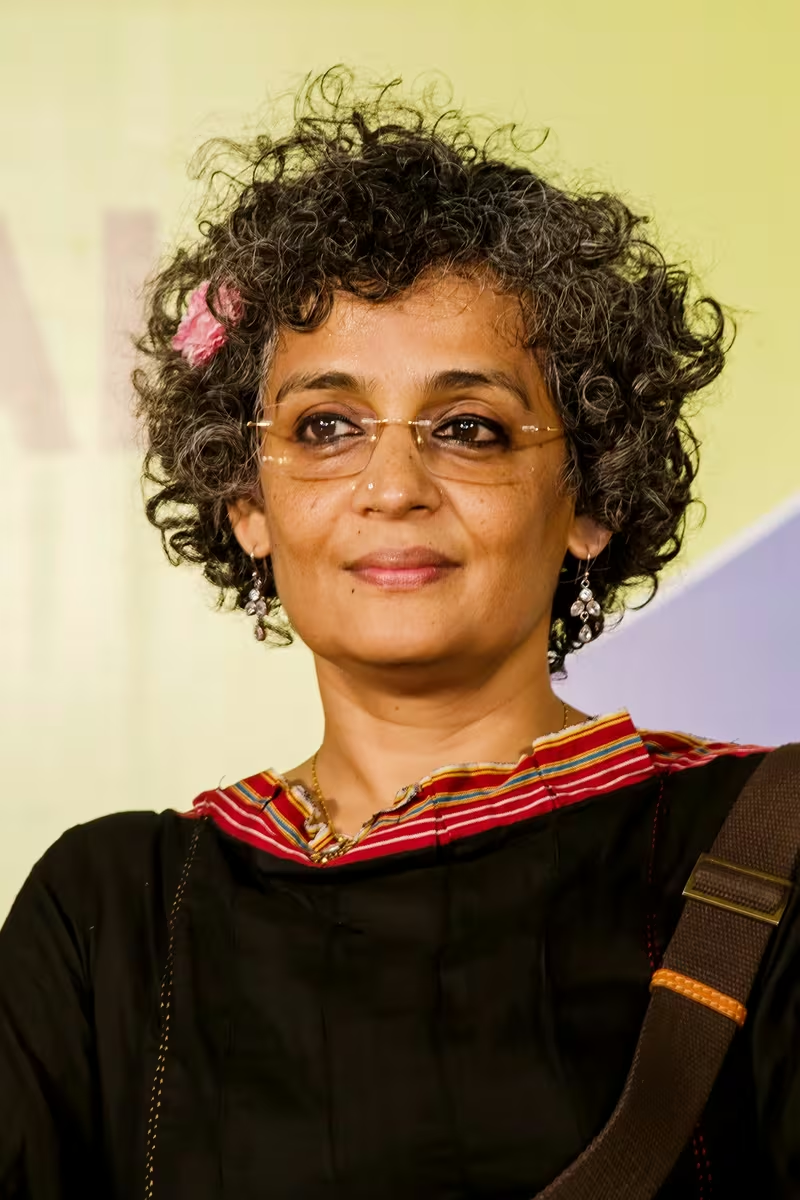
Arundhati Roy - Author and Activist
In the landscape of contemporary Indian literature and intellectual discourse, few figures loom as large or as polarizing as Suzanna Arundhati Roy. With a pen that can weave the lyrical, intimate tragedies of a family and the searing, incisive critiques of a nation-state, Roy occupies a unique space. She is at once the globally celebrated novelist who captured the world's imagination with her debut, and the relentless activist who has dedicated her public life to challenging the structures of power, from global capitalism to nationalistic policies. Her journey is a testament to the power of a single, unwavering voice to comfort the afflicted and afflict the comfortable, making her one of the most significant and debated public figures in modern Indian history.
Early Life & Background
Suzanna Arundhati Roy was born on November 24, 1961, in Shillong, Meghalaya, to Mary Roy, a Malayali Syrian Christian women's rights activist, and Rajib Roy, a Bengali Hindu tea plantation manager. Her early life was marked by movement and a sense of being an outsider, themes that would later permeate her writing. Following her parents' separation when she was two, she moved with her mother and brother to Ootacamund (Ooty) in Tamil Nadu and later to Aymanam in Kerala.
This small village of Aymanam, nestled along the backwaters, would become the atmospheric, almost mythical setting for her future masterpiece. Her childhood here was unconventional. Her mother, Mary Roy, was a formidable figure in her own right—an educator and activist who successfully challenged the inheritance laws that discriminated against Syrian Christian women in a landmark 1986 Supreme Court case. Mary Roy founded the Corpus Christi School, where Arundhati first studied, and her fierce independence and refusal to conform to societal norms deeply influenced her daughter. This upbringing, outside the traditional confines of patriarchal Keralan society, instilled in Roy a critical perspective and a skepticism of authority from a young age.
For her secondary education, Roy attended the Lawrence School, Lovedale, in Nilgiris, Tamil Nadu. At sixteen, she left home for Delhi, living independently and enrolling at the School of Planning and Architecture. It was in the vibrant, politically charged environment of Delhi that she began to forge her own path, supporting herself with various jobs while immersing herself in the city's artistic and intellectual circles. These formative years, defined by a blend of Keralan lushness and metropolitan grit, shaped the dual sensibilities that would define her work: a deep connection to the particularities of place and a broad, critical understanding of national and global power dynamics.
Career & Major Contributions
Roy's career did not begin with the novel but with the moving image. In the 1980s and early 1990s, she worked in film and television. Her most notable early work was the screenplay for In Which Annie Gives It Those Ones (1989), a semi-autobiographical film based on her experiences at architecture school. The film, directed by her then-husband Pradip Krishen, won the National Film Award for Best Screenplay. She also wrote the screenplay for the film Electric Moon (1992) and appeared in minor acting roles.
This early foray into screenwriting honed her skills in dialogue and visual storytelling, but it was a different kind of writing that was brewing within her. In 1992, she began writing her first novel, a process that would consume the next four and a half years of her life.
The God of Small Things (1997)
When The God of Small Things was published in 1997, it was not merely a successful debut; it was a global literary phenomenon. The novel, set in Aymanam, Kerala, tells the story of fraternal twins, Estha and Rahel, and the tragic events that shatter their family and their childhoods. It is a deeply personal and political work, exploring the "Love Laws" that dictate "who should be loved, and how. And how much."
Roy's prose was a revelation. It was playful, inventive, and saturated with sensory detail, creating a linguistic world as lush and treacherous as the Keralan monsoon. She employed a non-linear narrative, weaving back and forth in time, slowly revealing the secrets at the heart of the Ipe family's tragedy. The novel masterfully dissects the oppressive structures of Indian society—the brutal realities of the caste system, the hypocrisy of the Anglophilic elite, the vestiges of colonialism, and the suffocating weight of social convention.
The book's success was immediate and overwhelming. It received rapturous reviews internationally and, in 1997, was awarded the prestigious Booker Prize for Fiction, making Arundhati Roy an overnight literary superstar. The prize catapulted her onto the world stage, but instead of following up with another novel, she chose to leverage her newfound platform for a different purpose.
A Turn to Activism and Non-Fiction
Having witnessed the power of words to capture the world's attention, Roy dedicated the next two decades almost exclusively to political activism and non-fiction writing. She became one of India's most prominent and fearless dissenters, using her essays and speeches to confront issues she felt were being ignored or misrepresented by the mainstream.
Her first major political essay, "The End of Imagination" (1998), was a blistering critique of the Indian government's decision to conduct nuclear tests. She wrote with a novelist's passion and a citizen's fury, decrying the jingoistic nationalism that celebrated the bomb. This set the tone for her future work: meticulously researched, passionately argued, and written with literary flair.
In 1999, she published "The Greater Common Good," an essay that marked her deep involvement with the Narmada Bachao Andolan (Save the Narmada Movement). She spent time with the activists and villagers protesting the construction of the Sardar Sarovar Dam, which was set to displace hundreds of thousands of tribal people. Her essay dismantled the government's rhetoric of "national interest" and exposed the human cost of large-scale development projects. Her activism on this front led to a contempt of court case and a symbolic one-day imprisonment in 2002.
Throughout the 2000s, her essays tackled a vast range of subjects:
- Critiques of Neo-imperialism and Globalization: She became a vocal critic of US foreign policy, particularly the wars in Afghanistan and Iraq, and a leading voice in the anti-globalization movement.
- The Kashmir Conflict: Roy has been an outspoken advocate for the rights of Kashmiris, challenging the official Indian narrative of the conflict. Her statements, particularly those questioning India's integral claim to the region, have made her a target of intense criticism and legal threats, including sedition charges.
- The Maoist Insurgency: In 2010, she published "Walking with the Comrades," a controversial and immersive account of the time she spent with Naxalite-Maoist guerrillas in the forests of central India. She sought to understand their motivations, portraying them not as simple terrorists but as people pushed into armed struggle by systemic injustice and corporate land grabs.
Return to Fiction: The Ministry of Utmost Happiness (2017)
Twenty years after her Booker-winning debut, Roy returned to fiction with The Ministry of Utmost Happiness. If her first novel was a perfectly crafted miniature, her second was a sprawling, polyphonic epic. The novel traverses decades of turbulent modern Indian history, from the anti-Sikh riots and the Bhopal gas tragedy to the rise of Hindu nationalism and the conflict in Kashmir.
Its central characters—Anjum, a Hijra (transgender woman) who creates a sanctuary in a Delhi graveyard, and Tilo, an enigmatic architect-turned-activist—navigate a fractured, often brutal landscape. The novel is a testament to the marginalized, the forgotten, and the broken, those who find solace and community in the ruins of the grand, official narrative of India. While its reception was more divided than that of her first novel, it was longlisted for the Booker Prize and hailed by many as a brave, ambitious, and deeply compassionate work that reflected the political urgencies of its time.
Legacy & Influence
Arundhati Roy's legacy is twofold, and the two parts are inextricably linked. As a novelist, she redefined the possibilities of Indian writing in English. The God of Small Things remains a landmark achievement, a novel that proved an intensely local, vernacular-infused story could possess profound universal resonance. Its linguistic innovation and emotional depth have influenced a generation of writers both in India and abroad. It is a permanent fixture on university syllabuses and continues to be read and cherished worldwide.
As an activist and public intellectual, her influence is more contentious but no less significant. Roy has consistently used her voice to speak for those on the margins: Adivasis, Dalits, Kashmiris, and the poor. She has become the country's most recognizable dissenter, a figure who refuses to be silenced by state pressure, media criticism, or public condemnation. Her essays have brought international attention to complex and often uncomfortable truths about India's democracy. For her supporters, she is a courageous truth-teller, a moral compass in a time of political compromise. For her detractors, she is an anti-national ideologue, a provocateur who undermines the nation's image.
Today, Arundhati Roy continues to write, speak, and agitate. She is remembered not just as the author of a beloved novel, but as a fearless conscience of her nation. Her life's work stands as a powerful argument that art is not separate from politics and that the role of the writer is not merely to observe the world, but to challenge it. Her legacy is one of immense literary talent fused with unwavering political conviction—a combination that has made her one of the most essential and enduring voices of our time.