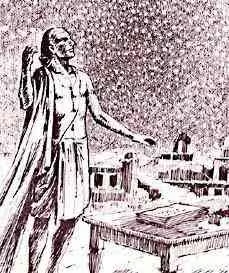
Aryabhata - The Luminary of India's Golden Age
In the year 476 CE, as the Gupta Empire basked in the zenith of its power—a period often celebrated as the Golden Age of India—a mind was born that would forever alter the trajectory of global science. This was Aryabhata, a mathematician and astronomer of such profound genius that his work would resonate across continents and centuries. In an era when celestial events were shrouded in myth and mathematics was often an abstract pursuit, Aryabhata applied rigorous logic and observation to chart the heavens and unlock the secrets of numbers. His magnum opus, the Āryabhaṭīya, was not merely a book; it was a revolution in a hundred and twenty-one verses, a beacon of rational thought that would illuminate the path for future scholars from the banks of the Ganga to the scholarly courts of Baghdad and beyond.
Early Life & The Cradle of Genius
The precise origins of Aryabhata remain one of the few mysteries surrounding a life dedicated to precision and clarity. While he states in the Āryabhaṭīya that he composed the text at the age of 23 in the year 499 CE, details of his birthplace are a subject of scholarly debate. He mentions his association with Kusumapura, widely identified with Pataliputra (modern-day Patna), the magnificent capital of the Gupta Empire. This bustling metropolis, with its rich intellectual traditions and proximity to the great university at Nalanda, would have been a fertile ground for a prodigious talent like Aryabhata to flourish.
However, later commentators, notably the 7th-century mathematician Bhāskara I, identify Aryabhata with the Aśmaka region, a territory located in the Deccan, possibly in modern-day Maharashtra or Telangana. It is conceivable that he was born in Aśmaka and later traveled to Kusumapura, the empire's intellectual heart, to pursue his advanced studies and research. Regardless of his geographical origins, the environment in which he worked was one of immense intellectual ferment. The Gupta period saw unprecedented advancements in philosophy, literature, art, and science, creating a culture that valued knowledge and inquiry.
Lacking documented details about his parentage or specific teachers, we are left to deduce his education from the sheer mastery displayed in his work. The Āryabhaṭīya reveals a deep understanding of Sanskrit, poetics, and, most importantly, the foundational mathematical and astronomical knowledge of his time. He was clearly a beneficiary of a sophisticated system of learning, one that empowered him not just to absorb existing knowledge but to challenge and radically reshape it.
A Revolution in Numbers and Stars: Major Contributions
Aryabhata's enduring legacy is encapsulated in his seminal work, the Āryabhaṭīya, and a now-lost treatise on astronomical calculations, the Arya-siddhanta. The Āryabhaṭīya is a concise, sutra-style text composed of 121 verses, divided into four distinct sections or pādas:
- Gitikapada (Time Divisions): An introduction that sets out the core astronomical parameters and a revolutionary system for representing large numbers using the letters of the Sanskrit alphabet.
- Ganitapada (Mathematics): A compendium of mathematical knowledge, covering arithmetic, algebra, geometry, and trigonometry.
- Kalakriyapada (The Reckoning of Time): This section deals with planetary motion, defining units of time from the microscopic to the cosmic, and laying out methods for determining the positions of planets.
- Golapada (The Sphere): Here, Aryabhata discusses the celestial sphere, the causes of day and night, the shape of the Earth, and the true scientific reasons for eclipses.
Within this compact framework, Aryabhata presented ideas that were centuries ahead of their time.
The Genius of Mathematics
Aryabhata's contributions to mathematics were foundational. He did not simply solve problems; he created new systems and tools for understanding the universe quantitatively.
The Place-Value System and the Concept of Zero: While Aryabhata did not use the familiar circular symbol for zero, his alphabetical number system was built upon a sophisticated place-value principle. In his system, letters represented numbers, and their value was determined by their position. This system inherently required a placeholder concept—the idea of null or void—to function correctly. This conceptual framework for zero (kha or 'emptiness') and the decimal place-value system were monumental leaps that streamlined calculation, making it possible to handle enormously large numbers with ease and paving the way for the modern number system that the world uses today.
Approximation of Pi (π): One of the most celebrated verses in the Ganitapada provides a remarkably accurate approximation of π. He wrote:
“Add four to one hundred, multiply by eight, and then add sixty-two thousand. The result is approximately the circumference of a circle of diameter twenty thousand.”
This calculation, (100 + 4) x 8 + 62000, gives the circumference 62,832 for a diameter of 20,000. This yields a value for π of 62832/20000 = 3.1416, a figure accurate to four decimal places. This was the most precise approximation of π in the world at the time and remained so for centuries.
The Birth of Trigonometry: Aryabhata revolutionized the study of triangles. While Greek astronomers relied on the chord, Aryabhata pioneered the use of the half-chord, which corresponds to the modern sine function. He called it ardha-jya (half-chord), which was eventually shortened to jya. He meticulously calculated a table of sines at intervals of 3.75 degrees, providing a powerful new tool for astronomical calculations. When Arab scholars translated his work, jya became jiba, which was later mistaken for the Arabic word jaib (cove or bay) and translated into Latin as sinus, giving us the modern term 'sine'.
Advances in Algebra: Aryabhata provided elegant solutions to linear indeterminate equations of the form ax + by = c, a type of problem that arises in both astronomy and pure mathematics. His method, known as kuṭṭaka ('pulverizer'), was a systematic algorithm that demonstrated a deep understanding of number theory.
The Visionary Astronomer
If his mathematics was foundational, his astronomy was revolutionary. Aryabhata applied his mathematical prowess to the cosmos, challenging deep-seated mythological beliefs with scientific reasoning.
A Spinning Earth: In a geocentric world, where the Earth was considered static and the heavens revolved around it, Aryabhata proposed a radical idea: the Earth rotates on its own axis. In the Golapada, he wrote:
“Just as a man in a boat moving forward sees the stationary objects on the bank as moving backward, so are the stationary stars seen by the people on earth as moving exactly towards the west.”
This brilliant analogy explained the apparent daily motion of the stars as a result of the Earth's own rotation. This heliocentric flicker, suggesting a relative motion, was a courageous intellectual leap that pre-dated Copernicus by nearly a thousand years.
The Truth Behind Eclipses: For millennia, solar and lunar eclipses were feared as ominous events, often attributed to the celestial demons Rahu and Ketu devouring the Sun or Moon. Aryabhata swept away this superstition with a clear, scientific explanation. He correctly deduced that a lunar eclipse occurs when the Moon enters the Earth's shadow, and a solar eclipse happens when the Moon's shadow falls upon the Earth. He even provided a mathematical framework to calculate the timing of eclipses and the extent of the Earth's shadow.
Astronomical Precision: His calculations of celestial periods were astonishingly accurate. He calculated the length of the sidereal year (the time it takes for the Earth to orbit the Sun relative to the stars) as 365.25868 days. The modern accepted value is 365.25636 days, a difference of mere minutes. This level of precision, achieved with naked-eye observation and brilliant mathematics, is a testament to his extraordinary skill.
Legacy and Enduring Influence
Aryabhata's work did not fade into obscurity; it ignited a scientific tradition. His ideas were immediately studied, debated, and built upon by subsequent generations of Indian mathematicians and astronomers. Scholars like Varahamihira and Bhaskara I wrote extensive commentaries on the Āryabhaṭīya. Even his fiercest critic, Brahmagupta, who disagreed with several of his theories, engaged with his work so intensely that he inadvertently helped to preserve and popularize it.
His influence soon transcended the borders of India. In the early 9th century, during the intellectual blossoming of the Abbasid Caliphate in Baghdad, the Āryabhaṭīya was translated into Arabic as Zīj al-Āryabhaṭ. This translation became a conduit through which Indian numerals, the decimal system, algebraic methods, and trigonometric functions flowed into the Islamic world. Great thinkers like Al-Khwarizmi (from whose name we derive 'algorithm') and the polymath Al-Biruni studied his work extensively, integrating Indian scientific advancements into their own research.
From the Arab world, this knowledge, including Aryabhata's sine tables and numeral system, eventually made its way to Europe through Latin translations. It provided crucial mathematical tools that fueled the Renaissance and the subsequent Scientific Revolution. The numbers you use to count, the trigonometry used in engineering, and the very concept of a rational, predictable cosmos all bear the faint but undeniable fingerprints of this ancient Indian sage.
Today, Aryabhata is rightfully honored as one of the fathers of Indian science. When India launched its first satellite into space on April 19, 1975, it was named Aryabhata in a fitting tribute to the man who first set the nation's sights on the stars. An impact crater on the Moon also bears his name, a permanent celestial monument to his legacy. He remains a symbol of India's rich intellectual heritage—a bold rationalist who used the pure language of mathematics to decode the universe and dared to imagine a world governed not by myth, but by reason.