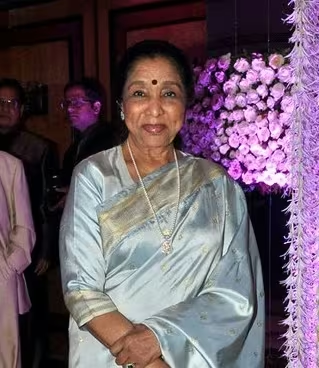
Asha Bhosle - The Undisputed Queen of Versatility
In the grand tapestry of Indian music, few threads are as vibrant, enduring, and versatile as the voice of Asha Bhosle. For over eight decades, her voice was a constant presence in the lives of millions, a dynamic force that could articulate every shade of human emotion—from coquettish charm and rebellious angst to profound sorrow and spiritual yearning. More than just a playback singer, Asha Bhosle was a musical revolutionary, an artist who constantly reinvented herself, defied conventions, and carved out a unique identity in a world often dominated by her legendary older sister, Lata Mangeshkar. Her journey from the shadows of the industry to becoming a global icon is a testament to her unwavering spirit, prodigious talent, and an insatiable hunger for her craft.
Early Life & Background
Asha Mangeshkar was born on September 8, 1933, in the small village of Goar in Sangli State (now Maharashtra), into a family where music was as essential as air. Her father, Pandit Deenanath Mangeshkar, was a towering figure in Marathi theatre, a celebrated classical vocalist and actor of the Natya Sangeet tradition. Her mother, Shevanti, was his second wife. Asha was the third of five siblings—Lata, Meena, Usha, and Hridaynath—all of whom would go on to have distinguished careers in music.
Her earliest education was not in a formal school but at the feet of her father. He was a strict disciplinarian and a profound guru who began training his children in the nuances of classical music from a very young age. These formative years, filled with the rigorous practice of ragas and melodies, laid the foundation for the technical mastery that would later define Asha's career. However, this idyllic, music-filled childhood was tragically cut short. In 1942, when Asha was just nine years old, Deenanath Mangeshkar passed away, plunging the family into a severe financial crisis.
The burden of providing for the family fell on the young shoulders of Lata and Asha. The Mangeshkars moved from Pune to Kolhapur and finally to Mumbai, the heart of the burgeoning Hindi film industry. To make ends meet, the sisters began singing and acting in films. Asha recorded her first film song, "Chala Chala Nav Bala," for the Marathi film Majha Bal in 1943. Her Hindi film debut came in 1948 with the song "Saawan Aaya" for the film Chunariya.
These early years were fraught with struggle. The Hindi film music scene of the late 1940s and early 1950s was dominated by powerful voices like Shamshad Begum, Geeta Dutt, and her own sister, Lata Mangeshkar, who was rapidly ascending to superstar status. Asha often received the assignments that the top-tier singers rejected: songs for vamps, side characters, or B-grade films. Compounding her professional struggles were personal challenges. At the age of 16, she eloped with Ganpatrao Bhosle, a man much older than her. The marriage was tumultuous and ultimately ended in separation in 1960. A single mother to three children, Asha's resolve was tested, but it was this very period of hardship that forged her resilience and a fierce determination to succeed on her own terms.
Career & Major Contributions
Asha Bhosle's career can be seen as a series of powerful collaborations that not only defined her sound but also reshaped the landscape of Hindi film music.
The Rise with O. P. Nayyar (1950s-1960s)
While she sang for many composers in the 1950s, it was her partnership with O. P. Nayyar that truly catapulted her into the limelight. Nayyar, a composer with a distinctively peppy, rock-and-roll-infused style, saw in Asha's voice a vivacity and sensuality that others had overlooked. He broke away from the prevalent style of delicate, classical-based melodies and gave her songs that were bold, rhythmic, and modern. Their collaboration began with the 1956 film C.I.D., but it was the soundtrack of Naya Daur (1957) that became a landmark. Songs like "Maang Ke Saath Tumhara" and the flirtatious "Uden Jab Jab Zulfein Teri" were massive hits, establishing Asha as a leading playback singer.
Throughout the late 50s and 60s, the Nayyar-Bhosle duo delivered an incredible string of chartbusters: the sultry "Aaiye Meherbaan" (Howrah Bridge), the romantic "Deewana Hua Badal" (Kashmir Ki Kali), and the poignant "Chain Se Humko Kabhi" (Pran Jaye Par Vachan Na Jaye). Nayyar gave Asha her own identity, a voice that was distinct from Lata's—earthy, exuberant, and unapologetically modern.
A New Dimension with S. D. Burman
Simultaneously, Asha was doing significant work with Sachin Dev Burman. Initially, S. D. Burman primarily used Lata for his leading heroines. However, during a period of professional disagreement between Burman and Lata from 1957 to 1962, he turned to Asha, giving her some of his most memorable compositions. He entrusted her with songs that required a deep emotional range, such as the melancholic "Ab Ke Baras Bhej" from Bandini (1963). He also recognized her flair for the seductive and gave her timeless classics like the slinky, jazz-inflected "Raat Akeli Hai" from Jewel Thief (1967).
The Revolutionary Pancham Era (Late 1960s-1980s)
If O. P. Nayyar gave Asha her identity, it was Rahul Dev Burman (Pancham) who unleashed her full, untamed potential. Their professional and personal partnership is legendary in the annals of Indian music. R. D. Burman was a musical innovator who fused Western influences—rock, jazz, funk, and pop—with Indian melodies. In Asha, he found the perfect muse: a vocalist who was not only technically brilliant but also fearless and willing to experiment.
Together, they shattered every existing norm of Hindi film music. Their collaboration produced some of the most iconic songs of all time:
- "Piya Tu Ab Toh Aaja" (Caravan, 1971): With its spoken-word interludes and signature panting, this cabaret number became a cultural sensation, forever associating Asha's voice with a bold, modern sensuality.
- "Dum Maro Dum" (Hare Rama Hare Krishna, 1971): A psychedelic anthem for a generation, this song captured the rebellious spirit of the hippie movement and became a timeless classic.
- "Chura Liya Hai Tumne" (Yaadon Ki Baaraat, 1973): A soft, romantic ballad that showcased her ability to convey gentle vulnerability with as much ease as fiery passion.
- "Mera Kuchh Saamaan" (Ijaazat, 1987): Penned by Gulzar, this free-verse, ghazal-like song was a compositional masterpiece. Asha's nuanced, deeply moving rendition won her a National Film Award and proved her mastery over complex, poetic expressions.
They married in 1980, and their partnership continued to produce magic, from the disco beats of "Jawaan-E-Jaaneman" (Namak Halaal) to the soulful melodies of "Roz Roz Aankhon Tale" (Jeeva).
The Pinnacle of Versatility
What truly set Asha Bhosle apart was her staggering versatility. She refused to be typecast. While she was the undisputed queen of peppy numbers and cabaret songs, her command over classical forms was absolute.
- Ghazals: Her work in the 1981 film Umrao Jaan, with composer Khayyam, is considered a masterclass in ghazal singing. Songs like "Dil Cheez Kya Hai" and "In Aankhon Ki Masti Ke" are benchmarks of the genre, earning her the first National Film Award of her career.
- Classical and Devotional: Songs like "Tora Man Darpan Kehlaye" (Kaajal) demonstrated her deep understanding of classical music.
- Regional Music: She was a prolific singer in her native Marathi, delivering countless memorable bhavgeet and film songs. She recorded songs in over 20 Indian and foreign languages, a testament to her linguistic and musical adaptability.
- Non-Film and International Work: Beyond films, she released numerous private albums, collaborated with artists like Boy George and the Kronos Quartet, and even toured with ghazal maestro Ghulam Ali. In 2011, the Guinness Book of World Records officially recognized her as the most recorded artist in music history.
Legacy & Influence
Asha Bhosle's legacy is monumental and multifaceted. She was not just a singer; she was a cultural phenomenon who redefined the role of a female playback singer in India.
The Voice of the Modern Indian Woman: In an era where the heroine's voice (often Lata's) was synonymous with purity and tradition, Asha became the voice of the 'other' woman—the vamp, the dancer, the rebel. But she infused these characters with a humanity, confidence, and zest for life that was empowering. She was the voice of Helen's electrifying dances, Zeenat Aman's bohemian spirit, and Rekha's sophisticated allure. She represented a modernity and independence that resonated deeply with changing times.
A Symbol of Resilience: Her life story—marked by early tragedy, personal struggles, and intense professional competition—is an inspiring saga of perseverance. She carved her own path, emerging from the colossal shadow of her sister to create an equally significant, though stylistically different, legacy. The two sisters, though often pitted against each other by the media, shared a deep personal bond, representing two different yet equally brilliant facets of Indian music.
Influence on Future Generations: Her influence on subsequent generations of singers is immeasurable. Artists like Kavita Krishnamurthy, Alisha Chinai, and Sunidhi Chauhan have all cited her as a major inspiration, emulating her energy, vocal dexterity, and stage presence. She proved that a playback singer could be a star in their own right.
Her contributions were recognized with India's highest honors in cinema and civil society. She received the Dadasaheb Phalke Award in 2000 and the Padma Vibhushan in 2008. But her true reward lies in the millions of hearts she touched and the timelessness of her music.
Asha Bhosle is remembered not just for the staggering quantity of her songs, but for their incredible quality and emotional range. She was the voice of first love, of heartbreak, of celebration, and of quiet contemplation. She was a force of nature, an artist who never stopped learning, experimenting, and pushing the boundaries of her art. Her voice, a vibrant and indelible part of India's cultural soul, will continue to echo through the ages, a timeless testament to a life lived with passion, courage, and unparalleled artistry.