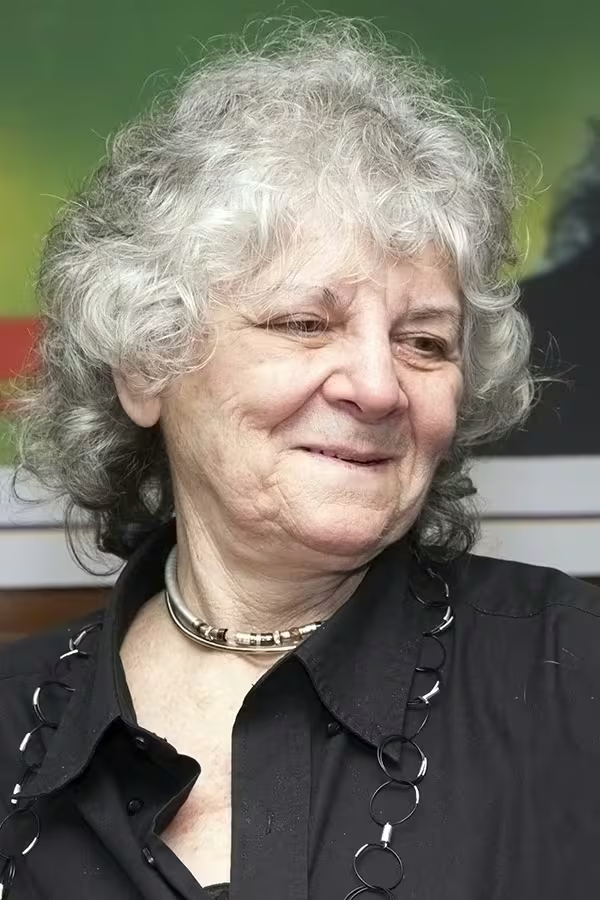
In the hallowed, often spartan, laboratories of early 20th-century India, the sight of a woman meticulously conducting experiments was a quiet revolution. In a world overwhelmingly dominated by men, where science was considered a male preserve, one woman from Calcutta not only carved a niche for herself but also laid the foundation for an entire field of study in the country. This was Asima Chatterjee, a pioneering chemist whose relentless curiosity and profound intellect unlocked the secrets hidden within India's rich botanical heritage, transforming plants into life-saving medicines.
Her journey was one of extraordinary firsts: the first woman to be awarded a Doctorate of Science from an Indian university, the first woman to be elected General President of the Indian Science Congress, and a trailblazer whose work on natural products chemistry brought her global acclaim. This is the story of a scientist who, through sheer determination and brilliance, navigated societal barriers and resource scarcity to become one of India's most important scientific minds.
Early Life & A Passion for Chemistry
Asima Chatterjee was born Asima Mookerjee on September 23, 1917, in Calcutta, British India. She grew up in a middle-class Bengali family where education, for both sons and daughters, was valued—a progressive stance in the context of the era. Her father, Indra Narayan Mukherjee, was a medical doctor with a deep and abiding passion for botany. His fascination with the medicinal properties of Indian plants was a constant presence in her childhood, planting the seeds of curiosity that would later blossom into her life's work. He would often encourage his young daughter's interest, and it was this early exposure to the nexus of medicine and nature that set her on a unique path.
In an age when most women's ambitions were confined to the domestic sphere, Asima was determined to pursue higher education. She enrolled at the prestigious Scottish Church College of the University of Calcutta, where her aptitude for chemistry became undeniable. In 1936, she graduated with honours in the subject, a remarkable achievement in itself. She continued her academic ascent at the University of Calcutta, earning a Master of Science degree in organic chemistry in 1938.
Her ambition, however, did not stop there. She set her sights on a doctorate, a pursuit fraught with immense challenges. The university's chemistry departments were not equipped with the advanced instrumentation or consistent funding seen in the West. Asima had to be resourceful and resilient. To support her research, she began teaching at Lady Brabourne College in Calcutta, often using her modest salary to purchase the chemical reagents and equipment necessary for her experiments. Her journey was a testament to her unwavering dedication; she was not just a student of science but a patron of her own pioneering research.
This period of struggle culminated in a historic moment in 1944. Asima Chatterjee was awarded the Doctorate of Science (D.Sc.) from the University of Calcutta. She was the first woman in the history of India to receive this high academic honour from any Indian university, shattering a significant glass ceiling and paving the way for generations of women in science to follow.
A Trailblazing Career in Phytochemistry
Asima Chatterjee's career was dedicated to the field of phytochemistry—the study of chemicals derived from plants. She saw India's vast and diverse flora as a living, breathing pharmacy waiting to be understood. Her work focused primarily on alkaloids and coumarins, naturally occurring compounds known for their potent physiological effects.
Groundbreaking Research and Discoveries
Her most significant contributions came from her systematic investigation of Indian medicinal plants, which had been used for centuries in traditional Ayurvedic medicine. Chatterjee applied the rigour of modern organic chemistry to validate, isolate, and understand the active principles behind these ancient remedies.
Vinca Alkaloids and Anti-Cancer Research: One of her most celebrated areas of research involved the alkaloids from the Madagascar periwinkle (Catharanthus roseus, formerly Vinca rosea). Her investigations into the chemical constituents of this plant were foundational. While the American researchers Gordon H. Svoboda and Irving S. Johnson are credited with isolating the potent anti-cancer drugs vincristine and vinblastine from the plant, which are now crucial in chemotherapy, Chatterjee's independent and concurrent research on these alkaloids was a significant contribution to the global understanding of these vital compounds.
The Anti-Epileptic Drug from Marsilea minuta: Perhaps her most direct contribution to medicine was the development of a patented anti-epileptic drug. Over several decades, she meticulously studied the properties of Marsilea minuta, a common water fern. Her research led to the isolation of active compounds that proved effective in managing epilepsy. This culminated in the development of 'Ayush-56', an Ayurvedic drug that provided a safe, effective treatment for patients, showcasing her unique ability to bridge traditional knowledge with modern scientific validation.
Developing Anti-Malarial Drugs: In a country ravaged by malaria, Chatterjee's work was of immense national importance. She investigated the chemical properties of plants like Alstonia scholaris (Devil's tree), Swertia chirata, and Picrorhiza kurroa, all known in traditional medicine for their fever-reducing properties. Her research helped in the development of effective anti-malarial drugs, offering new hope against a persistent and deadly disease.
Global Recognition and Institution Building
Chatterjee's expertise did not go unnoticed by the international scientific community. She was awarded prestigious fellowships that allowed her to work alongside some of the world's leading chemists. She conducted research with László Zechmeister at the California Institute of Technology (Caltech) and with the Nobel laureate Paul Karrer at the University of Zurich. These experiences broadened her horizons and brought cutting-edge techniques back to her laboratory in Calcutta.
Upon her return to India, she dedicated herself to her alma mater. In 1954, she joined the University of Calcutta as a Reader in Pure Chemistry. Her excellence and leadership were soon recognized, and in 1962, she was appointed the Khaira Professor of Chemistry, a highly prestigious chair she held with distinction until her retirement in 1982. She was not just a researcher but a visionary institution-builder, founding a new Department of Pure Chemistry and establishing a school of thought around natural products chemistry that attracted students from all over India.
Throughout her career, she published around 400 papers in national and international journals. Her work was characterized by its meticulous detail and profound insight. She also co-authored and edited a comprehensive, multi-volume work, "The Treatise on Indian Medicinal Plants," published by the Council of Scientific and Industrial Research (CSIR). This magnum opus remains a seminal reference work for botanists, chemists, and pharmacologists studying the subcontinent's botanical wealth.
Legacy & Influence
Asima Chatterjee's legacy is multifaceted, extending far beyond her laboratory. She was a scientist of the highest calibre, a barrier-breaking pioneer for women, and a figure of national importance.
A Legacy of Firsts
Her life was marked by a series of trailblazing achievements that fundamentally altered the landscape for women in Indian science and academia:
- First Woman D.Sc. (1944): Her doctorate was a landmark event that proved intellectual pursuits at the highest level were not exclusive to men.
- First Woman General President of the Indian Science Congress (1975): In its 62-year history, the most prestigious scientific body in India had never been led by a woman. Her election to this post was a powerful statement of her standing in the Indian scientific community.
- First Woman recipient of the Shanti Swarup Bhatnagar Prize (1961): She was the inaugural female awardee of India's premier prize for science and technology.
National Honours and Public Service
Her contributions were recognized with some of India's highest honours. In 1975, the Government of India awarded her the Padma Bhushan, the nation's third-highest civilian award, for her contributions to science and engineering. Her wisdom and influence were sought even beyond the scientific realm. From 1982 to 1990, she was nominated by the President of India to serve as a member of the Rajya Sabha, the upper house of the Indian Parliament. In this role, she brought a much-needed scientific perspective to national policymaking.
An Enduring Inspiration
Asima Chatterjee passed away on November 22, 2006, at the age of 89, leaving behind an indelible legacy. She is remembered not just for the drugs she helped develop or the hundreds of papers she published, but for her quiet tenacity and unwavering belief in the power of scientific inquiry. She mentored dozens of students who went on to become leading scientists themselves, ensuring that her school of natural product chemistry would continue to thrive.
In 2017, on what would have been her 100th birthday, her legacy was celebrated globally when Google honoured her with a Doodle, introducing her remarkable story to a new generation. Asima Chatterjee's life remains a powerful narrative of perseverance against the odds. She was a scientist who looked to the ancient wisdom of her land and used the tools of modern science to bring its gifts to the world, proving that with passion and intellect, one person can indeed change the world.