Sri Aurobindo - Indian Nationalist and Yogi
In the sprawling, complex tapestry of modern Indian history, few figures present as profound a paradox as Sri Aurobindo Ghose. His life was a dramatic arc, a journey of two distinct and monumental phases: one as a fiery, intellectual architect of India's revolutionary nationalism, and the other as a serene, world-altering yogi and philosopher. Born on the very day that would, 75 years later, mark India's independence, August 15, 1872, Aurobindo's life seemed destined to be interwoven with the destiny of the nation itself. He was at once a political firebrand who dreamed of a free India and a spiritual visionary who dreamed of a divine humanity.
Early Life & Background
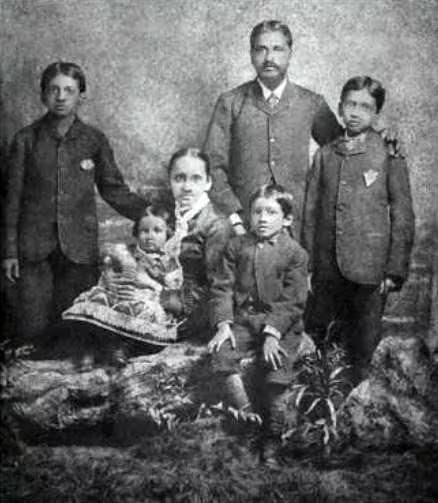
Sri Aurobindo was born in Calcutta, Bengal Presidency, into a family that was a product of the cultural crossroads of 19th-century India. His father, Dr. Krishnadhan Ghose, was a civil surgeon and a staunch Anglophile. Convinced that an English upbringing was superior, he sent his sons—Aurobindo, Benoybhushan, and Manmohan—to England in 1879 for a completely European education. Aurobindo was just seven years old.
Entrusted to the care of the Drewett family in Manchester, the young Aurobindo was insulated from Indian culture. He proved to be a prodigious student, mastering Greek and Latin with astonishing speed. His academic brilliance earned him a scholarship to St. Paul's School in London, and subsequently, another to the prestigious King's College, Cambridge. There, he excelled in classical studies, securing a first-class in the Classical Tripos examinations. The path seemed set for a distinguished career in the Indian Civil Service (ICS), the elite administrative cadre of British India.
He passed the rigorous written examinations for the ICS with high marks. Yet, during this period of deep immersion in Western literature and philosophy, a different current was stirring within him. He began to feel a growing unease with the prospect of serving the British Empire. This internal conflict culminated in a quiet act of rebellion: he failed to present himself for the mandatory horse-riding test, leading to his disqualification from the ICS in 1892. Many believe this was a deliberate choice, the first overt sign of his nascent nationalism.
While in England, he had joined secret societies like the "Lotus and Dagger," dreaming of India's liberation with fellow Indian students. The Western education intended to mould him into a loyal subject of the Crown had instead forged a powerful intellect that would soon be turned against it.
Career & Major Contributions
Aurobindo's life can be understood as two great movements, a crescendo of political action followed by a deep, sustained symphony of spiritual exploration.
The Revolutionary Nationalist (1893–1910)
In 1893, at the age of 21, Sri Aurobindo returned to an India he barely knew. He secured a position in the service of the Maharaja of Baroda, where for the next thirteen years, he served in various administrative and academic roles, including as a professor at Baroda College. This period was his self-imposed Indian re-education. He plunged into the study of Sanskrit, Bengali, and Marathi, and voraciously consumed India's foundational scriptures—the Vedas, the Upanishads, and the Bhagavad Gita. This immersion reconnected him with the soul of his motherland.
His political voice soon emerged. In a series of articles titled "New Lamps for Old," published in the journal Indu Prakash in 1893-94, he launched a scathing critique of the moderate, petition-based politics of the Indian National Congress. He found their approach to be a form of political mendicancy and called for a more self-reliant, assertive, and radical approach to achieving freedom.
The turning point came with the Partition of Bengal in 1905. This British policy, designed to divide the region along religious lines, ignited a firestorm of nationalist protest. For Aurobindo, it was a call to action. In 1906, he resigned from his comfortable position in Baroda and moved to Calcutta, plunging headfirst into the vortex of the Swadeshi movement.
He quickly became a leading voice of the Extremist faction of the Congress. As the first principal of the Bengal National College, he helped shape an alternative education system free from colonial influence. But his most potent weapon was his pen. As the editor of the nationalist newspaper Bande Mataram, his editorials were electric, articulating a clear and uncompromising vision for India. He was one of the first leaders to demand Purna Swaraj—complete and absolute independence. He laid out a comprehensive program for achieving it: Swadeshi (promotion of Indian goods), Boycott (of British goods), National Education, and Passive Resistance. Yet, he did not rule out violent struggle as a necessary last resort.
His revolutionary activities led to his arrest in May 1908 in connection with the Alipore Bomb Case, a conspiracy to assassinate a British magistrate. Though he was not directly involved in the plot led by his brother Barin, he was implicated as the mastermind. He spent a year as an undertrial prisoner in Alipore Jail.
This year of incarceration proved to be the most transformative of his life. In the solitude of his cell, his spiritual quest, which had begun years earlier, intensified dramatically. He reported a series of profound mystical experiences. The most significant was what he called the "Vasudeva experience," where the walls of his cell, the prison bars, the tree in the courtyard, the guards, and the other prisoners all seemed to shimmer and dissolve into a single divine consciousness—the presence of God, or Vasudeva. The trial that had been meant to silence him instead catalyzed his spiritual awakening.
He was acquitted in 1909, thanks to a masterful defense by the brilliant lawyer Chittaranjan Das. In his closing argument, Das uttered a prophetic statement: "Long after this controversy is hushed in silence... he will be looked upon as the poet of patriotism, as the prophet of nationalism and the lover of humanity. Long after he is dead and gone, his words will be echoed and re-echoed not only in India but across distant seas and lands."
The Yogi and Philosopher (1910–1950)
Upon his release, Aurobindo found the political landscape had changed. The British had successfully suppressed the revolutionary movement. He felt an inner guidance, an Adesh (divine command), to withdraw from active politics and dedicate himself entirely to a new, spiritual mission.
In early 1910, warned of an impending re-arrest, he secretly left British India for the French enclave of Chandernagore. From there, on April 4, 1910, he sailed to Pondicherry, a quiet coastal town in French-ruled South India. He would never leave this sanctuary for the remaining forty years of his life.
The first years in Pondicherry were spent in intense, secluded spiritual practice, or sadhana. He was charting a new spiritual path, one that did not seek escape from life but its total transformation. This path he would later call Integral Yoga.
In 1914, a pivotal meeting occurred. Mirra Alfassa, a French spiritual seeker of Turkish and Egyptian descent, arrived in Pondicherry with her husband, Paul Richard. Upon meeting Aurobindo, she immediately recognized him as the spiritual master she had envisioned in her dreams. Though she had to leave with the outbreak of World War I, she returned permanently in 1920. She became Sri Aurobindo's spiritual collaborator, and was known as The Mother. As a community of disciples grew, it was The Mother who organized it, eventually establishing the Sri Aurobindo Ashram in 1926.
From 1926 until his passing in 1950, Sri Aurobindo lived in complete seclusion, focusing his entire consciousness on his spiritual work. During this period, he produced a staggering body of work, a spiritual and philosophical legacy that is among the most profound of the modern era.
His major works, mostly serialized in the philosophical journal Arya (1914-1921), include:
The Life Divine: His philosophical magnum opus. It outlines a vast cosmology of spiritual evolution, arguing that consciousness is evolving from its involution in matter towards a supramental state, which will ultimately manifest a divine life on Earth.
The Synthesis of Yoga: A comprehensive guide to his Integral Yoga, which seeks to unify the traditional paths of knowledge (Jnana Yoga), devotion (Bhakti Yoga), and works (Karma Yoga) and elevate them towards a higher, transformative spiritual practice.
Savitri: A Legend and a Symbol: Considered his greatest literary achievement, this epic poem of nearly 24,000 lines is a poetic embodiment of his entire spiritual philosophy. Using the ancient Mahabharata tale of Savitri and Satyavan, it transforms the story into a symbol of the human soul's journey to conquer ignorance, suffering, and death through divine love and spiritual power.
Legacy & Influence
Sri Aurobindo's impact is twofold, echoing the two major phases of his life. As a nationalist, he was a torchbearer of Purna Swaraj, and his concept of India as a divine Mother-spirit galvanized a generation of freedom fighters. His writings in Bande Mataram set a new standard for revolutionary journalism and political thought.
However, his more enduring legacy lies in his spiritual philosophy. Integral Yoga represents a radical departure from many traditional Indian paths that see the material world as an illusion (maya) to be transcended. For Sri Aurobindo, the goal was not to escape the world but to divinize it. He posited the evolution of a new, "supramental" consciousness that would transform human nature itself, leading to a "life divine on earth."
This vision found its most tangible expression in two institutions. The Sri Aurobindo Ashram in Pondicherry continues to be a vibrant center for the practice of his yoga. And Auroville, the "city of human unity" founded by The Mother in 1968 near Pondicherry, stands as a unique global experiment dedicated to realizing human unity and conscious evolution, inspired by his teachings.
He was also a literary giant. Nominated for the Nobel Prize in Literature in 1943 and 1950, his prose is marked by its intellectual rigor and spiritual depth, while his poetry, especially Savitri, is a monumental work of spiritual art.
Sri Aurobindo passed away on December 5, 1950. He is remembered today not just as a patriot or a poet, but as a Mahayogi—a great seer who offered humanity a breathtaking vision of its future potential. In the beautiful, poignant symmetry of history, the man born on India's future Independence Day dedicated his life first to the freedom of its body, and then to the evolution of its soul.