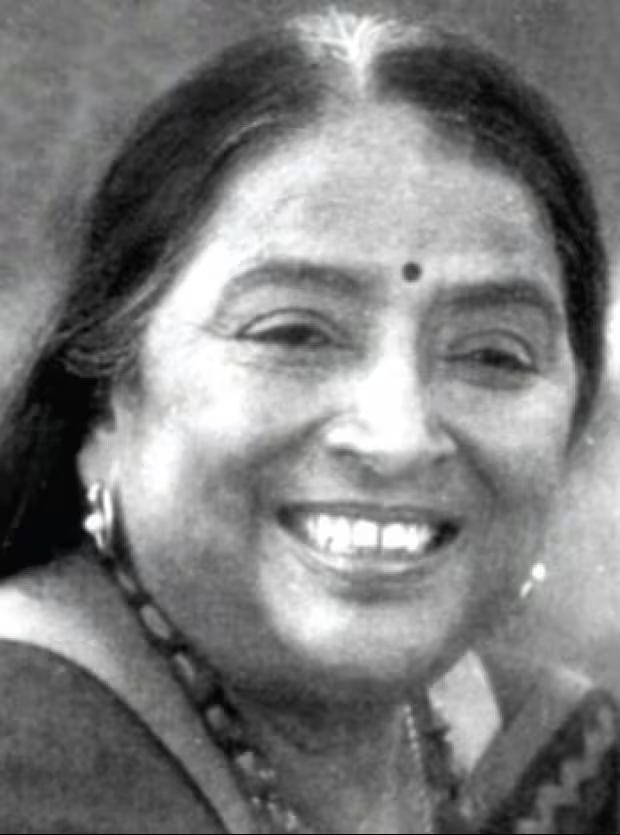
B. Prabha: The Soulful Chronicler of Indian Womanhood
In the vibrant, male-dominated landscape of post-Independence Indian art, one artist chose a singular, unwavering focus: the Indian woman. Not the deified goddess or the romanticized muse, but the real, toiling, pensive woman of rural India. B. Prabha (1933-2001) dedicated her life's work to capturing the silent dignity, the melancholic grace, and the resilient spirit of these women. Through her signature style of elegant, elongated figures, she created a visual language that was both deeply personal and universally resonant, securing her place as one of the most significant and recognizable artists of her generation.
Early Life & Background
Prabha’s journey began on 22nd July 1933, in the small village of Bela, near Nagpur in Maharashtra. Her roots in this rural setting would become the very soil from which her artistic vision grew. Surrounded by the rhythms of village life, she was an early witness to the lives of the women who would later populate her canvases—their daily labour, their quiet fortitude, and the subtle sorrows etched upon their faces. While details of her immediate family are not extensively documented, it is known that her father was a sculptor, an early exposure that likely nurtured her innate artistic inclinations.
Driven by a passion that was remarkable for a young woman of her time and place, Prabha enrolled at the Nagpur School of Art. Her talent was evident, but her ambition extended beyond the confines of her hometown. In 1954, with dreams of making her mark on the national stage, she made the momentous decision to move to Bombay (now Mumbai), the bustling epicentre of India's art world.
Her initial years in the city were fraught with struggle. As a young artist with limited means, she faced immense financial hardship. A now-famous anecdote from this period recounts how she sold her personal jewellery to buy art materials and sustain herself, a testament to her fierce determination. It was in this crucible of creativity and challenge that she found her footing, enrolling at the prestigious Sir J.J. School of Art. Here, she honed her skills, graduating in 1957 with a Diploma in both Painting and Mural Painting. The academic environment provided her with technical rigour, but her true subject matter remained tethered to the memories of her village.
Bombay was also where she met her future husband and lifelong creative partner, the artist and sculptor B. Vithal. They married in 1956, embarking on a partnership that was both deeply personal and professionally symbiotic. Together, they navigated the complexities of the art world, supporting and inspiring each other until Vithal's death in 1992.
Career & Major Contributions
B. Prabha's ascent in the art world was swift and decisive. Even before completing her diploma, she held her first major exhibition in 1956. This joint show with her husband, B. Vithal, at the Artists' Centre in Bombay, proved to be a turning point. It was here that her work caught the discerning eye of Dr. Homi J. Bhabha, the eminent physicist and a legendary patron of modern Indian art. Bhabha purchased one of her paintings, The Young Bride, for the prestigious collection of the Tata Institute of Fundamental Research (TIFR). This acquisition was more than a sale; it was a powerful endorsement that catapulted the young artist into the limelight.
From that point on, Prabha's career was a story of prolific creation and critical acclaim. She went on to hold over 50 solo exhibitions in India and internationally, showcasing her work in cities like London and Paris. Her singular focus on the female form became her defining characteristic. When once asked about her persistent theme, she made a statement that has since become synonymous with her artistic philosophy: "I have yet to see one happy woman."
This profound observation formed the emotional core of her oeuvre. Her women were not passive subjects; they were imbued with a rich inner life. They were often depicted with downcast eyes, lost in thought, their graceful forms conveying a sense of melancholy and quiet contemplation.
The Signature Style
Prabha’s style is instantly recognizable. Her primary contribution was the development of a unique figurative language characterized by:
- Elongated Forms: Her figures, with their long necks, slender limbs, and oval faces, are elegant and stylized, moving beyond strict realism to capture an emotional essence.
- Dominant Colour Palette: She often used a single, dominant colour to saturate the canvas, creating a powerful, uniform mood. Earthy tones—ochres, browns, reds, and yellows—evoked the rural landscape, while cooler blues and greys conveyed a sense of introspection and sorrow.
- Thematic Consistency: While her style evolved, her subject remained constant. She painted fisherwomen from the Koli community of Mumbai, their bodies strong from their labour; she depicted Rajasthani women in vibrant attire, their faces still marked by a shared melancholy; she captured the plight of women in drought-stricken regions, their forms stark against a barren landscape. Her series on Kashmiri women and Goan fisherfolk further demonstrated her commitment to exploring the diverse, yet unified, experience of Indian womanhood.
Major Works and Impact
Prabha’s work was not overtly political, yet it carried a powerful social commentary. By focusing on the marginalized rural woman, she gave visibility to a segment of the population largely ignored in the grand narratives of a newly independent nation. She portrayed their labour, their environment, and their social constraints with empathy and dignity.
Her Fisherwomen series is perhaps her most celebrated. Inspired by the coastal communities near her home in Bombay, these paintings capture the strength and grit of the Koli women. With baskets on their heads and a determined gaze, they are depicted not as victims, but as pillars of their community, their grace undiminished by their hardship.
Her work found a home in some of India’s most important art collections, including the National Gallery of Modern Art (NGMA) in New Delhi and the Lalit Kala Akademi. She was also one of the many modern artists commissioned by Air India, which in the mid-20th century built a formidable collection of contemporary art. Her paintings adorned their calendars and offices, introducing her accessible yet profound style to a much wider, non-specialist audience and helping to democratize modern art in India.
Legacy & Influence
B. Prabha passed away in Nagpur in 2001, leaving behind a vast and influential body of work. Her legacy is multifaceted and continues to resonate in the world of Indian art.
A Pioneer for Women Artists
In an era when the art scene was dominated by male artists and collectives like the Progressive Artists' Group, B. Prabha carved out a distinct and powerful identity for herself. She was one of the first modern Indian women artists to achieve significant commercial success and critical recognition purely on her own terms. By placing the female experience at the absolute centre of her art, she paved the way for future generations of women artists to explore themes of identity, gender, and social reality.
The Iconography of the Indian Woman
Prabha’s greatest contribution is arguably the creation of an iconic visual representation of the rural Indian woman. Her elongated, graceful figure has become a shorthand in Indian art history for a specific kind of modern Indian sensibility—one that is rooted in tradition but expressed through a modern, stylized form. She gave a face to the silent majority, portraying them with a deep, abiding respect that elevated their everyday struggles into a subject worthy of high art.
Enduring Relevance
Today, B. Prabha's paintings are highly coveted by collectors and celebrated in major retrospectives. Her work is remembered not just for its aesthetic appeal but for its profound humanism. She was a chronicler of a changing India, capturing the anxieties and hopes of a nation through the eyes of its women. Her art serves as a timeless reminder of the power of a focused vision and the importance of empathy in creation. She found the universal in the particular, and in the graceful, melancholic lines of a single village woman, she painted the story of an entire subcontinent.