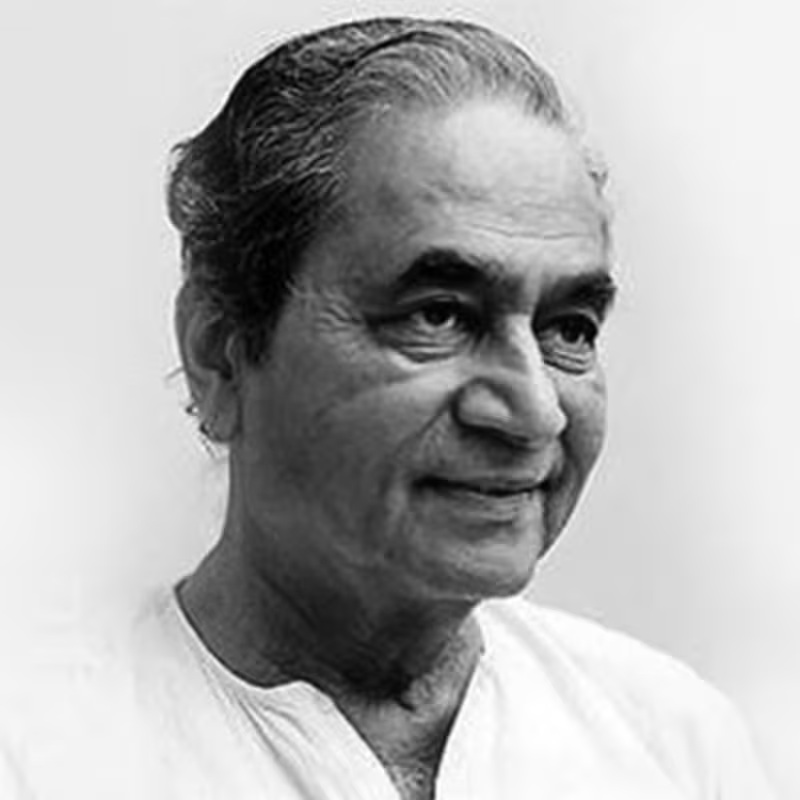
Badri Narayan: The Storyteller on Canvas
In the vibrant tapestry of post-independence Indian art, where movements and manifestos often defined an artist's identity, Badri Narayan stood as a gentle, singular voice. He was a storyteller first and foremost, a self-taught polymath whose universe unfolded not in grand, abstract gestures, but in intimate, narrative tableaus. An artist, illustrator, author, and teacher, Narayan (1929-2013) crafted a deeply personal visual language that drew from the ancient wells of Indian mythology, fables, and folklore, reinterpreting them with a modern, humanist sensibility. His work was a quiet rebellion against the dominant trends of abstraction, a testament to the enduring power of the story and the symbol in a rapidly changing world.
Early Life & The Making of a Storyteller
Badri Narayan was born on July 22, 1929, in Secunderabad, then part of the princely state of Hyderabad. His childhood was steeped in the very traditions that would later permeate his art. He was raised in a household where stories were a part of daily life, spun by his grandmother who filled his imagination with tales from the Ramayana, the Mahabharata, and countless local fables. His father, a schoolteacher, instilled in him a love for literature and learning.
Unlike many of his contemporaries who sought formal training at established art schools like the J.J. School of Art in Bombay or Santiniketan in Bengal, Narayan's path to art was entirely his own. He was an autodidact, driven by an innate passion for drawing and an insatiable curiosity. His formal education led him to an M.A. in English Literature, a qualification that would profoundly shape his artistic vision. This literary background gave him a unique perspective, allowing him to approach his canvas not just as a surface for colour and form, but as a page on which to inscribe a narrative.
His artistic journey began in earnest in 1949. For five years, he balanced a day job with his passion for painting, honing his skills through relentless practice and observation. The cultural environment of Hyderabad, a melting pot of Deccani and Mughal traditions, provided a rich visual backdrop. He held his first solo exhibition in Hyderabad in 1954, a pivotal moment that solidified his resolve. Shortly after, he made the momentous decision to dedicate his life entirely to art, moving to Bombay (now Mumbai), the bustling epicentre of the Indian art world.
Career & Contributions: A Universe in Watercolour and Ink
Badri Narayan’s career was a testament to his versatility and unwavering commitment to his unique vision. He worked across a remarkable range of mediums, including watercolour, ink, pastels, woodcuts, engravings, and even ceramic tiles, but it was in the delicate and luminous medium of watercolour that he found his most eloquent voice.
The Artist's Vision
Narayan’s style was distinct and immediately recognizable. He consciously eschewed the Western traditions of perspective and chiaroscuro (the use of strong contrasts between light and dark). Instead, his works possessed a two-dimensional, flattened quality reminiscent of Indian miniature paintings and folk art. His compositions were carefully structured, with figures often placed centrally, creating a sense of intimate, theatrical staging.
His visual vocabulary was built on a foundation of recurring symbols. The figures in his paintings—the bearded sage, the graceful woman, the curious child—were not specific individuals but archetypes, representing universal human experiences. Animals, too, played a crucial symbolic role: the wise crow, the intuitive cat, the steadfast horse, each carrying layers of meaning drawn from fables and personal mythology. These elements came together to create what he called a “private world of symbols,” a language through which he explored themes of life, death, relationships, and spiritual quests.
His subjects were deeply rooted in Indian tradition. He drew extensively from the Jataka Tales, the Panchatantra, and the great epics. However, his paintings were never mere illustrations. He used these ancient stories as a framework to comment on contemporary human emotions and dilemmas. A scene from the Mahabharata might become a meditation on conflict and duty, while a simple fable could transform into a profound statement on wisdom and folly.
The Prolific Illustrator
Parallel to his career as a painter, Badri Narayan was one of India's most distinguished illustrators. For decades, his charming and evocative line drawings graced the pages of renowned publications like The Illustrated Weekly of India and The Times of India. This work was not a secondary pursuit but an integral part of his artistic practice. It allowed him to bring his narrative art to a mass audience, making his unique style accessible to people from all walks of life.
He was particularly passionate about illustrating for children. He collaborated extensively with the National Book Trust and other publishers, lending his art to numerous children's books, including illustrated versions of the Ramayana and the Mahabharata. His illustrations were never condescending; they respected the intelligence of the young reader, using simple, expressive lines to convey complex emotions and stories with clarity and warmth.
The Writer's Pen
Narayan’s literary background was not just an early influence; it was a continuous creative stream that ran alongside his art. He was an accomplished writer, authoring short stories and fables for both children and adults. His art and writing were inextricably linked. Often, a story he wrote would inspire a painting, or a visual idea on his canvas would blossom into a written narrative. This seamless integration of the visual and the literary made him a complete storyteller, a modern-day sutradhar who used both image and word to engage his audience.
Recognition and Acclaim
Throughout his long and productive career, which spanned over six decades and included more than 50 solo exhibitions, Badri Narayan received widespread recognition for his contributions. In 1965, he was honoured with the National Award from the Lalit Kala Akademi, India’s premier institution for fine arts. The pinnacle of his state recognition came in 1987 when the Government of India conferred upon him the Padma Shri, the fourth-highest civilian award, for his immense contribution to Indian art and culture.
Legacy & Influence: A Gentle Modernist
Badri Narayan passed away on September 23, 2013, in Mumbai, leaving behind an extraordinary body of work and an enduring legacy.
Historical Significance
In the historical context of Indian modernism, Badri Narayan carved a unique and important niche. While many of his peers in the Progressive Artists' Group were looking to European modernism and abstraction, Narayan chose a different path. He demonstrated that modernity in Indian art did not require a rejection of its rich narrative and figurative traditions. His work served as a vital bridge between India's classical and folk past and its modern artistic present. He proved that an artist could be contemporary while remaining deeply rooted in their own cultural soil.
His status as a self-taught artist is also a significant part of his legacy. In a field often dominated by institutionally trained artists, his success was an inspiration, proving that vision, dedication, and a unique voice could triumph over a lack of formal academic training.
Lasting Impact
Badri Narayan's influence is most profoundly felt in his championing of narrative art. He kept the art of storytelling alive in Indian painting, reminding a generation of artists and viewers that a painting could be a poem, a fable, and a philosophical reflection all at once. His accessible, humane style demystified art for many, inviting viewers into his world with warmth and generosity rather than intellectual austerity.
As an illustrator, he elevated the craft, setting a high standard for narrative drawing and influencing countless artists who followed. His work for children, in particular, helped shape the aesthetic sensibilities of generations of young Indians.
Today, Badri Narayan is remembered as a quiet master, a sage-like figure whose art speaks in a gentle but profound whisper. His works are treasured by collectors and celebrated in museums as timeless explorations of the human condition. In his deceptively simple lines and luminous colours, we find a world of wisdom, wonder, and deep humanity—a world built by a man who was, above all, a magnificent storyteller.