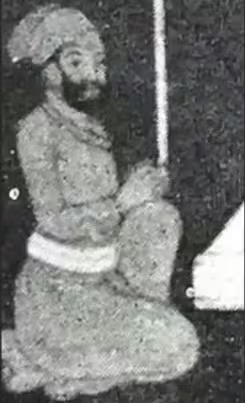
The Lion Who Caged an Empire: Baghel Singh's Conquest of Delhi
In the tumultuous theatre of 18th-century India, where empires crumbled and new powers rose from their ashes, few moments were as symbolically potent as the sight of the saffron Nishan Sahib, the revered flag of the Sikh Khalsa, flying atop the Red Fort in Delhi. This was the heart of the Mughal Empire, a citadel that had projected absolute power for centuries. In March 1783, it was humbled by a confederacy of Sikh warriors. The man who orchestrated this audacious feat, who held the Mughal Emperor Shah Alam II captive to his will, and who used this power not for personal glory but to reclaim a sacred heritage, was Sardar Baghel Singh Dhaliwal.
A master strategist, a devout follower of the Gurus, and the formidable leader of the Karorasinghia Misl, Baghel Singh was a product of his time—an era of chaos that demanded men of extraordinary courage and vision. His life's work was the culmination of a century-long Sikh struggle for survival and sovereignty, and his greatest achievement was etching the Sikh identity permanently onto the landscape of the imperial capital.
Early Life & Rise in the Dal Khalsa
Baghel Singh was born around 1730 in the village of Jhabal Kalan, near Amritsar, into a Dhaliwal Jat family. His formative years unfolded against a backdrop of relentless conflict. The Punjab was a battleground, caught between the decaying Mughal authority from Delhi, the recurring, brutal invasions of Afghan rulers like Ahmad Shah Abdali, and the fierce, nascent resistance of the Sikh Misls.
For a young man like Baghel Singh, the call of the Khalsa—the martial brotherhood established by Guru Gobind Singh—was not merely a matter of faith, but a path to survival and honour. He was drawn into the fold of the Dal Khalsa, the confederate army of the Sikhs, a formidable guerrilla force that lived in the saddle and challenged the might of empires. He joined the fighting group, or jatha, that would later be known as the Karorasinghia Misl, named after its formidable leader, Sardar Karora Singh.
Baghel Singh quickly distinguished himself through his bravery, intelligence, and leadership. When Karora Singh was killed in battle in 1761, the mantle of leadership of this powerful Misl, which commanded a force of over 10,000 horsemen, fell upon Baghel Singh. From his headquarters at Chhalaundi, near present-day Karnal, he began to consolidate his power and expand his Misl's influence across the Cis-Sutlej region, the strategically vital plains between the Sutlej and Yamuna rivers.
Career & Major Contributions: The Road to Delhi
As a Misl chief, Baghel Singh was both a nation-builder and a warlord. He, along with other Sikh Sardars, perfected a system of governance and control in the chaotic political vacuum of the time. They established the 'Rakhi' system, offering protection to villages and towns from other invaders in exchange for a portion of their revenue. This was not mere extortion; it was the foundation of a new Sikh-dominated political order in the region.
His military ambitions, however, lay further south, in the fertile and wealthy Ganga-Yamuna Doab—the Mughal heartland. Throughout the 1770s, Baghel Singh, often in alliance with other powerful Misl leaders like Jassa Singh Ahluwalia and Jassa Singh Ramgarhia, led daring raids deep into Mughal territory. These were not simply for plunder; they were strategic strikes designed to cripple Mughal resources, destabilize their administration, and boldly proclaim the arrival of Sikh power at the gates of Delhi.
They repeatedly outmaneuvered and defeated the forces of powerful adversaries like Zabita Khan, the Rohilla chief who controlled large swathes of territory east of the Yamuna. These campaigns showcased Baghel Singh’s mastery of swift cavalry warfare, which left the larger, more cumbersome imperial armies bewildered and helpless.
The Apex: Conquest of the Mughal Capital (1783)
The winter of 1783 presented the perfect opportunity. The Mughal Empire under Shah Alam II was a hollow shell. The emperor was a ruler in name only, his authority barely extending beyond the walls of his capital, his court a nest of intrigue and treachery. The Dal Khalsa, sensing the weakness, united for its most audacious campaign yet.
A formidable force of approximately 30,000 Sikh horsemen under the joint command of Jassa Singh Ahluwalia, the supreme leader of the Dal Khalsa, and Baghel Singh crossed the Yamuna. They swept through the Mughal territories with impunity. On March 8, 1783, they captured Malka Ganj and Sabzi Mandi, wealthy suburbs of Delhi.
The city was in a state of panic. The small, demoralized Mughal force sent to confront them was routed. On March 11, the Sikh forces stormed into the city. While Jassa Singh Ramgarhia secured the area around Red Fort, Baghel Singh and Jassa Singh Ahluwalia established their camp at a place now known as Tis Hazari, named after the 30,000 horsemen encamped there.
The Sikhs were now masters of the imperial capital. In a moment of immense symbolic power, the Dal Khalsa entered the Diwan-i-Am (Hall of Public Audience) in the Red Fort and placed Jassa Singh Ahluwalia on the Mughal throne. This act, while brief, was a powerful declaration of Sikh sovereignty and a reversal of a century of persecution.
Terrified, Emperor Shah Alam II and his courtiers hid in the palace's private chambers. They sent emissaries to negotiate a truce. The treaty that followed is a testament to Baghel Singh’s political acumen and his deep-seated devotion to his faith. The terms were remarkable:
- The main body of the Dal Khalsa would withdraw from Delhi upon receiving a substantial payment.
- Sardar Baghel Singh would remain in the city with a contingent of 4,000 troops.
- Crucially, Baghel Singh was granted the authority and funds to locate, acquire land for, and construct gurdwaras at sites sanctified by the Sikh Gurus.
- To finance this monumental task, he was given control over the city's police station (Kotwali) in the Chandni Chowk area and was permitted to charge a commission of six annas on every rupee (a 37.5% share) of the city's tax and trade revenue.
For nearly eight months, from March to December 1783, Baghel Singh was the de facto power in Delhi. The Mughal emperor paid him, and the city's administration answered to him. But his mission was not imperial; it was spiritual.
The Architect of Delhi's Gurdwaras
Baghel Singh embarked on his sacred task with methodical zeal. He faced the immense challenge of identifying sites whose histories had been deliberately obscured over the decades. Aided by local intelligence, particularly an elderly Muslim woman who had witnessed the events of 1675, he began his work.
His most significant constructions include:
Gurdwara Sis Ganj Sahib: He identified the exact spot in the heart of Chandni Chowk where the ninth Guru, Guru Tegh Bahadur, was martyred in 1675. The site was occupied by a mosque. Baghel Singh laid claim to the location, and when the local authorities disputed it, he famously promised to spare the mosque if they could find the well into which the Guru’s executioner had washed his hands. The well was found, validating the Sikh claim, and the Gurdwara was built.
Gurdwara Rakab Ganj Sahib: This shrine marks the place where the brave Lakhi Shah Vanjara and his son cremated the headless body of Guru Tegh Bahadur by setting their own house on fire to avoid Mughal detection. Baghel Singh honored this supreme act of devotion by building a magnificent shrine.
Gurdwara Bangla Sahib: He located the bungalow (haveli) of Raja Jai Singh where the eighth Guru, Guru Har Krishan, had stayed and tended to the sick during a smallpox epidemic, eventually succumbing to the illness himself.
Gurdwara Bala Sahib: He built a shrine on the banks of the Yamuna where Guru Har Krishan was cremated.
Gurdwara Majnu Ka Tilla: He identified the historic location where the first Guru, Guru Nanak, had camped during his visit to Delhi in the 16th century.
In just a few months, Baghel Singh accomplished a task of immense historical and religious importance. He did not just build structures of brick and mortar; he resurrected a sacred geography, giving the Sikh community permanent, physical anchors to their history in the very heart of the empire that had tried to erase them.
Legacy & Influence
After fulfilling his mission in Delhi, Baghel Singh returned to his territories in Punjab in late 1783. He continued to rule as a powerful chieftain until his death around 1800 in Hariana, in the Hoshiarpur district. Having no direct heir, his territories were eventually absorbed into the burgeoning Sikh Empire of Maharaja Ranjit Singh.
Baghel Singh's legacy, however, transcends the lifespan of his Misl. He is remembered not as an emperor, but as a selfless servant of the Khalsa Panth.
The Conqueror with a Conscience: His conquest of Delhi was not an end in itself. Unlike other conquerors who sought to establish dynasties, he used his absolute power to fulfill a religious and historical mandate. The treaty he signed with Shah Alam II is a masterclass in using military leverage for cultural preservation.
A Symbol of Sikh Sovereignty: The image of the Nishan Sahib flying over the Red Fort, however briefly, became an indelible part of Sikh history and folklore. It symbolized the ultimate triumph of the Khalsa after decades of persecution, a definitive statement that they were now a power to be reckoned with on the Indian subcontinent.
The Enduring Shrines of Delhi: His most tangible legacy remains the network of gurdwaras he established. Today, these shrines are not just historical monuments; they are vibrant centers of faith, community, and service, drawing millions of pilgrims and visitors. Every time a devotee bows their head at Gurdwara Sis Ganj or partakes in the langar (community kitchen) at Gurdwara Bangla Sahib, they are living a part of Baghel Singh's legacy.
Sardar Baghel Singh Dhaliwal was a quintessential 18th-century Sikh leader—a fierce warrior, a shrewd politician, and a man of unwavering faith. He rose from the chaos of his time to command armies and challenge an empire, but his greatest victory was ensuring that the sacrifices of his Gurus would be remembered and revered for centuries to come, right in the heart of the city that had once sought to silence them.