The Last Sigh of the Mughal Empire: Bahadur Shah Zafar
In a small, dilapidated wooden house in Rangoon, far from the marble pavilions and bustling lanes of his beloved Delhi, an old man dipped his pen in ink. He was a king without a kingdom, an emperor in exile, a prisoner of a foreign power that had systematically dismantled his heritage. His name was Abu Zafar Siraj-ud-din Muhammad Bahadur Shah, but history would remember him by his poetic signature, Zafar—'Victory'. It was a name steeped in bitter irony, for his life was a testament not to victory, but to a profound and tragic loss that marked the final, gasping breath of the mighty Mughal Empire.
Bahadur Shah Zafar was the last of a dynasty that included titans like Akbar, Jahangir, and Shah Jahan. Yet, his story is not one of conquest or architectural splendor. It is a poignant tale of a cultured, sensitive poet forced by destiny to preside over the twilight of his dynasty and become the unwilling figurehead of India's First War of Independence.
Early Life: A Prince in a Gilded Cage
Born on October 24, 1775, Mirza Abu Zafar was the son of Emperor Akbar Shah II and his Hindu Rajput wife, Lal Bai. He came into a world where the Mughal Empire was a phantom of its former self. The once-vast dominion that stretched across the subcontinent had shrunk to the confines of Delhi, specifically the great red-walled fortress, the Qila-i-Mubarak (the Red Fort). The real power in Hindustan was the British East India Company, which paid the Emperor a pension and kept a Resident in his court, a minder who held the true authority.
Zafar was not his father's chosen heir. Akbar Shah II favoured his younger son, Mirza Jahangir, a preference that perhaps inadvertently shaped Zafar's future. Sidelined from the intrigues of succession, Zafar immersed himself in the softer, more refined pursuits of the court. He received a superb education in the classical languages of Persian and Arabic, but his heart belonged to Urdu. He studied calligraphy, music, and the deep, mystical traditions of Sufism, becoming a disciple of the noted saint Shah Ghulam Mustafa.
His formative years were spent within the Red Fort, a city within a city that was a microcosm of a dying empire. It was a place of fading grandeur, where elaborate court rituals were performed with meticulous care, even as the Emperor’s power evaporated beyond the fort’s walls. This environment nurtured in Zafar a deep melancholy and a philosophical detachment, themes that would later dominate his poetry. He grew up understanding that his title was a magnificent relic, and his throne, a gilded cage.
Career: The Poet on a Phantom Throne
On September 28, 1837, upon the death of his father, the 62-year-old Zafar ascended the throne. He was Emperor of India in name only. The coins were still struck with his image, and he was the recipient of formal respect, but his authority was a carefully managed illusion. The British dictated policy, controlled the treasury, and their military power was absolute. Zafar was, for all practical purposes, a pensioner of the Company.
Despite his political impotence, Zafar’s reign was a period of extraordinary cultural brilliance, often called the last great renaissance of Mughal culture. The court of Delhi, under his patronage, became the undisputed centre of the Urdu literary world. Zafar, an accomplished poet in his own right, presided over a court that glittered with poetic genius. His own ustad (teacher) was the poet laureate, Sheikh Ibrahim Zauq. And in the lanes of Delhi lived Zauq’s great rival, the inimitable Mirza Ghalib. The poetic duels and mushairas (symposiums) of Zafar's court were legendary, representing the final, brilliant flare of a culture on the verge of extinction.
Zafar wrote under the takhallus (pen name) Zafar. His poetry, primarily in the form of ghazals, is suffused with Sufi mysticism, a deep sense of world-weariness (duniyadari), and the poignant sorrow of life’s transient nature. He wrote of love, loss, and the search for the divine, but his verses also carry the unmistakable weight of a man presiding over a magnificent decay. His words were the soul of a culture that had turned inward, finding solace in art and spirituality as its political power crumbled.
For nearly two decades, this fragile world persisted. Zafar held his court, composed his poetry, and oversaw the intricate rituals of the Red Fort, a phantom emperor ruling over a city of memories.
The Storm of 1857: The Reluctant Emperor
On the hot morning of May 11, 1857, this delicate balance was shattered forever. A group of rebellious sepoys from the garrison at Meerut, having mutinied against their British officers over the infamous greased cartridges, rode into Delhi. They swarmed the Red Fort, massacred the British officials in the city, and sought out the bewildered, 82-year-old Emperor.
They proclaimed him their leader, the restored Emperor of Hindustan. Zafar was horrified and hesitant. He was an old man, a poet, not a commander. He understood the terrifying might of the British and the likely consequences of such a rebellion. Accounts suggest he pleaded with the sepoys, citing his age and feebleness. But he was left with no choice. Caught between the bayonets of the sepoys and the looming wrath of the British, he gave his reluctant consent. A symbol was needed to unite the disparate rebel forces, and who better than the occupant of the throne of Akbar?
Overnight, Bahadur Shah Zafar was transformed from a pensioned figurehead into the leader of the greatest challenge to British power in India. For a few brief months, Delhi was the epicentre of the revolt. A rudimentary administration was established in Zafar's name, with his sons, particularly Mirza Mughal, taking on military roles. The Emperor issued proclamations calling for the unity of Hindus and Muslims against the foreign ruler, embodying the syncretic ideals of his ancestors.
However, the rebellion was chaotic and poorly organized. Zafar had little real control over the fractious sepoy leaders, and the 'liberated' city descended into disorder. He was a frail anchor in a raging storm. The British, recovering from their initial shock, regrouped and laid siege to Delhi. The ensuing battle, lasting from June to September 1857, was brutal. The city was bombarded relentlessly, its people starved, and its defences eventually breached.
On September 20, 1857, Delhi fell. The British unleashed a wave of horrific retribution, massacring soldiers and civilians alike. The city was looted, and its great monuments were desecrated. The cultural world that Zafar had so carefully nurtured was annihilated in a storm of fire and blood.
Legacy: Exile, Death, and the Poet's Enduring Voice
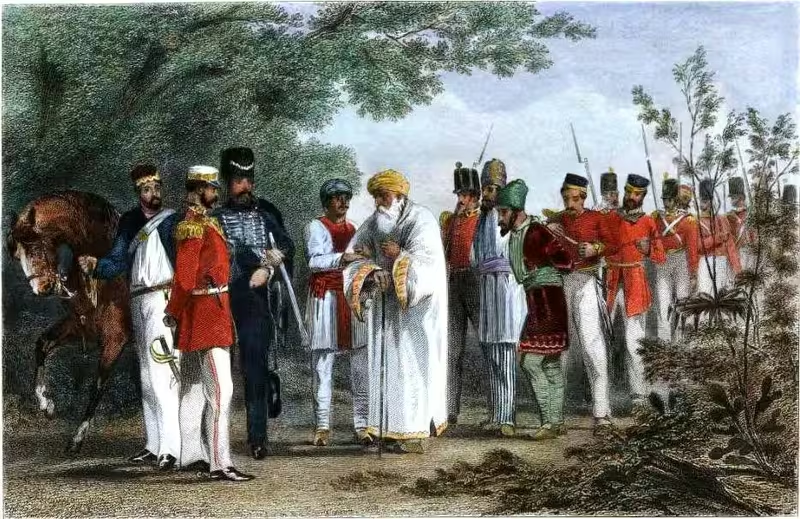
Zafar, along with his wife Zeenat Mahal and his sons, had taken refuge in the grand tomb of his ancestor, Humayun. It was here that he surrendered to Major William Hodson on the promise that his life would be spared. In a brutal act of treachery, Hodson later captured Zafar’s sons and grandsons, stripped them, and executed them in cold blood at the spot now known as Khooni Darwaza (The Bloody Gate).
The final humiliation was yet to come. The British put the last Mughal Emperor on trial in his own hall of audience, the magnificent Diwan-i-Khas in the Red Fort. The charges were treason, rebellion, and murder. The trial was a piece of political theatre, designed to legally extinguish the Mughal dynasty. The irony was stark: the East India Company, a trading entity that had ruled in the Mughal Emperor's name, was now charging that very sovereign with treason against them. The verdict was a foregone conclusion. Zafar was found guilty.
Rather than executing him and creating a martyr, the British exiled him to the farthest corner of their new empire: Rangoon, Burma. Stripped of his titles and dignity, the frail old poet was transported in a bullock cart and then by ship, leaving behind the land of his ancestors forever. He spent his final four years as a state prisoner, confined to a small, guarded compound. His only solace was his poetry, where he poured out his grief, his longing for Delhi, and his profound sense of loss.
He died on November 7, 1862, at the age of 87. Fearing his tomb would become a shrine for future rebellions, the British buried him in an unmarked grave, with the anonymous rites of a common man. His jailor, Captain H.N. Davies, wrote, "A bamboo fence was put around the grave for some distance, and by the time the fence is worn out, the grass will have again covered the spot, and no vestige will remain to distinguish where the last of the Great Moghuls rests."
But a poet's voice cannot be so easily silenced. A couplet, famously attributed to him, perfectly encapsulates his tragedy:
Kitna hai bad-naseeb 'Zafar' dafn ke liye Do gaz zameen bhi na mili kuu-e-yaar mein
(How unfortunate is Zafar! For his burial Not even two yards of land were to be had in the land of his beloved.)
For over a century, the location of his grave was lost. It was only rediscovered in 1991 during excavations in Yangon. Today, it is a Sufi dargah, a shrine visited by people of all faiths.
Bahadur Shah Zafar’s legacy is complex and deeply poignant. As an emperor, he was a failure, a powerless monarch who oversaw the final dissolution of his empire. But as a symbol, he is immensely powerful. He represents the end of an era, the last sovereign of a 300-year-old dynasty. In the Indian national consciousness, he is remembered as a patriotic, secular figure who, in his final, tragic hour, stood as a symbol of unity against colonial rule. Above all, he is remembered as Zafar the poet, whose mournful ghazals have outlived his empire, his throne, and his captors, echoing through time as the last, haunting sigh of Mughal India.