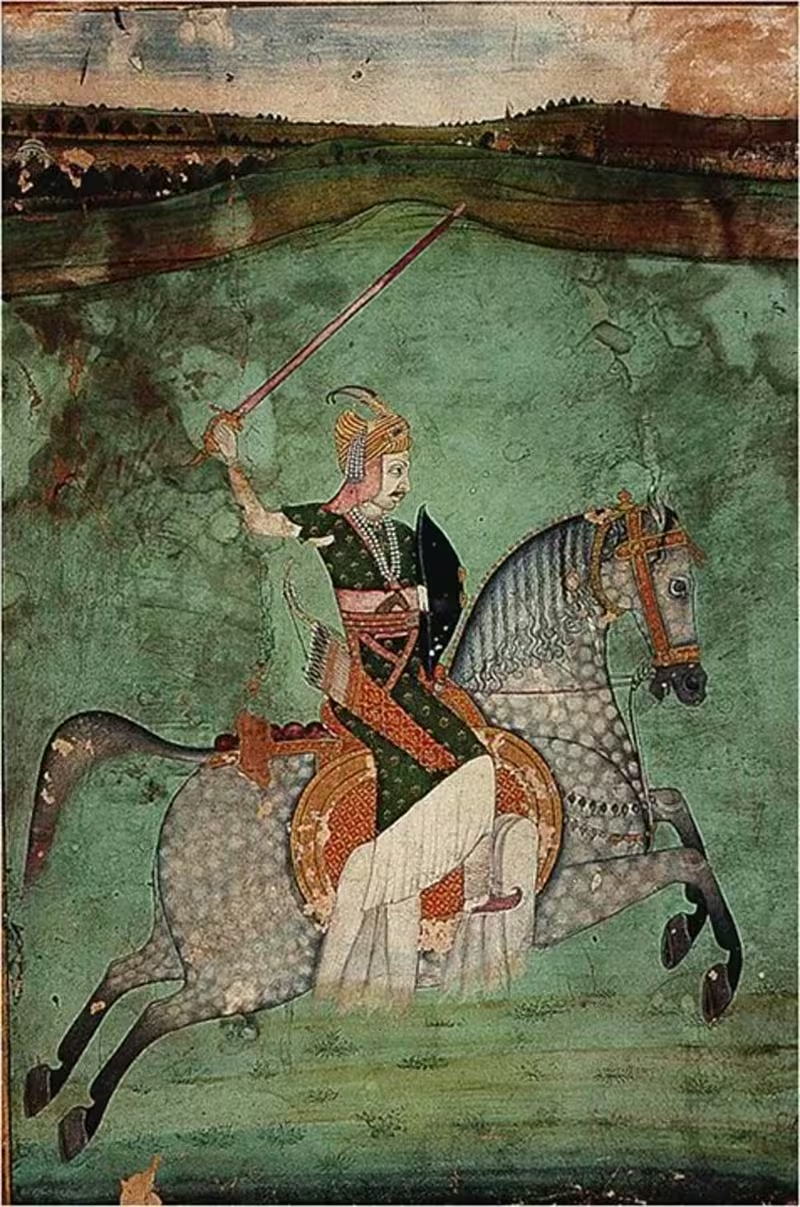
The Storm from the Deccan: Shrimant Bajirao Ballal
In the grand tapestry of Indian history, few figures stride with the same relentless, conquering momentum as Shrimant Bajirao Ballal Bhat, popularly known as Bajirao I. He was not a king born to a throne, but a Peshwa (Prime Minister) who, through sheer military genius and indomitable will, became the de facto ruler of the Maratha state and the architect of its imperial ambitions. In a brief but brilliant career spanning twenty years (1720-1740), this warrior-statesman never lost a single battle, redrawing the map of 18th-century India and shaking the foundations of the declining Mughal Empire. His story is one of audacious strategy, lightning-fast campaigns, and an unyielding vision to carry the saffron Maratha flag—the Bhagwa Dhwaj—across the subcontinent.
Early Life & The Forging of a Warrior
Bajirao was born on August 18, 1700, into the influential Bhat family, a lineage of Konkanastha Chitpavan Brahmins who had distinguished themselves through administrative skill and loyalty. His father, Balaji Vishwanath, was a man of exceptional diplomatic talent who had risen to become the first hereditary Peshwa under Chhatrapati Shahu I, the grandson of the legendary Shivaji Maharaj. Balaji Vishwanath had skillfully navigated the treacherous politics of the time, consolidating Maratha power and restoring stability to a kingdom fractured by civil war and Mughal incursions.
From a very young age, Bajirao and his younger brother, Chimaji Appa, were immersed in this world of statecraft and warfare. Their education was not confined to scriptures and texts; it took place in the saddle, on the campaign trail, and in the royal court. Accompanying their father on military and diplomatic missions, the young Bajirao witnessed firsthand the art of negotiation, the logistics of managing an army, and the complex dynamics of power. He learned to read the terrain as astutely as he read a political opponent, developing a sharp, analytical mind that could process vast amounts of information and formulate decisive plans.
This formative period coincided with a pivotal moment in Indian history. The formidable Mughal Empire, once an unchallengeable behemoth, was crumbling under the weight of weak successors, internal rebellions, and administrative decay. This power vacuum created an opportunity that the ambitious Marathas, under the sagacious Chhatrapati Shahu, were perfectly poised to exploit. It was into this charged atmosphere that Bajirao would step, not merely as a participant, but as the primary force of change.
The Warrior Peshwa: A Career of Conquest
In 1720, following the sudden death of his father, the twenty-year-old Bajirao was appointed Peshwa by Chhatrapati Shahu. The appointment was met with skepticism and jealousy from senior nobles and commanders at the court, who viewed him as too young and inexperienced for such a high office. However, Shahu, a shrewd judge of character, saw in Bajirao's eyes a fire and a strategic brilliance that belied his age. He famously declared, “He has the head to plan and the hand to execute.” Shahu’s faith would be vindicated beyond all expectations.
The Doctrine of Expansion and Lightning Warfare
Bajirao inherited a stable kingdom, but his vision was far grander. He was a proponent of an aggressive expansionist policy, famously articulated as Hindu Pad Padshahi (Hindu Emperorship). He believed that the time was ripe to strike at the heart of the decaying Mughal power and establish Maratha supremacy across India. In a powerful speech at Shahu’s court, he is said to have declared, “Let us strike at the trunk of the withering tree, and the branches will fall off themselves. By directing our efforts to Hindustan, the Maratha flag shall fly from the Krishna to Attock.”
To achieve this, he perfected a unique style of warfare. While the Mughals and other regional powers relied on massive, slow-moving armies burdened by heavy artillery, large infantry formations, and elaborate camps, Bajirao championed speed and surprise. His primary weapon was his light cavalry. Maratha horsemen travelled with minimal baggage, living off the land and covering astonishing distances—often 40 to 50 miles a day. This mobility allowed Bajirao to outmaneuver his enemies, choose his own battlegrounds, disrupt supply lines, and strike where least expected. His campaigns were not singular battles but fluid, relentless movements that confused and demoralized his foes long before the first sword was drawn.
Masterstrokes on the Battlefield
Bajirao’s military career is a catalogue of decisive victories, each a testament to his strategic genius.
The Battle of Palkhed (1728): This campaign is considered his tactical masterpiece, a textbook example of mobile warfare. Asaf Jah I, the Nizam-ul-Mulk of Hyderabad and a veteran Mughal general, refused to recognize Maratha rights to collect taxes (chauth and sardeshmukhi) in the Deccan. Seeking to undermine Shahu’s authority, he challenged Maratha supremacy. Bajirao responded not with a direct assault but with a brilliant strategic feint. He drew the Nizam’s large, cumbersome army into a chase across the Deccan. While seemingly retreating, Bajirao’s forces plundered the Nizam’s territories, cutting off his supplies and communication. Finally, near the village of Palkhed, Bajirao used the terrain to corner the Nizam’s army, cutting off its access to water. Starved into submission, the proud Nizam was forced to sign the Treaty of Mungi-Shevgaon, which affirmed all Maratha rights and cemented Bajirao’s reputation as an invincible commander.
The Bundelkhand Campaign (1729): The valiant Rajput ruler of Bundelkhand, Maharaja Chhatrasal, was besieged by the Mughal commander Muhammad Khan Bangash. In a desperate situation, Chhatrasal sent a heartfelt appeal to Bajirao. At the time, Bajirao was engaged in another campaign, but he immediately turned his army towards Bundelkhand. In a rapid march, he covered hundreds of miles, arriving to surprise and completely rout Bangash’s forces. Overwhelmed with gratitude, Chhatrasal treated Bajirao as his son. He granted the Marathas a third of his kingdom, including key territories like Jhansi and Sagar. It was also during this campaign that he introduced Bajirao to his daughter, Mastani, whose relationship with the Peshwa would become a celebrated and controversial saga.
The March on Delhi (1737): To shatter the illusion of Mughal invincibility, Bajirao executed his most audacious plan. While the Mughal court in Delhi was debating how to contain the Maratha threat, Bajirao led a small, elite force of cavalry on a lightning raid directly on the capital. Bypassing several Mughal armies sent to intercept him, he appeared at the gates of Delhi as if from nowhere, creating panic and chaos. He defeated a Mughal force at the Battle of Delhi before making a strategic withdrawal, demonstrating that the Mughal emperor was no longer safe even within his own capital. The raid was a profound psychological blow from which Mughal prestige never fully recovered.
The Battle of Bhopal (1737): Alarmed by the Delhi raid, the Mughal emperor called upon the Nizam of Hyderabad to lead a grand coalition to drive the Marathas out of northern and central India. The Nizam assembled a massive army, supported by Rajputs and other nobles. Instead of being intimidated, Bajirao saw an opportunity. He trapped the entire allied army near Bhopal, employing his classic strategy of cutting off all supplies and forage. For weeks, the mighty Mughal force was held prisoner in its own camp, facing starvation. The Nizam was eventually forced into a humiliating surrender, signing the Treaty of Doraha Sarai in January 1738. He ceded the entire province of Malwa to the Marathas and paid a massive war indemnity. This victory was the culmination of Bajirao's northern ambitions, giving the Marathas a permanent foothold in Central India and a launchpad for further expansion.
Legacy and Lasting Influence
On April 28, 1740, at the zenith of his power, Bajirao died suddenly from a fever while encamped at Raverkhedi on the banks of the Narmada river. He was only 39 years old. His premature death was an immense loss, but the empire he had forged was built on solid foundations.
The Architect of a Pan-Indian Empire
Bajirao's greatest legacy was the transformation of the Maratha kingdom from a regional power into a sprawling, pan-Indian empire. When he became Peshwa, Maratha influence was largely confined to parts of Maharashtra. By the time of his death, the Maratha Empire stretched from the Deccan to Gujarat, Malwa, and Bundelkhand, with its armies raiding deep into the Gangetic plains and towards Delhi. He established a system of semi-autonomous Maratha chieftains—the Scindias, Holkars, Gaekwads, and Pawars—who would carry the Maratha banner even further in the decades to come, creating the Maratha Confederacy.
An Unparalleled Military Strategist
Bajirao is consistently ranked among the greatest military commanders in Indian history. His personal record is staggering: in a 20-year career, he fought over 41 major battles and is not known to have lost a single one. His understanding of psychological warfare, his masterful use of speed and terrain, and his ability to inspire unwavering loyalty in his troops set him apart. British Field Marshal Bernard Montgomery, a celebrated strategist of World War II, studied Bajirao’s Palkhed campaign and acknowledged its brilliance in his writings, calling it a “masterpiece of strategic mobility.”
The Controversial Love of Mastani
No account of Bajirao is complete without mentioning Mastani. She was the daughter of Maharaja Chhatrasal and his Persian-Muslim concubine, Ruhaani Bai. A woman of legendary beauty, courage, and talent, she became Bajirao’s second wife. Their deep love, however, caused significant turmoil in the orthodox Brahmin society of Pune. The Peshwa's family, including his mother Radhabai and his first wife Kashibai, never fully accepted Mastani due to her Muslim heritage. This personal conflict cast a shadow over Bajirao's later years, but he remained devoted to her until his death. The story of Bajirao and Mastani has endured in folklore, literature, and cinema as a timeless saga of love transcending religious and social barriers.
A Name Etched in History
Shrimant Bajirao I was more than just a general; he was a visionary who fundamentally altered the political destiny of India. He was a leader who led from the front, sharing the hardships of his soldiers and earning their absolute devotion. He combined the strategic mind of a statesman with the heart of a warrior. Though his life was cut short, his legacy endured, paving the way for Maratha dominance over India for the better part of the 18th century. Today, he is remembered as Rau (a fond moniker) and Bajirao the Great—the unstoppable storm from the Deccan who dreamed of an empire and, through his sword and spirit, made it a reality.