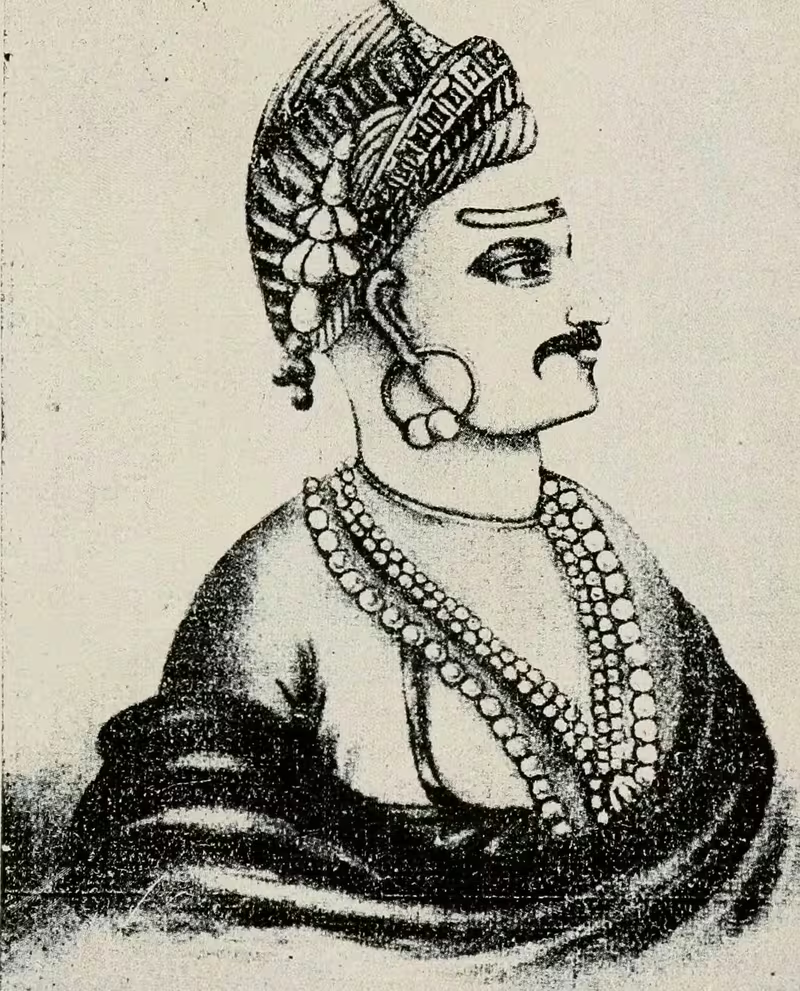
Baji Rao II: The Twilight of an Empire
In the grand, sweeping saga of the Maratha Empire—a story of swift cavalry, brilliant generals, and a saffron flag that once flew from the Cuttack to Attock—the final chapter is one of tragedy, intrigue, and decline. At the heart of this somber conclusion stands Shrimant Baji Rao II, the thirteenth and last Peshwa. He was a man destined by birth to lead, yet cursed by circumstance and character to preside over the very dismantling of the great confederacy his ancestors had forged with blood and fire. His life was not one of conquest but of confinement, not of astute diplomacy but of disastrous treaties, ultimately leading to the sunset of Maratha sovereignty and the dawn of the British Raj.
Early Life & A Legacy of Shadows
Born on January 10, 1775, Baji Rao II entered a world already fraught with peril. He was the son of Raghunathrao, or Raghoba, a former Peshwa whose ambition had fractured the Maratha leadership. Raghunathrao’s infamous alliance with the British during the First Anglo-Maratha War and the lingering suspicion of his involvement in the assassination of his nephew, Peshwa Narayanrao, cast a long, dark shadow over his family. His mother, Anandibai, was also implicated in the plot, and the name 'Raghoba' became synonymous with treachery in the halls of Pune's Shaniwar Wada.
This parentage was the defining factor of Baji Rao II’s youth. Following the Treaty of Salbai in 1782, which concluded the war, Raghunathrao was pensioned off. Upon his death a year later, his family, including the young Baji Rao II, was placed under house arrest by the powerful Pune court. The administration was then under the firm control of the ‘Barabhai’ council, a confederation of twelve Maratha nobles, masterfully guided by the brilliant statesman Nana Phadnavis.
For nearly two decades, Baji Rao II and his brothers lived as political prisoners, shuffled between forts and towns like Kopargaon, Anandvalli, and Mandavgan. His was not the upbringing of a future ruler. Instead of learning the arts of war and statecraft, he was schooled in the harsh lessons of survival, suspicion, and intrigue. He grew up in an environment where every word was weighed, and every gesture was a potential political move. This long confinement fostered in him a deeply suspicious and vengeful nature, traits that would prove disastrous when he finally ascended to power. He was a pawn in the complex chess game of Maratha politics, a prince held captive by the very court he was meant to one day lead.
The Turbulent Reign of a Faltering Peshwa
The opportunity for Baji Rao II to claim his birthright came unexpectedly in 1795 with the tragic death of Peshwa Madhavrao II. The young Peshwa died after falling from a balcony in the Shaniwar Wada, creating a sudden power vacuum. Nana Phadnavis, the regent-minister who had held the Maratha Confederacy together with his political acumen, was deeply reluctant to see the son of his old rival, Raghunathrao, on the throne. He attempted to arrange for a substitute, but the intricate web of Maratha power politics had other plans.
The powerful Maratha chiefs, particularly Daulat Rao Scindia of Gwalior and Yashwantrao Holkar of Indore, saw an opportunity to assert their dominance over Pune. After a period of intense and chaotic maneuvering, Baji Rao II, supported by Daulat Rao Scindia, was finally installed as Peshwa on December 4, 1796. However, his throne was less a seat of power and more a gilded cage. He was a sovereign in name only, a puppet whose strings were pulled first by the aging Nana Phadnavis and then, more brutally, by the ambitious Daulat Rao Scindia, whose armies effectively occupied Pune.
The death of Nana Phadnavis in March 1800 marked a turning point. The British Resident, Colonel Palmer, prophetically noted that with him, “departed all the wisdom and moderation of the Maratha government.” Without Nana’s stabilizing influence, the rivalry between Daulat Rao Scindia and Yashwantrao Holkar erupted into open conflict, with Pune as the prize.
Baji Rao II, resentful of Scindia’s dominance but fearing Holkar more, made a series of catastrophic miscalculations. In a fit of cruel vengeance, he sanctioned the brutal execution of Vithoji Rao Holkar, Yashwantrao’s brother, who was tied to an elephant's foot and dragged to his death through the streets of Pune in April 1801. This act of barbarity enraged Yashwantrao Holkar, who swore revenge. On October 25, 1802, at the Battle of Hadapsar on the outskirts of Pune, Holkar’s forces decisively crushed the combined armies of the Peshwa and Scindia. As Holkar’s army entered the city, Baji Rao II fled in terror.
The Treaty of Bassein: A Surrender of Sovereignty
Desperate and dethroned, Baji Rao II made the single most consequential decision of his life, one that would irrevocably alter the course of Indian history. He fled to the British and, on December 31, 1802, signed the Treaty of Bassein. In exchange for British military protection to restore him to his throne, Baji Rao II signed away Maratha independence. He agreed to maintain a British subsidiary force in his territory, ceded land for its upkeep, and, most critically, surrendered control over his foreign affairs to the East India Company.
For the British, the treaty was a masterstroke. For the Marathas, it was a death knell. The other Maratha chiefs—Scindia, Holkar, and the Bhonsles of Nagpur—were outraged. They viewed the treaty as an act of submission, a betrayal of the Maratha cause by its own leader. It directly triggered the Second Anglo-Maratha War (1803-1805). While the Maratha houses fought valiantly, their lack of unity and the superior military strategy of British commanders like Arthur Wellesley led to their comprehensive defeat. Baji Rao II, restored to Pune by British bayonets, was now a client ruler, his authority propped up by the very foreign power that was systematically dismantling the empire he nominally led.
The Final Surrender and Lingering Legacy
For over a decade, Baji Rao II chafed under British control. While he amassed a personal fortune, the humiliation of his subservience festered. He began to secretly plot his escape, attempting to rally the Maratha sardars for one last stand. His chief minister, Trimbakji Dengle, became the instrument of his intrigues, encouraging him to rebuild his armies and re-establish contact with other Maratha courts.
The situation came to a head with the murder of Gangadhar Shastri, an envoy from the Gaekwad of Baroda, who had come to Pune under British safe-conduct to settle financial disputes. The murder, which occurred during a pilgrimage to Pandharpur in 1815, was widely attributed to Trimbakji. The British, incensed by the assassination of a man under their protection, demanded Trimbakji’s arrest. Baji Rao II reluctantly complied, but Trimbakji’s subsequent escape from prison further implicated the Peshwa.
The British forced the humiliating Treaty of Poona on him in June 1817, compelling him to cede more territory and formally renounce his position as the head of the Maratha Confederacy. This was the final indignity. On November 5, 1817, Baji Rao II’s forces attacked and burned the British Residency in Pune, signaling the start of the Third Anglo-Maratha War.
Despite his numerical superiority, his army was decisively defeated by a smaller, more disciplined British force at the Battle of Khadki. This was followed by another defeat at Koregaon and a final, crushing blow at the Battle of Ashti in February 1818, where his able general Bapu Gokhale was killed. The war was lost. Baji Rao II was once again a fugitive, hunted across the Deccan by British columns.
On June 3, 1818, near the village of Mhow, a weary and defeated Baji Rao II surrendered to Sir John Malcolm. The British, determined to prevent any future revival of Maratha power, abolished the office of the Peshwa, annexed his territories into their expanding Bombay Presidency, and declared the Maratha Confederacy dissolved.
In a move of calculated magnanimity, the British spared his life. Instead of imprisonment, he was granted an extraordinarily large annual pension of 8 lakh rupees and exiled to Bithur, a small town on the banks of the Ganges near Kanpur. There, he spent the remaining 33 years of his life, a king without a kingdom. He lived as a religious recluse, building temples and bathing ghats, a living relic of a bygone era. He died on January 28, 1851, far from the land his ancestors had once ruled.
Baji Rao II’s legacy is undeniably tragic. He is remembered as the Peshwa who lost an empire. His reign was characterized by poor judgment, personal vindictiveness, and a chronic inability to lead. His fateful decision to sign the Treaty of Bassein was the tipping point that surrendered Maratha autonomy and paved the way for complete British domination of the subcontinent.
Yet, his story has one final, powerful echo. In Bithur, Baji Rao II adopted a son, Dhondu Pant, who would become known to history as Nana Saheb. When the old Peshwa died, the British, under Lord Dalhousie's Doctrine of Lapse, refused to continue the pension to his adopted heir. This perceived injustice fueled Nana Saheb’s deep-seated resentment, transforming him into one of the central figures of the great Uprising of 1857. In this, the legacy of the last Peshwa is poignantly ironic: the man whose actions solidified British control inadvertently raised the very son who would later mount one of the most formidable challenges to that same British Raj.