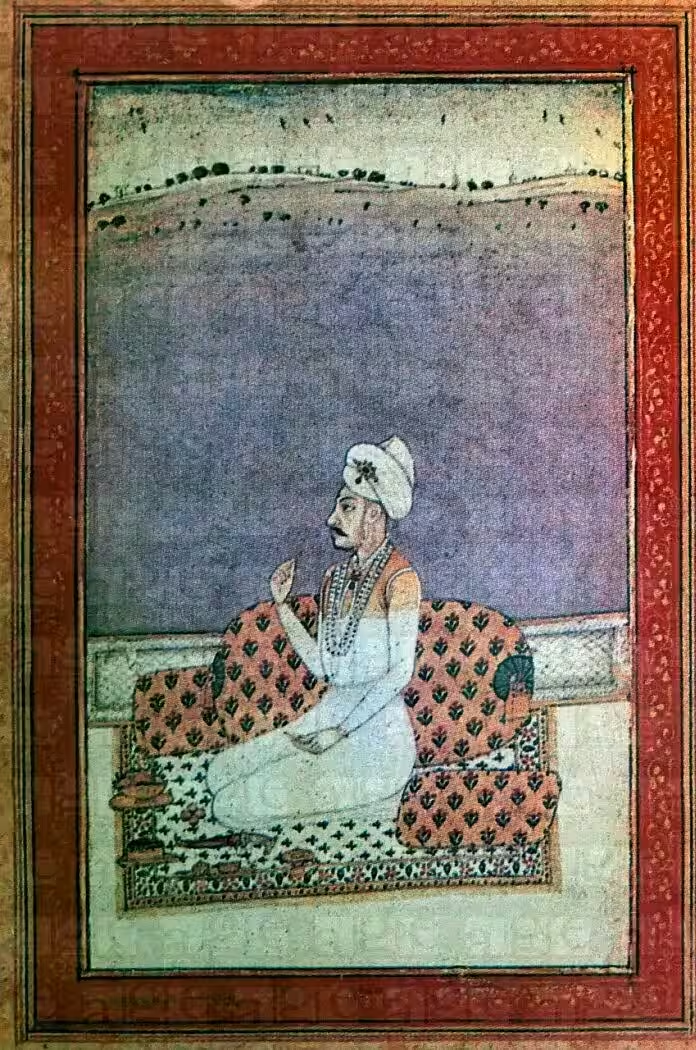
The Apex and the Abyss: The Reign of Balaji Baji Rao
In the grand tapestry of Indian history, few reigns encapsulate both the pinnacle of imperial glory and the depths of catastrophic failure as starkly as that of Shrimant Balaji Baji Rao Bhat. Known affectionately and respectfully as Nanasaheb Peshwa, he was the eighth Peshwa of the Maratha Empire. He inherited a formidable military machine and, through astute diplomacy and administration, expanded its reach to the farthest corners of the subcontinent. Under his leadership, the saffron banner of the Marathas flew from Attock on the Indus in the northwest to the deltas of Bengal in the east. Yet, this very zenith of power set the stage for a tragedy so profound it would break the heart of the empire and its leader, forever marking his legacy with the sorrowful fields of Panipat.
Early Life & Ascent to Power
Born on December 2, 1720, Balaji Rao was the eldest son of the legendary Peshwa Baji Rao I, a military genius who had never lost a battle, and his first wife, Kashibai. He grew up in the charged atmosphere of Pune, the burgeoning nerve center of Maratha power. Unlike his father, a quintessential warrior who thrived on the battlefield, the young Balaji Rao was groomed in the finer arts of statecraft. His education was comprehensive, covering military strategy, finance, and diplomacy. From a young age, he displayed a keen intellect and a natural aptitude for administration and governance, a disposition that would define his reign.
In 1740, the sudden and untimely death of Baji Rao I sent shockwaves through the empire. At the tender age of 19, Balaji Rao was chosen by the Maratha Chhatrapati, Shahu I, to succeed his father. The appointment was not without its challenges. Powerful Maratha sardars, or chieftains, like Raghoji Bhonsle of Nagpur, viewed the young Peshwa with skepticism. However, with the firm backing of Chhatrapati Shahu and his own diplomatic acumen, Balaji Baji Rao navigated these early challenges, steadily consolidating his authority over the vast and often fractious Maratha Confederacy.
The Architect of a New Order
The first decade of Nanasaheb's rule was marked by a significant internal power shift. Chhatrapati Shahu, a grandson of the great Shivaji Maharaj, was the unifying figurehead of the empire. While he delegated immense authority to his Peshwas (Prime Ministers), the ultimate sovereign power rested with him in his capital at Satara.
Shahu's death in December 1749 proved to be a pivotal moment. With no direct heir, a succession crisis loomed. Nanasaheb deftly managed the situation, installing a successor, Ramraja II, but stripping the office of the Chhatrapati of its executive powers. This was formalized through the Sangola Agreement of 1750. This historic pact effectively transferred all state authority to the Peshwa. The Chhatrapati became a ceremonial figurehead confined to Satara, while Pune, the Peshwa's seat, became the de facto capital and the true heart of the Maratha Empire. Nanasaheb was no longer just a prime minister; he was the undisputed master of the empire.
With his political power cemented, Nanasaheb embarked on transforming Pune from a provincial town into a magnificent capital. Under his patronage, the city flourished. He commissioned the construction of grand temples, including the iconic Parvati Hill temple complex, which offered a panoramic view of his growing city. He built aqueducts to ensure a stable water supply, constructed new bridges, and established new residential areas known as peths. Pune became a vibrant center for commerce, culture, and learning, attracting merchants, artisans, and scholars from across India.
The Saffron Banner Across the Subcontinent
With the home front secured, Nanasaheb pursued a policy of aggressive expansion, realizing his father's dream of establishing Maratha dominance over the entire subcontinent.
Dominance in the North: The decaying Mughal Empire in Delhi presented a golden opportunity. In 1752, Nanasaheb entered into a crucial agreement, the Ahamdiya Karar, with the Mughal Emperor. In exchange for the right to collect the lucrative chauth (a 25% tax on revenue) from vast territories across northern and eastern India, the Peshwa promised to protect the Mughal throne from all enemies, both internal and external. This treaty made the Marathas the effective rulers of Delhi and the paramount power in North India.
His generals, including his ambitious brother Raghunathrao, and the formidable chiefs Malhar Rao Holkar and Mahadaji Scindia, led relentless campaigns. They subjugated the Rajputs, collected tribute from the Jats, and extended their influence deep into the Gangetic plains. The climax of this northward push came in 1758. In a daring campaign, Raghunathrao chased the forces of Ahmad Shah Abdali, the Afghan king, out of Punjab, capturing the great cities of Lahore and, finally, Attock on the banks of the Indus River. For the first time, a Hindu power based in the Deccan had conquered the traditional gateway to India. The Maratha Empire had reached its territorial zenith, stretching, as the saying went, from 'Attock to Cuttack'.
Supremacy in the Deccan: While the north was the theater of grand expansion, Nanasaheb did not neglect the south. The Nizam of Hyderabad remained a persistent rival in the Deccan. The final contest for supremacy came at the Battle of Udgir in February 1760. The Maratha army, under the brilliant command of the Peshwa's cousin, Sadashivrao Bhau, inflicted a crushing defeat on the Nizam. The subsequent treaty forced the Nizam to cede vast, strategic territories, including the cities of Ahmednagar and Bijapur, solidifying Maratha dominance in their home region.
By 1760, Balaji Baji Rao stood at the apex of his power. He was the master of a vast, wealthy, and seemingly invincible empire.
The Gathering Storm: The Road to Panipat
The conquest of Punjab was a spectacular achievement, but it was also a fatal overreach. By planting their flag at Attock, the Marathas had directly challenged the authority of Ahmad Shah Abdali, who considered Punjab part of his domain. Enraged by this affront and invited by disgruntled Indian Muslim nobles like Najib-ud-Daula, Abdali raised a massive army and invaded India in late 1759 to reclaim his lost territories and punish the Marathas.
The news from the north was alarming. Abdali's forces quickly recaptured Punjab and annihilated a Maratha garrison at the Battle of Burari Ghat near Delhi. In response, Nanasaheb assembled the grandest army in Maratha history. Command was entrusted to his cousin, Sadashivrao Bhau, the victor of Udgir, with the Peshwa's own beloved son and heir, the 17-year-old Vishwasrao, as the nominal commander-in-chief.
The Maratha host marched north with immense pomp and confidence. However, Sadashivrao Bhau, a brilliant tactician but a proud and sometimes inflexible commander, made a series of critical diplomatic blunders. He failed to build a broad coalition against the foreign invader. His high-handed treatment alienated potential allies like the Jat king Suraj Mal, who abandoned the Maratha camp. The Rajputs, wary of Maratha taxation, remained neutral. The Marathas were left to fight Abdali's powerful coalition of Afghans and Indian allies virtually alone.
The Cataclysm of Panipat
After months of maneuvering, the two armies finally met on the historic battlefield of Panipat on January 14, 1761. The Maratha army, trapped in its camp for weeks and starving after Abdali cut off their supply lines, was forced to offer battle.
The Third Battle of Panipat was a slaughter of unprecedented scale. Despite fighting with desperate courage, the Marathas were outmaneuvered and overwhelmed. The Afghan cavalry and devastating swivel-mounted cannons wrought havoc. By sunset, the Maratha army was annihilated. Sadashivrao Bhau fought to the last and was killed. The young Vishwasrao, the hope of the empire, was struck down by a stray shot early in the battle. An entire generation of Maratha leadership was wiped out on a single, bloody day.
Weeks later, a merchant's coded message reached the Peshwa, who was marching north with reinforcements. The message, eloquent in its grief, read:
"Two pearls have been dissolved, twenty-seven gold mohurs have been lost and of the silver and copper the total cannot be cast up."
The two pearls were Vishwasrao and Sadashivrao Bhau. The gold mohurs were the other slain Maratha commanders. The silver and copper were the countless common soldiers.
A Broken Heart, A Shattered Legacy
The news shattered Balaji Baji Rao. The personal loss of his son and cousin, coupled with the sheer scale of the military disaster, was a blow from which he could not recover. His health, already frail, collapsed completely. He abandoned the march north and retreated to Pune, a broken man.
He spent his final months in grief and despair at his palace near Parvati Hill. On June 23, 1761, barely six months after the battle, Nanasaheb Peshwa died, his heart, it was said, broken by the tragedy of Panipat.
Balaji Baji Rao's legacy is one of profound duality. He was an outstanding administrator who presided over the empire's greatest expansion, transforming it into the subcontinent's supreme power. He gave Pune its golden age and cemented the Peshwa's authority for generations. Yet, this very success led to the hubris and overreach that culminated in the disaster at Panipat. The defeat, while not destroying the empire, checked its pan-Indian ambitions and created a power vacuum in the north that would eventually be filled by the British East India Company.
Today, Balaji Baji Rao is remembered as a ruler of immense vision and administrative talent, the architect of Maratha glory. But his story is also a poignant and tragic reminder that the highest peaks of power often stand perilously close to the deepest abyss of failure.