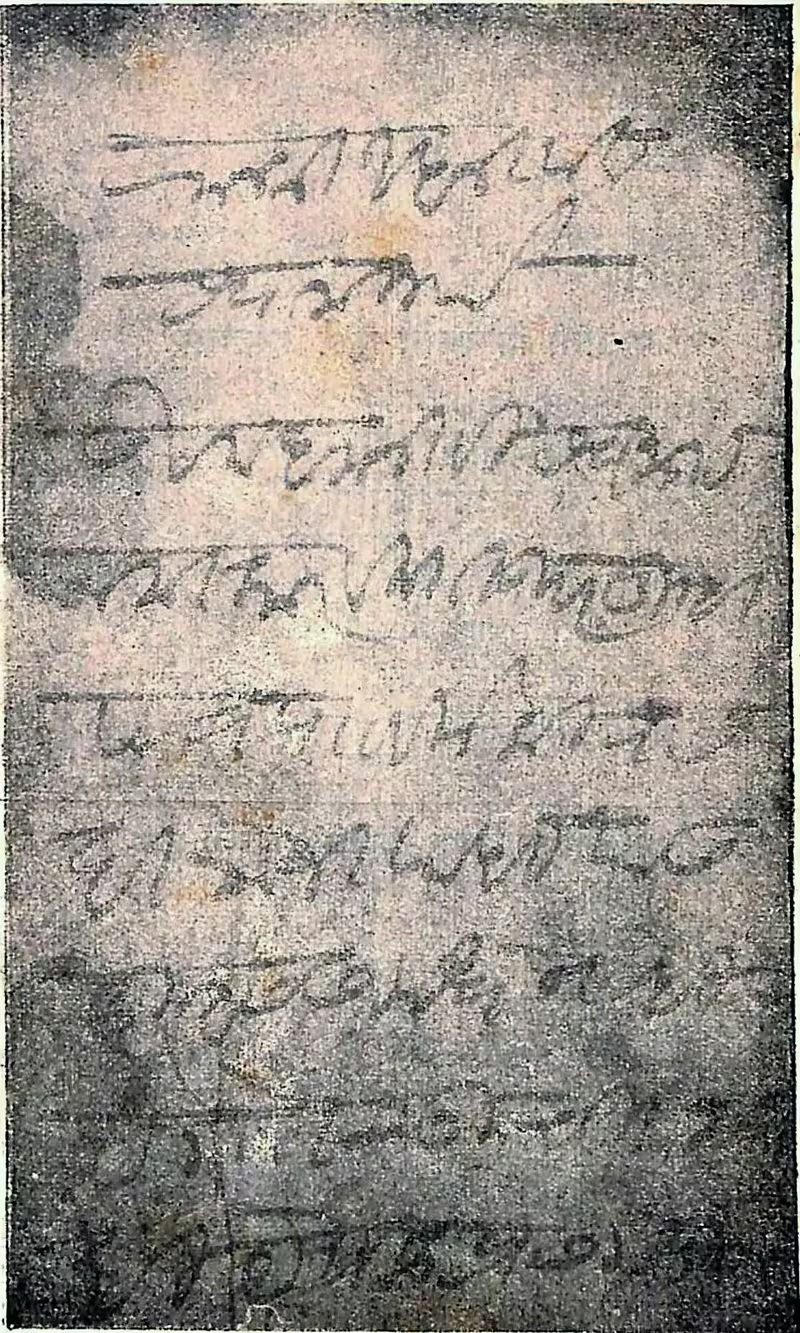
Balaji Vishwanath: The Architect of the Maratha Empire
In the grand theatre of Indian history, some figures command attention through the clash of swords and the thunder of cavalry. Others, quieter and more methodical, shape destinies not on the battlefield, but in the council chambers and revenue offices. Balaji Vishwanath Bhat (1662-1720) belongs firmly to the latter category. He was not a celebrated general in the mould of his legendary son, Baji Rao I, but a statesman of profound vision and administrative genius. Taking the reins of a Maratha state exhausted by decades of war and fractured by civil strife, Balaji Vishwanath didn't just mend it; he re-forged it, creating the robust political and financial framework that enabled its transformation into a subcontinent-spanning empire. He was the first in the line of hereditary Peshwas, the man who shifted the locus of power and became the true second founder of the Maratha dominion.
The Crucible of the Deccan: Early Life and Rise
Balaji Vishwanath was born in 1662 into a Chitpavan Brahmin family in the coastal town of Shrivardhan in the Konkan region. This sliver of land, nestled between the Western Ghats and the Arabian Sea, was known for producing hardy, intelligent, and often administratively gifted individuals. The Bhat family, while respected, was not part of the high Maratha aristocracy. Balaji’s beginnings were humble, and his path to power was paved not by birthright but by sheer competence.
His career began in the most foundational role of statecraft: a karkun, or revenue clerk. In the late 17th century, the Deccan was a landscape of perpetual conflict. The relentless 27-year war waged by Mughal Emperor Aurangzeb against the Marathas had turned the region into a crucible. It was here, amidst the chaos of shifting allegiances, guerrilla warfare, and devastated economies, that Balaji learned his trade. He served various Maratha chieftains, including the influential Ramchandra Pant Amatya and the celebrated general Dhanaji Jadhav. This period was his education. He mastered the complex art of revenue collection in a war-torn land, learning how to manage finances, negotiate with local landowners, and understand the delicate interplay of power, loyalty, and money that defined Deccan politics.
He witnessed firsthand the strengths and weaknesses of the Maratha system. He saw how the courage of its warriors could be undermined by internal feuds and a lack of centralized financial control. These formative years instilled in him a deep understanding that for the Maratha Swarajya (self-rule) to survive and thrive, it needed more than just military might; it needed a stable administration and a sound economic foundation.
From Civil War to Consolidation: The Path to Peshwa
The turning point came in 1707 with the death of Aurangzeb. The Mughal Empire, exhausted by the Deccan campaign, began to fracture. Seizing the opportunity, the Mughals released Sambhaji’s son, Shahu, who had been a royal captive since 1689. This was a calculated move to foment discord within the Maratha leadership. It worked perfectly. Shahu’s return sparked a bitter civil war. His aunt, Tarabai, who had valiantly led the Maratha resistance in the preceding years, refused to recognize his claim, championing her own son, Shivaji II, as the rightful Chhatrapati (king).
The Maratha sardars (nobles) were divided. Balaji Vishwanath, then in the service of Dhanaji Jadhav, was one of the first influential figures to grasp the strategic importance of backing Shahu. He saw in Shahu a legitimate, unifying figurehead who could bring stability. With his persuasive abilities, he was instrumental in convincing his master, Dhanaji Jadhav, to switch allegiance to Shahu, a major coup that significantly bolstered Shahu’s position.
Balaji’s true genius for diplomacy was showcased in his handling of Kanhoji Angre, the formidable chief of the Maratha navy. Angre, controlling the Konkan coast, was a power unto himself. He had sided with Tarabai and had defeated Shahu’s armies multiple times. While Shahu’s commanders planned another military campaign, Balaji proposed a different approach. He volunteered to go as an envoy to negotiate. It was a perilous mission, but Balaji understood that Angre’s defiance stemmed from a desire for autonomy, not disloyalty to the Maratha cause itself. Instead of threats, Balaji used reason and an appeal to a larger vision. He argued that a divided Maratha house would only benefit its enemies. He convinced Angre to accept Shahu as the Chhatrapati, in return for recognizing Angre's authority over the navy and the Konkan. This diplomatic masterstroke, achieved where force had failed, secured a vital flank for Shahu and demonstrated Balaji’s indispensable value.
Impressed beyond measure by his loyalty, administrative skill, and diplomatic acumen, Chhatrapati Shahu appointed Balaji Vishwanath as his Peshwa (Prime Minister) in November 1713. This was more than a reward; it was a recognition that to govern the fragmented kingdom, Shahu needed a man of intellect and vision, not just another warrior noble.
The Architect of an Empire: Major Contributions
As Peshwa, Balaji inherited a state in name only. The treasury was empty, the administration was in shambles, and powerful Maratha sardars acted as independent warlords. With methodical brilliance, he set about rebuilding the state from the ground up.
1. Financial and Administrative Reforms: His first priority was the treasury. Drawing on his long experience as a revenue official, he implemented a rational system of taxation that ensured a steady and predictable income for the central government. He disciplined the collection process, reducing corruption and increasing efficiency. This financial stabilization was the bedrock upon which all subsequent Maratha military power was built. An army, no matter how brave, could not march on an empty stomach.
2. Forging the Maratha Confederacy: Balaji’s most innovative political contribution was his solution to the problem of the powerful, ambitious Maratha sardars. Instead of trying to crush them—an impossible and self-destructive task—he co-opted them. He devised a system where these chiefs (who would later found dynasties like the Scindias, Holkars, and Gaekwads) were granted the right to collect chauth (one-fourth of revenue) and sardeshmukhi (an additional one-tenth) from Mughal territories. In return, they were to maintain a specified number of troops for the Chhatrapati and remit a portion of their collections to the central treasury. This was a stroke of genius. It legalized and systematized Maratha raids, redirecting the sardars' martial energies outward against the Mughals, and transformed them from potential rivals into stakeholders in the expansion of Maratha influence. This quasi-feudal arrangement was the genesis of the Maratha Confederacy, which would dominate India for the next century.
3. The Mughal Treaty of 1719: A Crowning Achievement: By the late 1710s, the Mughal court in Delhi was a hotbed of intrigue, dominated by the powerful Sayyid Brothers, who had become the de facto kingmakers. When their relationship with Emperor Farrukhsiyar soured, they sought external allies. Balaji Vishwanath seized this unprecedented opportunity.
In 1719, he led a large Maratha army to Delhi, not as an invader, but as an ally of the Sayyid Brothers. The sight of Maratha banners fluttering in the Mughal capital was a stunning reversal of fortunes. The Marathas, once dismissed as "mountain rats," were now arbiters of power at the heart of the empire they had long resisted.
The expedition resulted in a landmark treaty, often called the “Magna Carta of the Maratha Dominion.” The new Mughal emperor, a puppet of the Sayyids, formally granted the Marathas what they had been fighting for for decades:
- Swarajya: Chhatrapati Shahu was officially recognized as the ruler of Shivaji’s core territories.
- Chauth and Sardeshmukhi: The Marathas were given the legal right to collect these taxes from all six Mughal provinces of the Deccan.
- Release of Royal Family: Shahu’s mother, Yesubai, and other family members held captive in Delhi for thirty years were finally freed.
This treaty was a monumental victory. It transformed the Marathas from rebels into a legitimate, co-equal power in the subcontinent, with their authority now sanctioned by the Mughal throne itself. It provided the legal scaffolding for future Maratha expansion and cemented Balaji Vishwanath’s reputation as a master strategist.
The Enduring Blueprint: Legacy and Influence
Balaji Vishwanath Bhat passed away on April 12, 1720, just a year after his triumph in Delhi. He did not live to see the Maratha empire reach its zenith, but he had laid its every foundation stone. His legacy was profound and multifaceted.
His most immediate impact was the establishment of the hereditary Peshwaship. So complete was Shahu’s faith in him that upon his death, the Chhatrapati appointed Balaji’s 20-year-old son, Baji Rao, as the next Peshwa, overlooking other senior claimants. This unprecedented decision effectively made the office hereditary. The Bhat family dynasty would rule the Maratha Empire for the next century, with the Peshwas of Pune becoming the de facto heads of state and the Chhatrapatis of Satara receding into a more ceremonial role.
Balaji is rightly remembered as the second founder of the Maratha state. If Chhatrapati Shivaji Maharaj created the spirit and ideal of Swarajya through military genius and force of will, Balaji Vishwanath gave it the enduring institutions of a functional state. He found a collection of warring factions and left behind a cohesive, financially sound, and politically confident power.
His administrative and financial systems fueled the vast military campaigns of his successors. The Maratha Confederacy he designed, while eventually leading to internal rivalries, was the vehicle for Maratha dominance across India for generations. Without the stable platform Balaji built, the legendary exploits of his son Baji Rao I and the imperial expansion under his grandson Balaji Baji Rao would have been inconceivable.
Balaji Vishwanath’s story is a testament to the power of intellect in an age of brute force. He was a quintessential statesman whose weapons were diplomacy, finance, and an unparalleled understanding of political realities. He rose from a humble clerk to become the most powerful man in the kingdom, not by conquering territory, but by creating order, forging consensus, and building an empire on the unshakeable foundations of law and revenue.