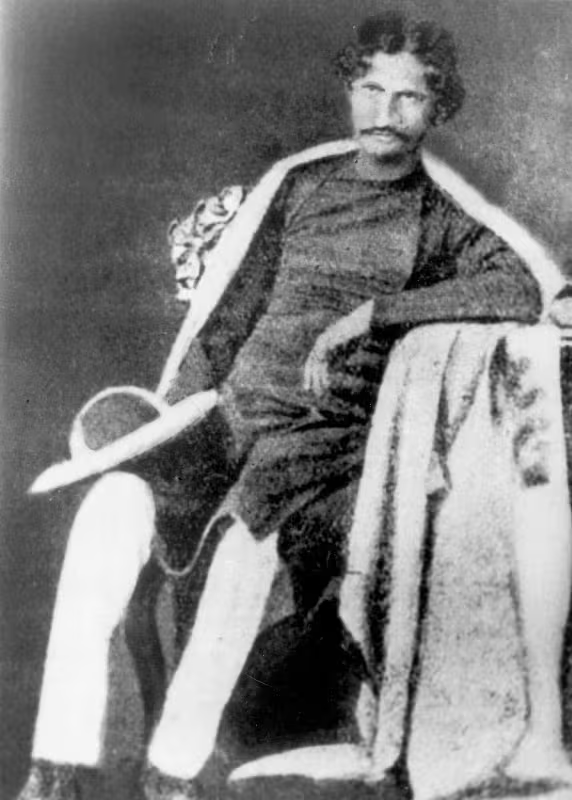
The Emperor of Literature: Bankim Chandra Chattopadhyay
In the grand theatre of the 19th-century Bengal Renaissance, where intellectual ferment and cultural awakening reshaped the Indian subcontinent, few figures stand as tall as Bankim Chandra Chattopadhyay. Known reverentially as the Sahitya Samrat (Emperor of Literature), he was a man of profound duality: a high-ranking administrator in the British Raj and the literary architect of Indian nationalism. Through his revolutionary novels and piercing essays, he forged a new language for Bengali prose and gave a voice to a nation yearning for self-discovery. His most enduring gift, the hymn "Vande Mataram," would become the sacred mantra of the freedom struggle, a cry of devotion to the motherland that echoed from the gallows to the halls of a newly independent India.
Early Life & A Formidable Education
Bankim Chandra was born on June 27, 1838, into an orthodox Brahmin family in the village of Kanthalpara, near Naihati in the 24 Parganas district of the Bengal Presidency. His father, Yadav Chandra Chattopadhyay, was a distinguished government official, serving as a Deputy Collector under the East India Company. This environment provided the young Bankim with a unique blend of influences: a deep-rooted grounding in Sanskrit and traditional Bengali culture at home, and a rigorous, modern, Western-style education in the institutions of Calcutta.
His intellectual brilliance was apparent from a young age. He attended the Hooghly Mohsin College and later the prestigious Presidency College in Calcutta. The year 1858 marked a significant milestone not just for Bankim Chandra, but for the history of Indian education. The University of Calcutta, one of the first modern universities in Asia, held its first-ever Bachelor of Arts examinations. When the results were declared, Bankim Chandra Chattopadhyay and Joddu Nath Bose became its first two graduates—pioneers of a new generation of Indian intellectuals educated to navigate both Indian and Western worlds. This dual education would become the bedrock of his literary genius, allowing him to master the form of the Western novel while infusing it with the soul of Indian thought and history.
A Dual Career: The Pen and the Sceptre
Following in his father's footsteps, Bankim Chandra joined the Subordinate Executive Service of the British Indian government in 1858. He was appointed a Deputy Magistrate and Deputy Collector, a position of considerable authority for an Indian at the time. For over three decades, until his retirement in 1891, he served the British Crown with diligence and integrity across various districts of Bengal. This long and distinguished career in colonial administration gave him an unparalleled, ground-level view of the mechanics of the Raj and the social fabric of rural and urban Bengal. He witnessed firsthand the complexities of law, the realities of peasant life, and the inherent contradictions of colonial rule. This deep well of experience would later irrigate the landscapes of his novels, lending them an authenticity and social depth previously unseen in Indian literature.
Yet, while his day-to-day work involved upholding the laws of the Empire, his true calling lay elsewhere. His literary journey began not in Bengali, but in English, with the novel Rajmohan's Wife (1864). However, he quickly realized that to truly connect with his people and shape their consciousness, he must write in his mother tongue. This pivotal decision marked a turning point for Bengali literature.
In 1865, he published Durgeshnandini (Daughter of the Fort Commander), his first Bengali novel. The book was an electrifying success. A historical romance set in the time of the Mughal-Pathan conflict in Bengal, it captivated readers with its gripping plot, well-etched characters, and, most importantly, its vibrant, modern prose. Bankim Chandra broke free from the stiff, heavily Sanskritized language that had dominated Bengali writing, crafting a style that was both elegant and accessible. With Durgeshnandini, the modern Indian novel was born.
The Architect of a Literary Revolution
Bankim Chandra's pen was prolific. He followed his initial success with a series of masterful works that explored a wide range of genres—from romance and history to social commentary and philosophy.
Kapalkundala (1866): A tale of breathtaking romance and tragedy, featuring one of the most memorable female characters in Indian literature. Its opening lines, describing a secluded beach at night, are considered among the most beautiful in Bengali prose.
Vishabriksha (The Poison Tree, 1873): This was a bold foray into the social novel. Tackling the controversial subject of widow remarriage, it delved into the complexities of human relationships, societal norms, and moral dilemmas, cementing his reputation as a keen observer of contemporary society.
Krishnakanter Will (1878): Considered by many to be his finest social novel, this work is a sophisticated exploration of love, greed, and morality, showcasing his mastery of plot and psychological depth.
In 1872, Bankim Chandra founded the monthly literary journal Bangadarshan. This was not merely a magazine; it was a cultural institution. It became the premier platform for the intellectual life of Bengal, serializing many of his own novels and publishing essays on literature, history, religion, and science. Through Bangadarshan, he nurtured a generation of writers and shaped the critical and intellectual discourse of his time, aiming to bring about an intellectual 'darshan' or vision for the Bengali people.
The Nationalist Trinity: Anandamath, Devi Chaudhurani, and Sitaram
As his literary prowess matured, his focus sharpened towards a larger purpose: the awakening of a national consciousness. This culminated in a trio of novels that would directly inspire the burgeoning freedom movement.
Anandamath (The Abbey of Bliss, 1882) is his most famous and politically explosive work. Set against the backdrop of the Sannyasi Rebellion of the late 18th century, the novel tells the story of a brotherhood of ascetics who dedicate their lives to freeing their motherland from the oppressive rule of a corrupt nawab, widely interpreted as a thinly veiled allegory for the British. It was in this novel that Bankim Chandra embedded a hymn that would alter the course of Indian history: "Vande Mataram" (I Bow to Thee, Mother).
The poem is a sublime ode to the motherland, personified as the divine mother goddess, Durga. It fuses patriotic fervour with spiritual devotion, transforming love for the nation into a sacred duty. The song was a revelation. It gave the abstract concept of 'India' a divine, tangible form that millions could worship and for which they would be willing to sacrifice their lives.
He followed this with Devi Chaudhurani (1884), a novel that championed female empowerment through the story of a young woman who, abandoned by her husband, becomes the formidable and righteous leader of a band of dacoits. His final major novel, Sitaram (1887), explored the tragic fall of a Hindu chieftain, serving as a cautionary tale about the need for moral strength and unity in the quest for self-rule.
Legacy & Enduring Influence
Bankim Chandra Chattopadhyay passed away on April 8, 1894, but his legacy was already immortal. His impact on Indian culture, politics, and literature is immeasurable.
The Father of the Indian Novel: He single-handedly established the novel as the preeminent literary form in India. He provided the template—blending Western structure with Indian content—that would be followed by writers across the subcontinent for decades. Greats like Rabindranath Tagore, who was a young contemporary, acknowledged his profound debt to Bankim's pioneering work.
The Voice of Nationalism: More than any other writer of his time, Bankim Chandra articulated the spirit of cultural and political nationalism. He reinterpreted Hindu philosophy, particularly in his essays like Krishna Charitra, presenting a robust, intellectual, and assertive vision of Dharma (duty) that resonated deeply with nationalist thinkers like Aurobindo Ghose and Bal Gangadhar Tilak. He provided the intellectual framework for a resurgent India, proud of its past and determined to shape its own future.
The Soul of a Song: The journey of "Vande Mataram" is a testament to his enduring power. In 1896, two years after his death, Rabindranath Tagore sang it for the first time at a session of the Indian National Congress. During the Swadeshi movement of 1905, it became the electrifying war cry of protesters. Freedom fighters went to the gallows with "Vande Mataram" on their lips. After independence, while Tagore's "Jana Gana Mana" was chosen as the national anthem, "Vande Mataram" was given equal status as the National Song of India—a tribute to its pivotal role in the freedom struggle.
Today, Bankim Chandra Chattopadhyay is remembered as a complex and brilliant visionary. He was a product of his time, a loyal servant of the British Empire who nonetheless laid the literary and philosophical foundations for its eventual overthrow. He was the Sahitya Samrat who did more than just write stories; he wrote the story of a new India, giving it a language, a purpose, and a song that continues to echo in the heart of the nation.