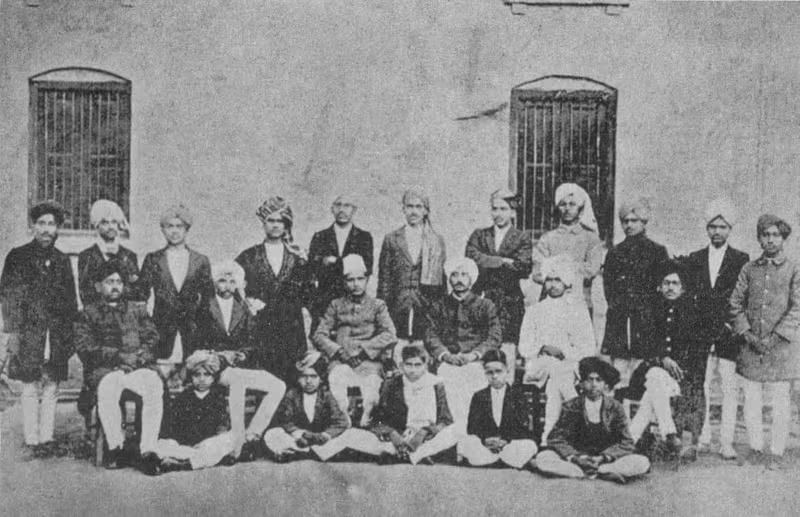
Bhagat Singh: The Intellectual Revolutionary
In the grand tapestry of India's struggle for independence, few figures blaze as brightly or as briefly as Bhagat Singh. More than a mere freedom fighter, he was a visionary, an intellectual, a socialist, and a revolutionary whose short, impactful life left an indelible mark on the national consciousness. Executed at the tender age of 23, his legacy transcends the single act of martyrdom; it resides in his powerful ideas, his profound critique of imperialism and capitalism, and his unwavering commitment to a truly free and equitable India. He was not just a man who died for his country, but a man who lived, thought, and fought for a specific vision of its future.
Early Life & Formative Years
Bhagat Singh was born on September 27, 1907, in the village of Banga, Lyallpur district, Punjab, in British India (now Faisalabad District, Pakistan). He was born into a Sandhu Jat family that was steeped in the ethos of rebellion. Nationalism was not an abstract concept in the Singh household; it was a lived reality. His father, Kishan Singh, and his uncles, Ajit Singh and Swaran Singh, were all deeply involved in the freedom movement, particularly with the Ghadar Party, a revolutionary group aimed at overthrowing British rule.
This environment of dissent shaped his worldview from his earliest days. He grew up hearing stories of sacrifice and resistance, internalizing the idea that freedom was a right to be fought for, not a privilege to be begged for.
Two events in his youth proved to be catalytic. The first was the Jallianwala Bagh massacre on April 13, 1919. A mere 12 years old, Bhagat Singh was profoundly shaken by the brutal killing of hundreds of unarmed Indians by British troops. It is documented that he skipped school the day after the massacre to visit the site in Amritsar, collecting a handful of blood-soaked earth as a solemn reminder of the tyranny of the Raj.
The second was Mahatma Gandhi's Non-Cooperation Movement (1920-22). Initially, a young Bhagat Singh was an ardent supporter, participating in protests and burning his British-made textbooks. However, Gandhi's abrupt withdrawal of the movement in 1922 following the Chauri Chaura incident left him and many other young nationalists disillusioned. This moment marked a crucial turning point, pushing him away from the path of non-violence and towards the conviction that only a revolutionary struggle could achieve true independence.
His education was equally influential. He attended the Dayanand Anglo-Vedic High School in Lahore, an institution of the Arya Samaj, which fostered a sense of national pride. Later, he enrolled in the National College, also in Lahore, which was founded by Lala Lajpat Rai as an alternative to British-run institutions. Here, he became a voracious reader, devouring works on the Irish, French, and Russian revolutions. He immersed himself in the writings of socialist and anarchist thinkers like Karl Marx, Friedrich Engels, Vladimir Lenin, and Mikhail Bakunin. This was not a passive education; it was the forging of an intellectual arsenal. Bhagat Singh was evolving from a passionate nationalist into a committed socialist revolutionary.
The Path of Revolution
Bhagat Singh's journey as an active revolutionary began in earnest when he moved to Kanpur in 1923 and joined the Hindustan Republican Association (HRA), a revolutionary organization founded by visionaries like Ram Prasad Bismil and Sachindra Nath Sanyal. Here, under the mentorship of figures like Chandrashekhar Azad, he learned the mechanics of revolutionary organization and action.
Naujawan Bharat Sabha and the HSRA
In March 1926, Bhagat Singh, along with his comrades, founded the Naujawan Bharat Sabha in Lahore. This was a more open, mass-oriented organization aimed at mobilizing students, peasants, and workers. Its stated goal was to establish an "independent socialist republic of the workers and peasants of India." This marked a significant ideological step, explicitly linking the struggle for national liberation with the struggle for social and economic emancipation.
His intellectual influence grew, and in September 1928, he met with other revolutionaries, including Azad, Sukhdev Thapar, and Shivaram Rajguru, at the Feroz Shah Kotla ruins in Delhi. At his insistence, the HRA was rebranded as the Hindustan Socialist Republican Association (HSRA). The addition of the word 'Socialist' was not merely cosmetic; it was a declaration of their ultimate aim: not just to replace British rulers with Indian ones, but to uproot the entire system of exploitation and create a classless society.
Avenging Lala Lajpat Rai
In 1928, the British government appointed the Simon Commission to report on India's political future, a commission that included no Indian members. It was met with massive protests across the country. During one such protest in Lahore on October 30, 1928, the veteran nationalist leader Lala Lajpat Rai was brutally beaten in a police lathi charge ordered by Superintendent James A. Scott. Rai succumbed to his injuries a few weeks later.
The HSRA vowed to avenge the death of 'The Lion of Punjab'. On December 17, 1928, Bhagat Singh, Rajguru, and Azad set out to assassinate Scott. In a case of mistaken identity, they shot and killed John P. Saunders, an Assistant Superintendent of Police. They managed a daring escape from Lahore, with Bhagat Singh famously disguising himself as a well-to-do gentleman in a fedora. The next day, HSRA posters appeared across the city, boldly claiming responsibility: "We are sorry for the death of a man, but he was a part of that inhuman and unjust system which we want to destroy."
'To Make the Deaf Hear': The Assembly Bombing
Bhagat Singh understood that acts of individual assassination alone would not spark a revolution. The HSRA needed a platform to broadcast its ideology to the entire nation. This led to their most audacious and historically significant act: the bombing of the Central Legislative Assembly in Delhi.
On April 8, 1929, as the Assembly was debating the draconian Public Safety Bill and Trade Disputes Bill, Bhagat Singh and Batukeshwar Dutt threw two low-intensity bombs from the public gallery onto the empty benches below. The explosions were designed to be loud but harmless. Amid the smoke and chaos, they showered the chamber with leaflets and shouted their iconic slogan, "Inquilab Zindabad!" (Long Live the Revolution!).
Crucially, they made no attempt to escape. This was the core of their strategy: to court arrest and use the subsequent trial as a national stage. Their act was not one of terror, but of political theatre, designed, in their own words, "to make the deaf hear."
The Trial, Imprisonment, and Martyrdom
The trial that followed became one of the most famous in Indian history. Bhagat Singh and his comrades transformed the courtroom into a revolutionary platform. Refusing legal counsel, they used their statements to articulate their vision for a free, socialist India. They clarified that their 'revolution' was not the "cult of the bomb and pistol" but a fundamental societal transformation to end all forms of exploitation.
While imprisoned, they launched a historic hunger strike demanding to be treated as political prisoners, not common criminals. They protested the deplorable jail conditions, which included unhygienic food and a lack of reading materials. The strike captured the nation's imagination, and the public's admiration for the young revolutionaries soared. The 63-day ordeal ended tragically with the death of one of their fellow revolutionaries, Jatin Das, whose martyrdom further galvanized the country.
Meanwhile, the British authorities connected Bhagat Singh, Sukhdev, and Rajguru to the Saunders murder case, known as the Lahore Conspiracy Case. Despite a trial that many considered a legal travesty, the three were sentenced to death by hanging.
There was a massive public outcry and appeals for clemency from across the political spectrum, but the British government remained unmoved. On March 23, 1931, a day ahead of schedule, Bhagat Singh (23), Sukhdev Thapar (23), and Shivaram Rajguru (22) were executed in Lahore Central Jail. It is said they walked to the gallows with smiles on their faces, shouting "Inquilab Zindabad" and "Down with British Imperialism" until their last breath. Their bodies were secretly taken away and cremated on the banks of the Sutlej River.
Legacy and Enduring Influence
In death, Bhagat Singh became immortal. He instantly transformed into 'Shaheed-e-Azam' (the Great Martyr), a supreme icon of patriotism and sacrifice. His image—the defiant young man with a fedora or a jaunty turban—became one of the most enduring symbols of the freedom struggle.
His legacy, however, is far more profound than his martyrdom:
The Intellectual Revolutionary: Bhagat Singh's greatest contribution was his emphasis on ideology. His jail diary and his powerful essay, "Why I Am an Atheist," reveal a sophisticated and secular thinker who engaged deeply with concepts of socialism, revolution, and reason. He established that the fight for freedom must be guided by clear ideas and a vision for the society that would replace colonial rule.
The Popularizer of 'Inquilab Zindabad': While the slogan was coined by Maulana Hasrat Mohani, it was Bhagat Singh and the HSRA who popularized it, making it the definitive clarion call of the independence movement. It encapsulated their vision of a radical, transformative revolution, not just a simple transfer of power.
A Symbol of Secularism: At a time when religious identity was often intertwined with politics, Bhagat Singh was a staunch atheist and secularist. He believed that communalism was as great an enemy as colonialism and envisioned an India free from religious strife.
An Enduring Inspiration: Bhagat Singh remains a potent symbol of youthful idealism, courage, and intellectual clarity. His life continues to inspire movements for social justice and dissent in modern India. While his path of revolutionary violence stood in contrast to the Gandhian mainstream, it represented a vital and powerful stream of the freedom struggle, reminding generations that the fight for justice can, and sometimes must, take many forms.
Bhagat Singh was not a fleeting meteor but a guiding star. His life serves as a timeless testament to the power of ideas and the indomitable spirit of a person willing to make the ultimate sacrifice for a future he would never see.