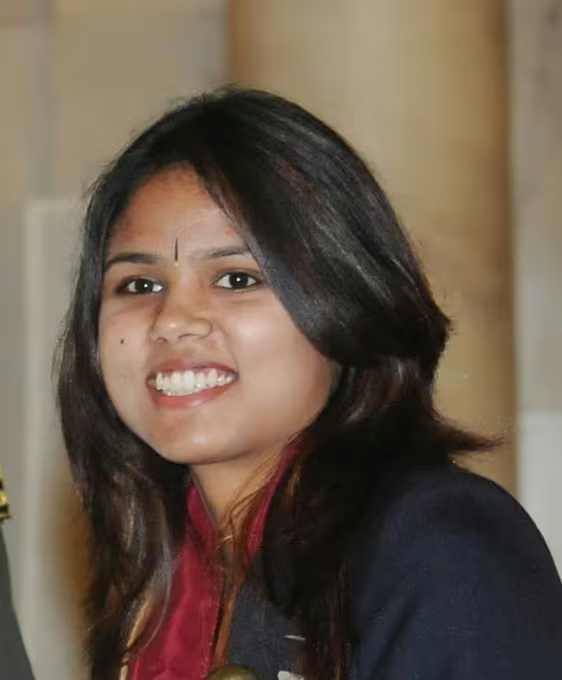
Bhakti Sharma: The Mermaid of Mewar
In the vast, silent expanse of the Antarctic Ocean, where water hovers just above freezing and icebergs drift like spectral mountains, the human body is a fragile intruder. To enter these waters is to defy nature; to swim in them is to flirt with the absolute limits of human endurance. On January 10, 2015, a young woman from the landlocked city of Udaipur, Rajasthan, plunged into this hostile 1°C water. For 41 minutes and 14 seconds, Bhakti Sharma sliced through the icy brine, her every stroke a testament to a lifetime of discipline and an unyielding spirit. When she emerged, she had not only covered 2.25 kilometres but had also etched her name into history, becoming the youngest person in the world and the first Asian woman to accomplish such a feat. Bhakti Sharma’s journey is not just a story of athletic prowess; it is a powerful narrative of a daughter and her mother-coach, of shattering records, and of planting the Indian tricolour in the most remote and challenging waters on Earth.
Early Life & A Splash of Destiny
Born on November 30, 1989, in Mumbai and raised in the historic city of Udaipur, Bhakti Sharma’s destiny seemed intrinsically linked to water, an irony given her upbringing in the heart of arid Rajasthan. Her aquatic education began at the tender age of two-and-a-half, under the watchful eye of her mother and lifelong coach, Leena Sharma. Leena, a national-level swimmer herself, saw a natural affinity for the water in her daughter and nurtured it with dedication. The swimming pools of Udaipur became Bhakti’s first playground and training ground.
However, it was the city’s magnificent lakes—the sprawling Pichola and the serene Fateh Sagar—that would shape her future. As Bhakti’s skills developed, Leena Sharma made a pivotal decision to transition her from the predictable, chlorinated confines of a swimming pool to the unpredictable, open expanse of the lakes. This was the genesis of an open water swimmer. Training in these lakes, with their changing currents, temperatures, and depths, instilled in the young Bhakti a resilience and adaptability that would become her greatest assets.
While her focus on swimming was intense, Bhakti also pursued her education with equal rigour. She balanced her gruelling training schedules with her studies, eventually earning a Bachelor's degree from the Symbiosis School of Media and Communication in Bengaluru, followed by a Master’s in Communications Management from the prestigious Mudra Institute of Communications, Ahmedabad. This dual pursuit of athletic and academic excellence demonstrates a well-rounded discipline that defined her approach to life’s challenges.
Conquering the World's Waters: A Career of Firsts
Bhakti Sharma’s professional open water career began in 2003, at just 14 years old. Her inaugural swim was a formidable 16-kilometre stretch from Uran Port to the iconic Gateway of India in Mumbai. Completing this demanding course was a declaration of intent; she was ready for the world’s greatest aquatic challenges.
The English Channel (2006)
For any long-distance swimmer, the English Channel is a rite of passage—a cold, unforgiving strait known for its treacherous currents and unpredictable weather. In July 2006, at the age of 16, Bhakti took on this legendary challenge. She did not do it alone. In a remarkable display of familial and team spirit, she swam as part of a three-person relay team with her mother, Leena, and her friend, Priyanka Gehlot. Together, they successfully crossed the channel, making history as the first mother-daughter pair from Asia to achieve the feat and the first three-member all-female Asian relay team to do so. This accomplishment was a powerful symbol of intergenerational strength and female solidarity.
The Quest for Five Oceans
Following her success in the English Channel, Bhakti set her sights on a monumental goal: to swim in all five of the world's oceans. This ambitious quest would take her across the globe, testing her skills in vastly different conditions.
Her journey began in the Indian Ocean in 2004, where she swam 36 kilometres from Dharamtal to the Gateway of India. In 2007, she turned to the Atlantic Ocean, undertaking the famous swim around the Rock of Alcatraz in San Francisco Bay, a swim notorious for its chilling waters and powerful currents. That same year, she conquered a stretch of the Pacific Ocean by swimming the Strait of Gibraltar, crossing from Tarifa, Spain, to the coast of Morocco. She continued her global tour by swimming 25 kilometres in the Gulf of Mexico and a challenging course in the Mediterranean Sea through the Strait of Bonifacio between Corsica and Sardinia.
By 2010, only one ocean remained to complete the set before Antarctica's unique challenge. She travelled to the high north and swam 1.8 kilometres in the Arctic Ocean, enduring its frigid embrace in a swim that lasted 33 minutes. This achievement made her only the second swimmer in the world, after Britain's Lewis Pugh, to have swum in four oceans.
The Crowning Glory: The Antarctic Ocean (2015)
The culmination of her life's work arrived in January 2015. The Antarctic swim was not merely another notch in her belt; it was the ultimate test of physical and mental fortitude. The preparation was immense, requiring specialised training to acclimatise her body to near-freezing temperatures and raising funds through crowdsourcing to finance the complex expedition.
On that fateful day, as the world watched, Bhakti Sharma entered the 1°C waters of the Antarctic Ocean. For over 41 minutes, she battled the profound, biting cold that threatens to shut down the body's systems. Every stroke was a victory against hypothermia, every breath a defiance of the extreme environment. When she finished the 2.25-kilometre swim, she had shattered two world records: those of British open water swimming legend Lewis Pugh and American icon Lynne Cox. More importantly, she became the youngest person and the first Asian woman to swim in the Antarctic Ocean.
The news of her historic achievement resonated across India and the world. Prime Minister Narendra Modi personally congratulated her, tweeting his admiration for her courage. She had not just achieved a personal dream; she had brought immense pride to her nation.
Her incredible career was officially recognised by the Government of India in 2012, when she was honoured with the Tenzing Norgay National Adventure Award, the highest honour for adventure sports in the country, placing her in the same esteemed category as recipients of the Arjuna Award.
The Legacy of a Water Warrior
Bhakti Sharma's legacy extends far beyond her impressive list of records. She is a pioneer who single-handedly raised the profile of open water swimming in India, a nation predominantly focused on mainstream sports like cricket. Her journey from the lakes of Udaipur to the ice-choked waters of Antarctica proved that with unwavering determination, athletes from any part of the country could achieve world-class success.
Her story is particularly resonant for Indian women and girls. In a field demanding immense physical strength and mental grit, she has become a powerful role model, demonstrating that gender is no barrier to conquering the world's toughest frontiers. The unique and enduring partnership with her mother-coach, Leena Sharma, adds another layer to her inspiring narrative. It is a story of mentorship, trust, and shared dreams, showcasing the profound impact of a strong support system.
Today, Bhakti Sharma continues to inspire. As a motivational speaker, she shares her experiences of overcoming fear, pushing boundaries, and the importance of meticulous preparation. Her TEDx talks and public appearances carry a message of resilience that resonates with audiences from all walks of life. She is remembered not just as a record-breaking athlete, but as the "Mermaid of Mewar," a symbol of what the human spirit can achieve when it refuses to be limited by the cold, the vast, or the seemingly impossible.