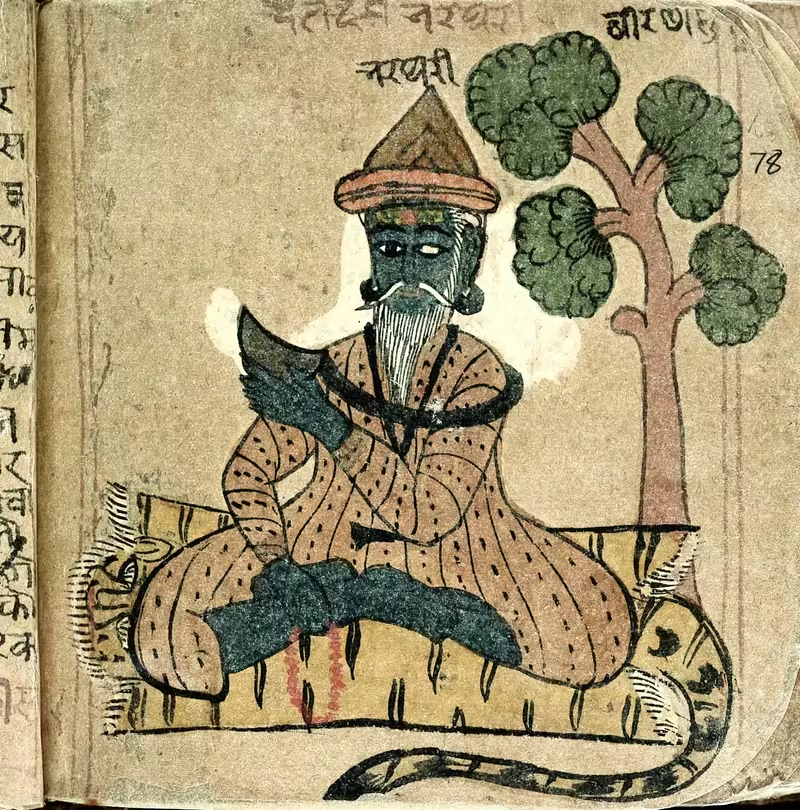
The Mind of Language: Bhartṛhari and the Cosmic Word
In the intellectual crucible of India's Gupta period, a time of unparalleled cultural and scientific flourishing, one thinker embarked on a journey not into the cosmos of stars, but into the universe contained within a single word. His name was Bhartṛhari (c. 5th century CE), a philosopher of language so profound that his ideas would echo through the subcontinent's philosophical corridors for more than a thousand years. He was not merely a grammarian cataloging the rules of Sanskrit; he was an architect of a grand metaphysical system, one who saw in the structure of language the very blueprint of consciousness and reality itself. Bhartṛhari elevated the science of grammar (vyākaraṇa) into a path of liberation (darśana), arguing that to understand language was to understand the ultimate nature of existence.
Life in an Age of Ideas
The historical record, often frustratingly silent on the personal lives of India's ancient sages, offers virtually no concrete details about Bhartṛhari's birth, family, or personal journey. We cannot speak of his parents, his upbringing, or the specific events that shaped his youth. However, we can paint a vivid picture of the world that produced him. He lived and worked during the Gupta Empire (c. 320-550 CE), a golden age where advancements in mathematics, astronomy, medicine, and the arts were matched by an intense flourishing of philosophical debate.
This was an era of sophisticated intellectual exchange. The air crackled with the arguments of various schools of thought: the logicians of the Nyāya school, the atomists of the Vaiśeṣika, the ritualists of the Mīmāṃsā, and the metaphysicians of the Vedānta. Alongside them, Buddhist philosophers like Dignāga were forging powerful new theories of logic and epistemology. It was within this vibrant, competitive landscape that Bhartṛhari developed his ideas. He was an heir to the formidable grammatical tradition of Pāṇini (c. 4th century BCE) and Patañjali (c. 2nd century BCE), whose works on Sanskrit grammar had already achieved near-scriptural status. Yet, Bhartṛhari was not content to be a mere custodian of this tradition. He sought to uncover the philosophical foundations that lay beneath their linguistic rules, asking not just how language works, but what language is.
The Great Contributions: A Universe of Meaning
Bhartṛhari's legacy rests primarily on two monumental works of Sanskrit scholarship, each a masterpiece in its own right.
The Vākyapadīya: The Sentence and the Word
His magnum opus, the Vākyapadīya (literally, “On the Sentence and the Word”), is one of the most important texts in the history of Indian philosophy. Composed in dense, aphoristic verse (kārikā), this work is a systematic exploration of the philosophy of language. It is divided into three books, or kāṇḍas, each building upon the last to construct a complete worldview.
1. The Brahma-kāṇḍa (Book on Brahman): Here, Bhartṛhari makes his most radical and foundational claim: the ultimate reality, Brahman, is identical with the principle of language, which he calls Śabda Tattva (the Principle of the Word) or Śabda Brahman. He famously opens the text with the verse:
“The Brahman, which is without beginning or end, whose very essence is the Word, which is the cause of the manifested phonemes, which appears as the objects, from which the creation of the world proceeds.”
For Bhartṛhari, language is not a human invention or a tool to describe a pre-existing reality. Instead, reality itself is a manifestation or transformation (vivarta) of this eternal, indivisible linguistic principle. The entire universe, with all its diverse objects and phenomena, flows from this cosmic Verbum. Consciousness, thought, and the world are all woven from the same linguistic fabric. This non-dualistic vision placed the study of grammar at the center of all knowledge, making it a key to understanding the cosmos.
2. The Vākya-kāṇḍa (Book on the Sentence): In this section, Bhartṛhari addresses the fundamental question of meaning. How do we understand a sentence? The prevailing view, particularly among the Mīmāṃsā school, was atomistic: the meaning of a sentence is built up sequentially from the meanings of its individual words. Bhartṛhari powerfully refutes this. He argues that the sentence (vākya) is the primary, indivisible unit of meaning. We do not grasp meaning word by word; we comprehend the entire proposition in a single flash of insight or intuition (pratibhā). The individual words are merely abstractions, analytical tools used by grammarians to understand a pre-existing, holistic meaning.
3. The Pada-kāṇḍa (Book on the Word): Having established the primacy of the sentence, Bhartṛhari then delves into the nature of individual words (pada) and their components. This book is a more technical grammatical analysis, but it is always informed by his holistic philosophy. He explores complex concepts like the relationship between a word and its referent, the nature of linguistic categories, and the function of grammatical cases, all within his overarching framework where words only have meaning in the context of the sentence-whole.
The Theory of Sphoṭa: The Burst of Meaning
Central to the Vākyapadīya is Bhartṛhari's celebrated theory of Sphoṭa. The term, derived from the root sphuṭ (to burst forth), refers to the stable, indivisible meaning-unit of language that “bursts forth” in the mind of the listener. Bhartṛhari distinguishes this singular Sphoṭa from the physical sounds (dhvani) that are used to articulate it.
Imagine someone says the word “cow.” The sounds /k/, /aʊ/ are produced sequentially. They are fleeting, varying in pitch, speed, and accent from speaker to speaker. For Bhartṛhari, these sounds are not the word itself; they are merely the vehicle that manifests or reveals the true word—the Sphoṭa. The Sphoṭa is the unified, timeless mental concept of “cow” that flashes in the listener’s consciousness. The sequential, ephemeral dhvani acts as a trigger, but the meaning itself is grasped holistically, not piece by piece. This brilliant theory resolved the philosophical problem of how a unified meaning could arise from a sequence of transient sounds.
The Mahābhāṣya-dīpikā: A Light on the Great Commentary
Bhartṛhari also authored the Mahābhāṣya-dīpikā (or Ṭīkā), a sub-commentary on Patañjali’s Mahābhāṣya (“Great Commentary”). Patañjali’s work was itself a commentary on the foundational grammar of Pāṇini. By writing the Dīpikā (“The Lamp”), Bhartṛhari was not just explaining a revered text; he was cementing his place in the hallowed lineage of India’s greatest grammarians. Though only a portion of this work survives, it showcases his sharp analytical mind and his deep mastery of the grammatical tradition he sought to philosophically ground.
The Poet of the Human Condition: The Śatakatraya
Tradition also attributes to Bhartṛhari a collection of about 300 lyrical poems known as the Śatakatraya (“The Three Centuries” or “Three Hundreds”). It is a matter of intense scholarly debate whether the austere grammarian-philosopher and the passionate poet were the same person. Regardless, these poems have become an inseparable part of the Bhartṛhari legacy.
The collection is a masterful triptych of the human experience:
- Śṛṅgāraśataka (Century of Love): A profound and often sensuous exploration of love, desire, and the beauty of women. It captures the intoxicating joys and bitter pains of romantic entanglement.
- Nītiśataka (Century of Ethics): A collection of wise and pragmatic verses on morality, politics, wealth, courage, and proper conduct in the world. It is a guide to living a life of dignity and purpose.
- Vairāgyaśataka (Century of Renunciation): A powerful and moving reflection on detachment, the transient nature of worldly pleasures, and the search for inner peace. It charts the journey from worldly disillusionment to spiritual liberation.
Whether or not they were penned by the author of the Vākyapadīya, these verses reveal a mind acutely aware of the contradictions of the human heart—the pull between worldly attachment and the yearning for transcendence. Legends abound of a King Bhartṛhari who renounced his throne for a spiritual life, and these poems are often seen as a reflection of that inner conflict.
Legacy and Enduring Influence
Bhartṛhari’s impact on Indian intellectual history is immeasurable. His greatest achievement was to transform grammar from a descriptive science into a profound philosophical system, a darśana in its own right.
His ideas resonated deeply with subsequent schools of thought:
- Advaita Vedānta: The non-dualism of Śabda Brahman, the idea of the world as a manifestation (vivarta) of a singular, ultimate principle, profoundly influenced later Advaita thinkers like Gauḍapāda and Śaṅkarācārya.
- Kashmiri Śaivism: His theories on language as the creative power of consciousness found fertile ground in the sophisticated metaphysics of Kashmiri Śaivism, particularly in the works of thinkers like Abhinavagupta.
- Indian Linguistics: For centuries, nearly all subsequent work on the philosophy of language in India was, in essence, a dialogue with Bhartṛhari. Philosophers either built upon his theories or defined their own positions in opposition to him.
Today, Bhartṛhari is studied by linguists, philosophers, and Indologists across the globe. His holistic theory of meaning stands as a powerful counterpoint to the purely atomistic models of language. His insights into the relationship between language, cognition, and reality prefigure discussions in modern structuralism, semantics, and the philosophy of mind. He remains a testament to an era when the study of a sentence was a path to understanding the universe, and the analysis of a word could reveal the very nature of God.