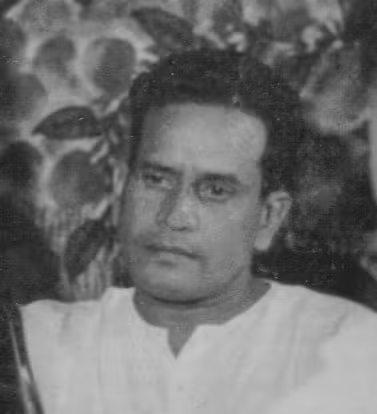
Pandit Bhimsen Joshi: The Voice of a Nation
In the grand pantheon of Indian classical music, few voices resonate with the raw power, spiritual depth, and technical brilliance of Pandit Bhimsen Gururaj Joshi (1922-2011). A titan of the Kirana gharana, his voice was not merely a medium for music; it was a force of nature—a thunderous river that could carve canyons of complex taans and a serene lake reflecting the deepest emotions of a devotional abhang. For over six decades, Bhimsen Joshi was more than a vocalist; he was a cultural icon, a spiritual conduit, and a symbol of national unity whose legacy is etched into the very soul of India.
Early Life & Background: A Runaway's Quest for a Guru
Bhimsen Joshi was born on February 4, 1922, in Gadag, a town in the Dharwad district of what is now Karnataka. His father, Gururajrao Joshi, was a respected school teacher and lexicographer, while his mother, Godavaribai, was a homemaker. Born into a Kannada Madhwa Brahmin family, the young Bhimsen grew up in an environment where culture and scholarship were valued, but his heart was captivated by something else entirely: the sound of music.
From a very early age, he was irresistibly drawn to any form of melody. He would often follow musical processions, transfixed by the sound of bhajans, and was known to be deeply moved by the music he heard on gramophone records. A recording of the Kirana gharana maestro Ustad Abdul Karim Khan's thumri, "Piya Bin Nahi Aavat Chain," is said to have left an indelible mark on his young mind, igniting a lifelong passion.
This passion soon transformed into a burning quest. Convinced that his destiny lay in music, and that he must find a master—a true guru—to guide him, the 11-year-old Bhimsen ran away from home in 1933. This was not a flight of fancy but a determined pilgrimage. With no money and a heart full of hope, he began an arduous journey across India. He traveled by train, often without a ticket, to Bijapur and then Pune. His search eventually led him to Gwalior, a historic seat of Hindustani music, where he enrolled in the Madhava Music School.
His quest took him further, to the bustling metropolises of Calcutta and to Jalandhar in Punjab, where he briefly studied under maestros of different gharanas. For three years, the young boy wandered, absorbing the sounds of the subcontinent, surviving on the kindness of strangers, and honing his resolve. His father, after a frantic search, finally tracked him down and brought him home.
However, the journey was not in vain. It had crystallized Bhimsen's purpose. Back in Karnataka, his determination finally led him to the guru he was destined to find: Rambhau Kundgolkar, known to the music world as Sawai Gandharva. A premier disciple of Ustad Abdul Karim Khan, Sawai Gandharva was a torchbearer of the Kirana gharana. From 1936 to 1940, Bhimsen Joshi lived with his guru in Kundgol in a traditional gurukul system. Life was rigorous; it involved performing household chores and serving his guru, with music lessons often being spontaneous and demanding. Here, alongside fellow disciples like Gangubai Hangal, he imbibed the core tenets of the Kirana style—the precise intonation of notes (swara), the emotional depth, and the methodical elaboration of a raga.
Career & Major Contributions: From Concert Halls to National Anthem
After years of intensive training, Bhimsen Joshi gave his first public performance in 1941 at the age of 19. His powerful voice, impeccable training, and innate musicality immediately caught the attention of connoisseurs. In 1942, HMV released his debut album of devotional songs in Kannada and Hindi, marking his formal entry into the world of recorded music.
He moved to Mumbai in 1943, working as a radio artist, but his breakthrough performance came in 1946. At a concert in Pune organized to celebrate his guru Sawai Gandharva's 60th birthday, Bhimsen Joshi's performance electrified the audience and announced the arrival of a formidable new talent on the national stage.
The Bhimsen Joshi Style
While his foundation was firmly in the Kirana gharana, Bhimsen Joshi’s genius lay in his ability to assimilate the best of other traditions, creating a style that was uniquely his own. His music was characterized by:
- A Powerful, Pliable Voice: He possessed a resonant baritone with incredible range and stamina, capable of executing lightning-fast taans that cascaded across three octaves with breathtaking precision.
- Profound Emotionality: He was a master of khayal singing, imbuing ragas like Shuddha Kalyan, Miyan Ki Todi, Puriya Dhanashri, and Darbari Kanada with a deep sense of pathos and devotion.
- Exceptional Breath Control: His mastery over his breath (saans) was legendary, allowing him to sustain notes and spin intricate melodic phrases for seemingly impossible durations.
- Devotional Fervor: Beyond the rarefied world of classical ragas, Joshi became the definitive voice for devotional music. His renditions of Marathi abhangs (poems of saints like Tukaram and Dnyaneshwar) and Kannada Dasavani (compositions of saints like Purandara Dasa) brought classical aesthetics to a wider audience, making him a beloved figure in households across Maharashtra and Karnataka.
The Sawai Gandharva Bhimsen Mahotsav
One of his most significant contributions was not as a performer, but as an institution-builder. In 1953, to honor the memory of his guru, he started the Sawai Gandharva Music Festival in Pune. What began as a modest gathering grew into India's most prestigious classical music festival. It became a coveted stage for both established legends and promising young artists, a democratic celebration of music that continues to draw thousands of listeners every year.
A Voice for the Silver Screen and National Unity
Though he primarily remained a classical concert artist, Pandit Joshi lent his voice to a few films with memorable results. His singing in films like Basant Bahar (1956) and Birbal My Brother (1973) was highly acclaimed. In 1985, he won the National Film Award for Best Male Playback Singer for his work in Ankahee.
However, his most iconic national contribution came in 1988 with the song "Mile Sur Mera Tumhara." This anthem of national integration, broadcast on Doordarshan, featured Bhimsen Joshi's powerful voice leading a chorus of India's greatest artists. It made him a familiar face and voice in every corner of the country, cementing his status as a national treasure.
Legacy & Influence: The Bharat Ratna
Pandit Bhimsen Joshi's journey was showered with accolades. He received the Padma Shri in 1972, the Sangeet Natak Akademi Award in 1975, the Padma Bhushan in 1985, and the Padma Vibhushan in 1999. The crowning glory came in 2009 when he was awarded the Bharat Ratna, India's highest civilian honor. He was the first male Hindustani classical vocalist to receive this award, a testament to his unparalleled contribution to India's cultural heritage.
His legacy is multi-faceted. For classical purists, he remains a benchmark for vocal prowess and raga interpretation. For millions of ordinary listeners, his voice is the sound of pure devotion, forever linked to the abhangs and bhajans that became a part of their spiritual lives. The Sawai Gandharva Bhimsen Mahotsav stands as a living monument to his vision, ensuring that the flame of classical music he carried so brilliantly continues to burn bright for future generations.
Pandit Bhimsen Joshi passed away on January 24, 2011, in Pune, the city he had made his home. He was accorded a state funeral, and his passing was mourned by the entire nation. Yet, a voice like his never truly falls silent. It lives on in his countless recordings, in the festival that bears his and his guru's name, and in the hearts of millions who found solace, joy, and a connection to the divine through his music. He was, and remains, a true Sangeet Martand—a sun in the firmament of Indian music.