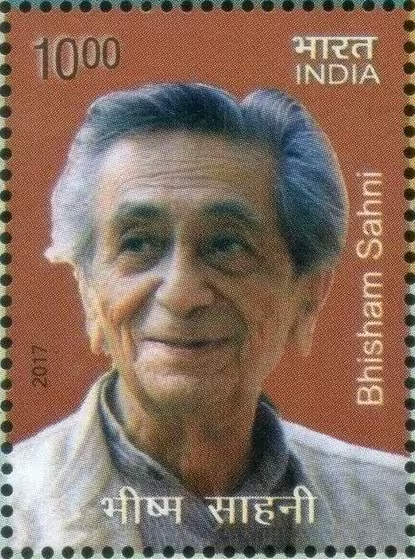
A Conscience Forged in Fire: The Life and Legacy of Bhisham Sahni
In the pantheon of modern Indian literature, few voices resonate with the quiet, profound authority of Bhisham Sahni (1915-2003). He was a writer, playwright, actor, and intellectual whose life and work were inextricably linked with the tumultuous history of 20th-century India. More than just a chronicler, Sahni was a conscience-keeper, a humanist who wielded his pen not as a weapon, but as a lamp to illuminate the darkest corners of the human soul and society. His legacy, anchored by the monumental Partition novel Tamas, remains a powerful testament to the enduring search for empathy in a world fractured by hatred.
Early Life & The Crucible of Partition
Bhisham Sahni was born on August 8, 1915, in the bustling garrison town of Rawalpindi, then a part of British-ruled Punjab. He grew up in a culturally and intellectually vibrant household. His father, Harbanslal Sahni, was a dedicated social worker deeply influenced by the reformist principles of the Arya Samaj, a movement that shaped the family’s progressive and patriotic values. This environment of social consciousness was shared with his elder brother, Balraj Sahni, who would go on to become one of the most celebrated and naturalistic actors in the history of Indian cinema.
Sahni’s formative years were spent absorbing the complex socio-political currents of the time. He pursued his higher education at the prestigious Government College in Lahore, earning a Master's degree in English Literature. It was here, and through his involvement with the Indian National Congress, that his political awareness sharpened. He witnessed firsthand the rising tide of the independence movement and, ominously, the deepening communal fault lines that ran through Punjabi society.
However, the single most defining experience of his life was the cataclysmic Partition of India in 1947. Sahni was in Rawalpindi when the fires of communal violence engulfed the city. He witnessed the horrific descent of neighbours into murderers, the brutal uprooting of communities, and the mass exodus driven by fear and fanaticism. This direct, traumatic experience of humanity’s collapse into barbarism would leave an indelible scar on his psyche. He and his family became refugees, forced to leave their ancestral home for the newly-formed India. This personal apocalypse would later become the raw, searing material for his greatest literary achievement.
After migrating to India, he continued his academic pursuits, eventually earning a PhD from Panjab University, Chandigarh, and embarked on a career as an educator, teaching at various colleges in Punjab and Delhi, most notably at Zakir Husain Delhi College.
A Literary Odyssey: From Moscow to Tamas
Bhisham Sahni’s career was a rich tapestry of literary, academic, and cultural engagement. A pivotal chapter began in 1957 when he moved to Moscow to work as a translator at the Foreign Languages Publishing House. During his seven-year stay, he immersed himself in Russian literature, translating nearly two dozen books, including seminal works by Leo Tolstoy and Anton Chekhov, into Hindi. This period not only honed his craft but also deepened his commitment to socialist ideals and social realism, which became hallmarks of his writing style.
Upon his return to India, Sahni's literary voice came into its own. He was a prominent figure in the Progressive Writers’ Association (PWA) and the Indian People's Theatre Association (IPTA), movements that believed art should serve a social purpose and reflect the struggles of the common person. It was within this ideological framework that he produced the body of work that would define him.
The Magnum Opus: Tamas
Published in 1974, Tamas (Darkness) was not merely a novel; it was an act of bearing witness. Drawing directly from his harrowing memories of the 1947 Rawalpindi riots, Sahni crafted a narrative that laid bare the anatomy of communal violence. The novel begins with a seemingly minor, cynical act: Nathu, a poor tanner, is paid by a local politician to kill a pig, ostensibly for a veterinary officer. The pig’s carcass is then surreptitiously thrown on the steps of a mosque, an act of calculated provocation that ignites a city-wide inferno of religious hatred.
What makes Tamas a masterpiece is its profound humanism. Sahni refused to paint communities in monolithic strokes of good and evil. Instead, he focused on ordinary people—Hindus, Muslims, and Sikhs—who are manipulated by political forces, consumed by fear, and ultimately driven to commit unspeakable acts. He shows how the bonds of centuries-old coexistence could be shattered in a matter of days. The narrative is unflinching in its depiction of violence, yet its true power lies in its deep empathy for the victims and its sharp critique of the vested interests that fan the flames of discord. The novel won the prestigious Sahitya Akademi Award in 1975, cementing its place as a cornerstone of Indian literature.
In 1988, director Govind Nihalani adapted Tamas into a powerful television miniseries. Its broadcast on the state-run Doordarshan channel triggered a massive public and political controversy but also forced a national introspection about the unhealed wounds of Partition, bringing Sahni’s stark, essential message to a new generation.
A Versatile Virtuoso
While Tamas remains his most celebrated work, Sahni’s literary canvas was vast. He was a master of the short story, a form he used to dissect the anxieties, hypocrisies, and quiet tragedies of Indian middle-class life. Stories like "Chief Ki Daawat" (The Chief's Dinner Party), a poignant satire on the compromises made for professional advancement at the cost of personal dignity, and "Amritsar Aa Gaya Hai" (We Have Reached Amritsar), a chilling account of a train journey through the heart of Partition violence, are considered classics of the genre.
His novels also explored a range of themes. Jharokhe (1967) is a sensitive portrayal of a child’s perspective on the adult world, while Basanti (1980) tells the story of a spirited girl from a slum navigating the harsh realities of urban poverty and exploitation. Mayyadas ki Mari (Mayyadas's Castle, 1988) is a sprawling historical novel set in 19th-century Punjab, showcasing his ability to weave grand historical narratives with intimate human drama.
Sahni was also a gifted playwright. His play Hanush (1977), based on the folk tale of a Czech locksmith who is blinded to prevent him from replicating his masterpiece clock, is a profound meditation on the artist's struggle against the state. He was also a fine, understated actor, appearing in films like Mohan Joshi Hazir Ho! (1984) and, most movingly, as an elderly Sikh man in the Tamas miniseries who chooses death over forced conversion.
Legacy & Influence: A Moral Compass
Bhisham Sahni’s historical significance lies in his role as one of the most honest and humane chroniclers of the Partition. Alongside Saadat Hasan Manto, Khushwant Singh, and Amrita Pritam, he helped create a body of literature that moved beyond political analysis to explore the deep, personal trauma of the event. His work provided a crucial counter-narrative to sanitized official histories, reminding India of the human cost of its birth.
His lasting impact extends far beyond his literary achievements. Sahni was a lifelong advocate for secularism and social justice. His belief in the power of art to foster communal harmony was not just a theme in his writing but a principle he lived by. After the brutal murder of theatre activist Safdar Hashmi in 1989, Sahni became the founder-chairman of SAHMAT (Safdar Hashmi Memorial Trust), an organization dedicated to defending artistic freedom and fighting communalism through culture. This institution stands as a living part of his legacy.
He is remembered today as a literary giant with an unwavering moral compass. His prose—simple, direct, and devoid of artifice—had the rare ability to convey complex emotional and social truths with piercing clarity. He wrote not to preach, but to understand. For his immense contributions to Indian literature, he was honoured with the Padma Bhushan in 1998 and the Sahitya Akademi Fellowship, the highest honour given by the academy, in 2002.
Bhisham Sahni passed away on July 11, 2003, leaving behind a body of work that continues to be a vital resource for understanding the complexities of modern India. In an age still grappling with the ghosts of the past and the challenges of religious intolerance, his voice remains more relevant than ever—a gentle but firm reminder that in the midst of the darkest Tamas, the flicker of human empathy is the only light we have.