Overview
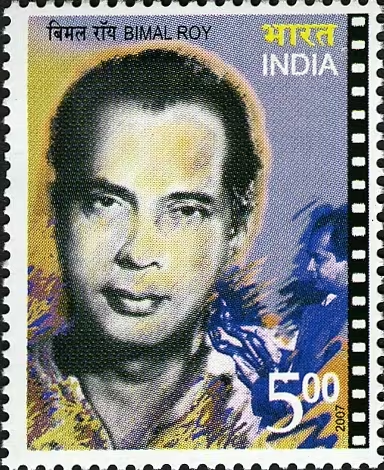
In the pantheon of Indian cinema, few names command as much reverence as Bimal Roy (1909-1966). A quiet revolutionary, Roy was a filmmaker whose camera was not merely a tool for entertainment, but a lens through which he examined the soul of a newly independent India. He was a master of social realism, a poet of the human condition, and an architect of what is now celebrated as the Golden Age of Indian Cinema. His films, marked by their profound empathy, technical brilliance, and understated narrative power, transcended the boundaries of popular cinema to become enduring works of art. From the neorealist grit of Do Bigha Zamin to the psychological depth of Bandini, Bimal Roy crafted a legacy built on integrity, compassion, and an unwavering belief in the dignity of the common man.
Early Life and Entry into Cinema
Bimal Roy was born on July 12, 1909, into a wealthy zamindar (landowner) family in the Dhaka district of what was then British India (now Bangladesh). His early life, though privileged, was not untouched by turmoil. The untimely death of his father and subsequent family disputes led to the loss of their estate, forcing a young Bimal Roy to relocate to Calcutta in search of a future.
In Calcutta, Roy's passion for photography, which he had nurtured from a young age, became his entry point into the magical world of cinema. He began his career in the early 1930s as a publicity photographer and soon found his way into the hallowed halls of New Theatres, the premier film studio of the era. Founded by the visionary B.N. Sircar, New Theatres was a crucible of talent, and it was here that Roy would hone his craft. He started in the camera department, quickly demonstrating a keen eye for light, shadow, and composition.
The New Theatres Era: Forging a Vision
At New Theatres, Bimal Roy worked under the tutelage of the celebrated director P.C. Barua. This apprenticeship was the most formative period of his career. He served as the cinematographer for Barua's iconic 1935 film, Devdas, starring the legendary K.L. Saigal. Through his lens, Roy learned the art of visual storytelling, mastering the use of chiaroscuro (the interplay of light and dark) to evoke mood and psychological depth—a technique that would become a hallmark of his own directorial style.
After years of mastering the technical aspects of filmmaking, Roy was given the opportunity to direct. His directorial debut, Udayer Pathey (The Way of the Dawn), released in 1944, was a cinematic thunderclap. The film, which explored the stark class divide between a wealthy industrialist's daughter and a struggling, idealistic writer, was a radical departure from the melodramatic norms of the time. Its realistic dialogue, contemporary themes, and socialist-leaning message resonated deeply with the audience. The film was a massive critical and commercial success, establishing Bimal Roy as a formidable new voice in Indian cinema. It was later remade in Hindi as Humrahi (1945), further solidifying his national reputation.
The Move to Bombay and Bimal Roy Productions
The partition of India in 1947 had a profound impact on the Calcutta film industry, leading to an exodus of talent. In the early 1950s, Bimal Roy, like many of his contemporaries, moved to Bombay (now Mumbai), the burgeoning center of Hindi cinema. He initially directed a few films for established studios, including Maa (1952) for Bombay Talkies.
However, to achieve complete creative freedom, Roy knew he needed to be his own producer. In 1952, he established Bimal Roy Productions. This was a pivotal moment. He assembled a team of brilliant collaborators who would become legends in their own right. His core unit included editor Hrishikesh Mukherjee, screenwriters Nabendu Ghosh and Paul Mahendra, music directors S.D. Burman and Salil Chowdhury, and a young assistant who would later become the celebrated poet and director, Gulzar. This creative powerhouse was set to redefine the landscape of Hindi cinema.
The Golden Era: A Triptych of Classics
The first few years of Bimal Roy Productions produced a string of masterpieces that cemented Roy's status as a master filmmaker.
His first home production was Do Bigha Zamin (Two Acres of Land, 1953), a film that remains a cornerstone of Indian cinema. Deeply influenced by Vittorio De Sica's Italian neorealist classic Bicycle Thieves, the film tells the heartbreaking story of Shambhu, a poor farmer who is forced to become a rickshaw puller in Calcutta to save his ancestral land from a greedy landlord. Featuring a towering performance by Balraj Sahni, the film was a stark, unflinching look at rural poverty, urban exploitation, and the erosion of human dignity. It was a commercial risk, devoid of the usual song-and-dance glamour, but its raw emotional power connected with audiences. Do Bigha Zamin went on to win the first-ever Filmfare Award for Best Film and received the prestigious International Prize at the 1954 Cannes Film Festival, bringing Bimal Roy and Indian cinema significant international acclaim.
In the same year, Roy directed Parineeta (The Married Woman, 1953), a sensitive adaptation of Sarat Chandra Chattopadhyay's beloved novel. Starring Ashok Kumar and Meena Kumari, the film was a beautifully crafted period romance that demonstrated Roy's versatility and his delicate touch in handling complex human emotions. Meena Kumari's portrayal of the conflicted Lalita won her the Filmfare Award for Best Actress.
He followed this with Biraj Bahu (1954), another poignant adaptation of a Sarat Chandra novel. The film explored the trials of a virtuous woman, played by Kamini Kaushal, who endures immense hardship to uphold her family's honor. It won the National Film Award for Best Feature Film, further cementing Roy's reputation as the foremost literary adapter in Indian cinema.
Exploring Social Mores: Devdas and Sujata
Having served as the cinematographer on the 1935 version, Bimal Roy felt a deep connection to the story of Devdas. In 1955, he directed his own interpretation of the classic novel, casting Dilip Kumar in the title role, alongside Suchitra Sen as Paro and Vyjayanthimala as Chandramukhi. Roy’s Devdas was a more introspective and psychologically nuanced film than its predecessor. He focused on the inner turmoil of his characters, using lingering close-ups and an atmospheric soundtrack to convey their unspoken anguish. Dilip Kumar's brooding, understated performance became the definitive portrayal of the tragic hero, influencing generations of actors.
In 1959, Roy turned his attention to one of India's most deep-seated social evils: the caste system. Sujata was a brave and progressive film for its time. It tells the story of an 'untouchable' orphan girl (a brilliant Nutan) raised by a liberal, upper-caste Brahmin family. The film delicately explores the insidious nature of prejudice that persists even in an educated, well-meaning household. Starring Sunil Dutt as the young Brahmin man who falls in love with Sujata, the film was a powerful plea for social equality and humanism. Its sensitive handling of a controversial subject earned it critical acclaim both in India and abroad, including a screening at the Cannes Film Festival.
The Gothic Romance: Madhumati
While best known for his social dramas, Bimal Roy proved his mastery over other genres with Madhumati (1958). A stark departure from his usual work, this film was a grand, atmospheric gothic romance centered on themes of reincarnation and eternal love. Starring Dilip Kumar and Vyjayanthimala in a double role, the film was a visual spectacle, shot beautifully in the hills of Nainital.
With a hauntingly beautiful musical score by Salil Chowdhury, including timeless songs like "Aaja Re Pardesi," Madhumati was a massive commercial blockbuster. It swept the Filmfare Awards, winning nine trophies, a record that stood for many years. The film's intricate plot became a template for countless reincarnation-themed thrillers in Indian cinema, but few have ever matched the elegance and artistry of Roy's original.
The Final Act: Bandini
Bimal Roy's final feature film, Bandini (The Imprisoned, 1963), is widely regarded by critics as his magnum opus. The film is a profound and poignant exploration of a woman's life, choices, and sacrifices, told through the eyes of Kalyani, a female prisoner in the 1930s. The film unfolds in a series of flashbacks, revealing the tragic circumstances that led a gentle, educated woman to commit a crime of passion.
Nutan delivered a career-defining performance as Kalyani, portraying a universe of emotions—love, betrayal, rage, and resignation—with remarkable subtlety and grace. Supported by powerful performances from Ashok Kumar and a young Dharmendra, the film is a masterclass in narrative construction and psychological depth. The climax of Bandini, set at a river ghat with a steamer horn blowing, is one of the most iconic and emotionally resonant endings in the history of cinema. The film won the National Film Award for Best Feature Film and six Filmfare Awards, including Best Film and Best Director, a fitting swansong for the master.
Directorial Style and Thematic Concerns
Bimal Roy's cinema was defined by a distinct set of principles:
- Deep-seated Humanism: At the core of every Bimal Roy film was a profound empathy for his characters. He portrayed the struggles of the marginalized—farmers, women, lower-caste individuals—not with pity, but with immense dignity and respect.
- Understated Realism: He eschewed loud melodrama, preferring a quieter, more observational style. He relied on subtext, silence, and the expressive faces of his actors to convey emotion. His background as a cinematographer was evident in his meticulous compositions and his masterful use of light to create mood.
- Literary Sensibility: Roy was a master of adapting literature for the screen, particularly the works of Sarat Chandra Chattopadhyay, whose understanding of human psychology and social critique resonated with his own worldview.
- Integral Music: Music in his films was never a mere interruption. He worked closely with composers like S.D. Burman and Salil Chowdhury to create songs that were deeply woven into the narrative, advancing the story and illuminating the characters' inner lives.
Personal Life
Bimal Roy was married to Manobina Roy, who was herself a pioneering photographer. They had four children: daughters Rinki Bhattacharya, Yashodhara Roy, and Aparajita Sinha, and a son, Joy Bimal Roy. He was known to be a quiet, introspective man, completely devoted to his craft.
Tragically, Bimal Roy's illustrious career was cut short. He passed away from cancer on January 8, 1966, at the age of 56, leaving a void in the world of cinema that could never be filled.
Legacy and Influence
Bimal Roy's legacy is immeasurable. He was a filmmaker who successfully bridged the gap between artistic integrity and commercial viability, proving that meaningful, socially relevant cinema could also find a wide audience. His films are not just historical artifacts; they are timeless explorations of the human spirit that continue to resonate today.
Perhaps his greatest legacy is the generation of filmmakers he mentored. His studio, Bimal Roy Productions, was a veritable film school. Luminaries like Hrishikesh Mukherjee, Gulzar, Basu Bhattacharya, and Nabendu Ghosh all began their careers under his guidance, and they went on to carry his philosophy of thoughtful, humanistic filmmaking forward.
Bimal Roy's work remains a benchmark for cinematic excellence in India. He was a storyteller who held a mirror to his society, capturing its conflicts, its compassion, and its enduring hope with a grace and honesty that remains unparalleled.