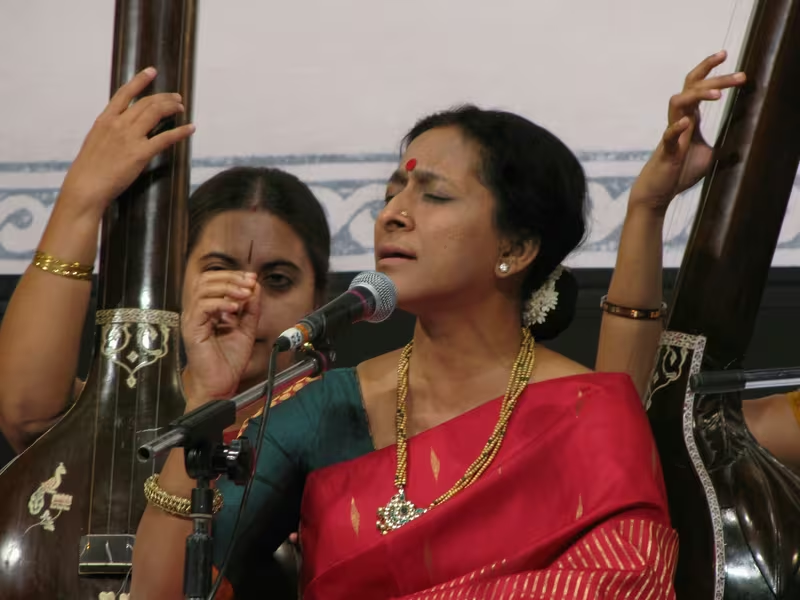
A Voice of Introspection: The Life and Art of Bombay Jayashri
In the grand theatre of Indian classical music, some voices command attention with pyrotechnic brilliance, while others invite the listener into a sanctuary of quiet contemplation. Jayashri Ramnath, known to the world as Bombay Jayashri, belongs to the latter. Her music is not a declaration but a deep, resonant conversation with melody and emotion. A Padma Shri recipient, an Oscar nominee, and the Sangeetha Kalanidhi designate for 2025, Jayashri has carved a unique niche for herself, embodying a classicism that is both profound and accessible, traditional yet globally resonant. Her journey is a testament to the power of a voice steeped in devotion (bhakti), honed by rigorous training, and guided by an unwavering artistic integrity.
Early Life & Background: A Melody Nurtured in a Musical Home
Born on October 23, 1963, in Calcutta (now Kolkata), Jayashri’s immersion in music was not a matter of choice but of inheritance and environment. She was the fourth generation of musicians in her family. Her parents, Seethalakshmy Subramanian and N. N. Subramanian, were her first gurus, cultivating a rich musical atmosphere within their home. The sounds of Carnatic music were the backdrop of her childhood, the daily lessons and practice sessions weaving the very fabric of her formative years. This early education was holistic, instilling in her not just the technical grammar of music but also its spiritual and cultural ethos.
Her family's move to Bombay (now Mumbai) in the late 1960s was a pivotal moment in her life and career. The bustling, cosmopolitan city, with its diverse cultural landscape, expanded her musical horizons. It was here that she began learning Hindustani music, training under accomplished masters like K. Mahavir Jaipurwale and Ajay Pohankar. This dual training gave her a unique perspective, allowing her to appreciate the nuances and shared aesthetics of India’s two great classical traditions. Though she would ultimately dedicate her life to Carnatic music, the melodic sensibilities of the Hindustani style subtly informed her expansive approach to improvisation.
However, the most definitive chapter of her tutelage began under the guidance of the legendary violinist and guru, Lalgudi G. Jayaraman. Becoming a disciple of the Lalgudi bani (school or style) was a transformative experience. Lalgudi Jayaraman was a master of bhavam (emotional expression), lyrical beauty, and structural perfection. Under his exacting mentorship, Jayashri's raw talent was meticulously sculpted. He taught her to look beyond the notes and delve into the soul of a composition, to understand the poet's intent, and to render each phrase with emotional clarity and grace. She also received advanced training from the vocalist Smt. T. R. Balamani in Mumbai. This combination of rigorous training under masters, coupled with her innate musicality, laid the foundation for the artist she would become.
Career & Major Contributions: The Ascent of a Unique Voice
Jayashri Ramnath’s ascent in the world of Carnatic music was steady and organic, built on the sheer power of her artistry. After moving to Chennai, the epicentre of Carnatic music, she began to make her mark in the prestigious sabha circuit, including the renowned Madras Music Season.
The Classical Stage
From the outset, her style was distinct. In a field that often celebrated virtuosic speed and complex rhythmic patterns, Jayashri’s music was marked by its unhurried grace, its meditative quality, and its profound emotional depth. Her concerts became known as immersive experiences, where the focus was on creating a tranquil, spiritual atmosphere. Her rendition of ragas like Sahana, Yadukulakamboji, and Kalyani were particularly lauded for their soul-stirring quality. She possesses a voice that can traverse octaves with effortless fluidity, but her true strength lies in her ability to sustain a note, to infuse it with feeling, and to let silence and pauses speak as eloquently as the melody itself. Her neraval (improvisation on a line of a composition) is not an athletic display but a deep exploration of the lyrical and melodic possibilities, always staying true to the composition's emotional core.
A Voice for the Silver Screen
While firmly rooted in the classical tradition, Jayashri's voice found a loving home in Indian cinema, where she brought a rare classicism to film music. Her breakthrough came with the song "Narumugaiye" from the 1996 film Iruvar, composed by A. R. Rahman. However, it was her rendition of "Vaseegara" from the 2001 Tamil film Minnale, composed by Harris Jayaraj, that made her a household name across South India. The song became an anthem of romance, its appeal lying in Jayashri’s delicate, intimate rendering that perfectly captured the feeling of new love. She proved that a classically trained voice could be immensely popular without compromising its integrity. She went on to collaborate with other leading composers like Ilaiyaraaja and M. M. Keeravani, lending her voice to memorable tracks that have stood the test of time.
A Global Canvas: The Oscar Nomination
Jayashri's most significant moment on the global stage arrived in 2012 with Ang Lee’s cinematic masterpiece, Life of Pi. She was approached by composer Mychael Danna to create a lullaby for the film's opening sequence. Not only did she lend her ethereal voice to the track, but she also penned the Tamil lyrics for what would become "Pi's Lullaby." The song, a gentle, haunting melody, perfectly set the tone for the film's magical and spiritual journey.
In 2013, "Pi's Lullaby" was nominated for an Academy Award for Best Original Song, bringing Jayashri and Carnatic music to the attention of a massive international audience. Performing at the star-studded Oscar ceremony was a landmark moment, a powerful recognition of her unique artistry and the universal appeal of her music.
Her international collaborations extend beyond this singular achievement. She has worked with Finnish composer Eero Hämeenniemi, headlining his opera Chiragh, and has performed alongside artists from different genres, including Hindustani vocalist Shubha Mudgal and Ustad Rashid Khan, always seeking to find common ground and create new artistic dialogues.
Legacy & Influence: A Voice of Bhakti and Bridge-Building
Bombay Jayashri's legacy is multifaceted. It is the legacy of a performer, a teacher, a collaborator, and a humanitarian.
The Signature Style
Her most enduring contribution is her signature musical style—one that prioritizes bhakti and introspection. She has shown generations of musicians that technical mastery is a means to an end, and that end is the evocation of rasa (aesthetic emotion). Her music is a powerful reminder that the true essence of Carnatic music lies in its ability to connect the listener to a deeper, more profound reality. She is a custodian of a tradition that values substance over showmanship, depth over dazzle.
Hitham: Music for a Cause
Beyond the concert hall, Jayashri has channelled her art towards social good. She founded the Hitham Trust, a deeply personal initiative focused on sharing the experience of music with children with special needs, particularly those on the autism spectrum. Hitham’s work is based on the belief that music can be a powerful tool for communication, connection, and healing for children who may struggle with conventional forms of interaction. This philanthropic work reflects the compassion and empathy that are so central to her music and her persona.
Accolades and Recognition
Over the decades, Jayashri has been honoured with numerous awards. In 2021, the Government of India conferred upon her the Padma Shri, one of the country's highest civilian honours, in recognition of her contributions to the arts.
However, the crowning glory of her classical career is her selection for the Sangeetha Kalanidhi award by the prestigious Madras Music Academy for the year 2025. Considered the highest accolade in Carnatic music, it is a recognition of a lifetime of dedication, mastery, and contribution to the art form. This award places her in the pantheon of the greatest Carnatic musicians in history.
Resilience and Return
In 2023, the music world was shaken by the news of her sudden illness, an aneurysm she suffered while on tour in the United Kingdom. The outpouring of prayers and support from fans, peers, and disciples across the globe was a testament to the deep affection and respect she commands. Her subsequent recovery and courageous return to the stage later that year was an inspiring story of personal resilience and an unshakeable bond with her art.
Today, Bombay Jayashri continues to be a luminous presence in Indian culture. She is more than a singer; she is an artist who has built bridges—between North and South Indian classical traditions, between classical and film music, between India and the world, and most importantly, between music and the human soul. Her voice, a gentle yet powerful force, remains a source of solace, joy, and spiritual upliftment for listeners everywhere, a timeless melody in the continuing story of Indian music.