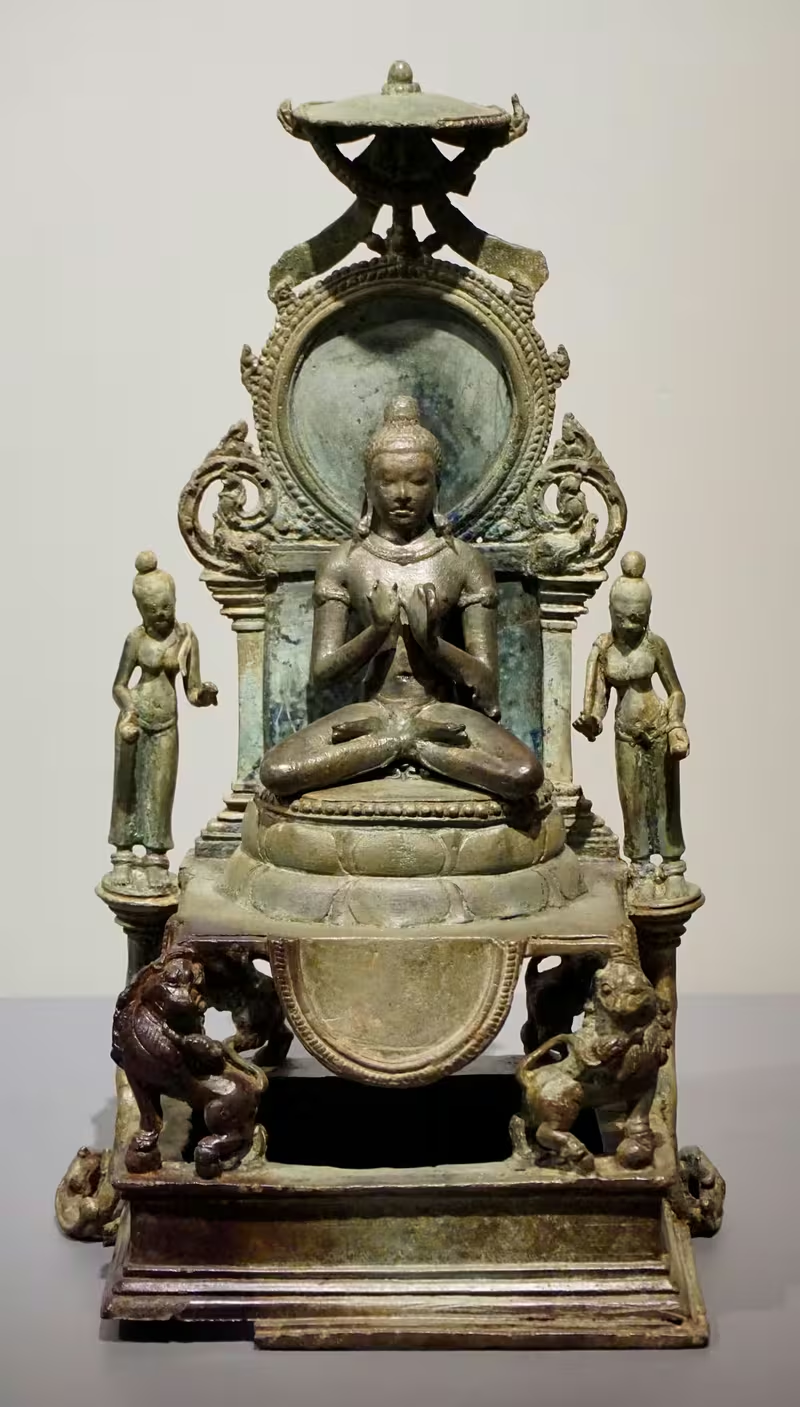
Siddhartha Gautama - The Buddha
In the annals of human history, few figures loom as large or as serene as Siddhartha Gautama. He was not a god, nor did he claim to be a divine messenger. He was a man, born into a life of staggering privilege, who voluntarily walked away from it all in a quest to understand the fundamental nature of human suffering. Through years of relentless seeking, he achieved a profound awakening, becoming the Buddha—the “Enlightened One.” His journey and the philosophical framework he established would ripple out from the Gangetic plains of ancient India to shape the spiritual and cultural landscape of Asia and, eventually, the entire world.
Early Life & The Great Renunciation
Siddhartha Gautama was born around 563 BCE in Lumbini, a verdant grove in what is now modern-day Nepal. He was the son of Suddhodana, the elected chieftain of the Shakya clan, a warrior tribe whose capital was Kapilavastu. His mother, Queen Maya, is said to have passed away just seven days after his birth, and he was raised by his maternal aunt, Mahapajapati Gotami.
Tradition holds that upon his birth, the sage Asita visited the palace and made a startling prophecy. This child, he declared, bore the marks of a great man and was destined for one of two paths: he would either become a universal monarch (chakravartin), a king who would rule the world with justice, or he would become a fully enlightened Buddha, a spiritual teacher who would show humanity the path to liberation.
Fearing the loss of his heir to an ascetic life, King Suddhodana resolved to shield his son from any sight or experience that might trigger spiritual contemplation. Siddhartha was raised in a gilded cage, surrounded by three magnificent palaces built for the different seasons. He was given the finest education, trained in the arts of warfare and statecraft, and enveloped in a world of pleasure, beauty, and comfort. He was intentionally kept from witnessing the harsh realities of old age, sickness, and death.
At the age of 16, he married his cousin, the princess Yasodhara, and they lived a life of refined ease. A son, Rahula, was later born to them. For 29 years, Siddhartha knew nothing but the curated perfection of his father's court. Yet, an unshakeable sense of unease and a deep curiosity about the world beyond the palace walls began to grow within him.
This sheltered existence was shattered during a series of chariot rides outside the palace. On these fateful excursions, Siddhartha encountered what are famously known as the Four Sights. First, he saw a decrepit old man, his body bent and frail, a stark testament to the ravages of time. Next, he saw a person wracked with disease, groaning in pain, revealing the fragility of the human body. Then, he witnessed a funeral procession carrying a corpse, confronting him for the first time with the stark, unavoidable reality of death. These three sights plunged him into a profound existential crisis. The pleasures of his life suddenly seemed hollow and transient in the face of this universal suffering (Dukkha).
On his final trip, he saw the fourth sight: a wandering ascetic (sramana), a man who had renounced worldly life, radiating an aura of deep peace and calm. In that moment, Siddhartha saw a path—a way to seek answers to the suffering that he now understood was inherent in existence. The encounter ignited his resolve. That very night, at the age of 29, he made the momentous decision known as The Great Renunciation. He took one last look at his sleeping wife and infant son, left the palace, and rode off into the darkness, trading his royal robes for the simple cloth of a mendicant and his princely life for a homeless quest for truth.
The Path to Enlightenment
Siddhartha began his search by seeking out the most famous spiritual teachers of his day. He studied under Alara Kalama and later Uddaka Ramaputta, quickly mastering their advanced techniques of meditation and philosophy. While he attained high states of consciousness, he recognized that these states were temporary and did not offer a permanent solution to the problem of suffering. The ultimate truth he sought still eluded him.
Believing that the subjugation of the body might free the mind, Siddhartha then embarked on a path of extreme asceticism. For six years, he practiced severe self-mortification near the Neranjana River with five companions. He subjected himself to breath control, prolonged fasting, and exposure to the elements, reducing his food intake until he was consuming as little as a single grain of rice a day. His body wasted away, becoming a mere skeleton covered in skin, and he came perilously close to death. Yet, this extreme path brought him no closer to enlightenment. Instead, he realized that a tortured body was a hindrance, not a help, to a clear and focused mind.
He abandoned this severe practice, accepting a bowl of milk-rice from a village girl named Sujata. This simple act of nourishment restored his strength and led him to a pivotal insight: the path to awakening lay not in the extremes of sensual indulgence or self-mortification, but in a balanced approach he called the Middle Way (Majjhimā Paṭipadā).
With renewed purpose, he traveled to a place now known as Bodh Gaya. He sat beneath a large fig tree (later the Bodhi Tree), making a firm vow not to rise until he had found the answer to his quest. As he sat in deep meditation, tradition speaks of his confrontation with Mara, a symbolic figure representing temptation, distraction, and the ego's fear of annihilation. Siddhartha remained steadfast, and as his concentration deepened through the night, he gained profound insights. He recalled his past lives, understood the universal law of karma (the cycle of action and consequence), and finally, in the pre-dawn hours, perceived the ultimate nature of reality. He understood the cause of suffering—craving and ignorance—and the way to its extinction. At the age of 35, Siddhartha Gautama became the Buddha, the Awakened One.
Career & Major Contributions
Following his enlightenment, the Buddha spent several weeks in contemplation. Initially hesitant to teach what he had realized, believing it too profound for others to grasp, he was moved by compassion for all suffering beings to share his discovery. He traveled to the Deer Park at Sarnath, near the ancient city of Varanasi, where he found his five former ascetic companions.
There, he delivered his first sermon, an event known as The Setting in Motion of the Wheel of Dharma (Dhammacakkappavattana Sutta). In this foundational discourse, he laid out the core of his teachings: The Four Noble Truths.
- The Truth of Suffering (Dukkha): Life is inherently characterized by suffering, dissatisfaction, and stress—from the obvious pains of birth, aging, sickness, and death to the subtle discontent of not getting what we want and the impermanence of what we have.
- The Truth of the Origin of Suffering (Samudāya): The root cause of this suffering is craving (taṇhā), attachment, and aversion, which are born from ignorance of the true nature of reality.
- The Truth of the Cessation of Suffering (Nirodha): It is possible to end this suffering completely by eliminating craving, attachment, and ignorance.
- The Truth of the Path to the Cessation of Suffering (Magga): The way to end suffering is to follow the Noble Eightfold Path.
The Noble Eightfold Path is a practical, systematic guide to achieving liberation, comprising three divisions: Wisdom (Right View, Right Intention), Ethical Conduct (Right Speech, Right Action, Right Livelihood), and Mental Discipline (Right Effort, Right Mindfulness, Right Concentration).
His five companions became his first disciples, forming the nucleus of the Sangha, the monastic community. For the next 45 years, the Buddha walked the dusty roads of the Gangetic plains, from the foothills of the Himalayas to the bustling cities of the lowlands. He taught his Dharma (the universal truth or law) to all who would listen, without distinction of caste, class, or gender. His teachings were pragmatic and non-dogmatic; he encouraged his followers not to accept his words on blind faith but to investigate and verify them through their own experience.
The Sangha he established was revolutionary for its time. It was an egalitarian community where a Brahmin priest and a so-called “untouchable” were equals. He also established an order of nuns (bhikkhunis), a radical step in the patriarchal society of ancient India, after the persistent requests of his aunt and foster-mother, Mahapajapati Gotami.
Legacy & Influence
The Buddha passed away around 483 BCE in Kushinagar, attaining what is known as Parinirvana (the final nirvana). His last words to his disciples were a call to self-reliance: “All composite things are perishable. Strive for your own liberation with diligence.”
His legacy is monumental. As a key figure of the Sramana movement, he challenged the ritualistic authority and hereditary privilege of the Vedic Brahmanical tradition. By rejecting the divine sanction of the caste system and emphasizing personal effort and ethical conduct over birthright, his teachings offered a powerful alternative spiritual path that resonated deeply with many.
The influence of his thought on Indian culture was profound. Emperor Ashoka of the Mauryan Empire, after a bloody conquest in the 3rd century BCE, converted to Buddhism and became its most powerful patron. He erected pillars with Buddhist edicts across his vast empire and sent missionaries to spread the Dharma to Sri Lanka, Southeast Asia, and the Hellenistic West. This royal patronage propelled Buddhism from a regional sect into a major world religion.
Buddhist philosophy, with its sophisticated analysis of the mind and concepts like Anatta (no-self) and Anicca (impermanence), spurred centuries of intellectual debate and influenced numerous other Indian philosophical schools. A vast and magnificent tradition of art and architecture arose to express its ideals. The stupa, a dome-shaped monument housing relics, and the vihara, or monastery, became iconic architectural forms, culminating in masterpieces like the great stupa at Sanchi and the cave temples of Ajanta and Ellora.
From India, Buddhism traveled along the Silk Road to China, Korea, and Japan, and via maritime routes to Southeast Asia, transforming each culture it touched while also being transformed in return. Today, Siddhartha Gautama is remembered not as a deity to be worshipped, but as an extraordinary human being who demonstrated that the potential for enlightenment exists within every person. His teachings on mindfulness, compassion, and the pursuit of inner peace continue to offer timeless wisdom to millions across the globe, a serene and enduring legacy of the prince who sought the truth and became the light of Asia.