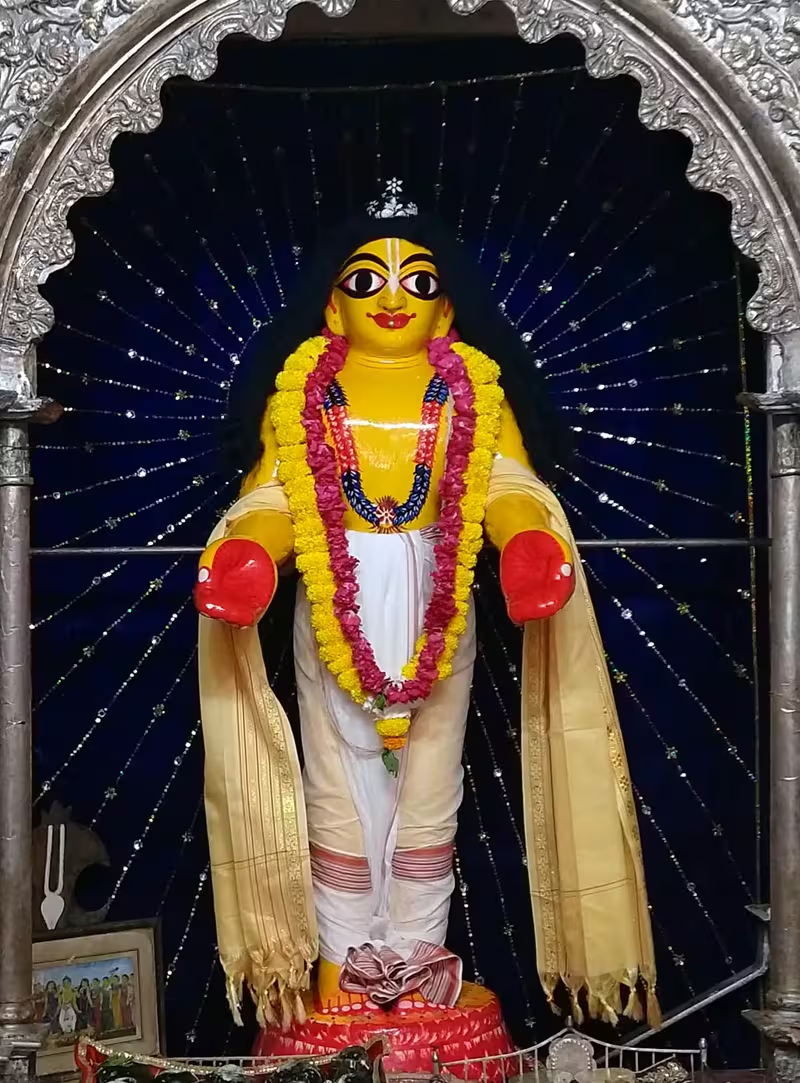
Chaitanya Mahaprabhu: The Golden Avatar of Divine Love
In the late 15th century, the Gangetic plains of Bengal were a crucible of political change and intellectual ferment. The Bengal Sultanate was at its zenith, and the city of Nabadwip stood as a formidable center of Sanskrit learning, a bastion of orthodox logic (Nyaya) and Brahminical scholarship. It was into this world of rigid intellectualism and complex ritual that a figure of pure, unbridled devotional ecstasy was born—a man who would challenge the status quo not with debate, but with dance; not with logic, but with love. This was Vishvambhar Mishra, known to history as Chaitanya Mahaprabhu (1486-1534), the revolutionary saint who ignited a spiritual fire that continues to burn across the globe.
Early Life & Formative Years: The Scholar of Nabadwip
Born in 1486 in Nabadwip to Jagannath Mishra and Sachi Devi, the child was named Vishvambhar. His birth, auspiciously coinciding with a lunar eclipse, was celebrated with the chanting of holy names, a sound that would become the anthem of his life's mission. Known affectionately as 'Nimai' because he was born under a Neem tree, he grew into a prodigy of extraordinary intellect. He was brilliant, handsome, and famously mischievous, yet his scholarly prowess was undeniable. By his teenage years, he had mastered Sanskrit grammar, rhetoric, and logic, surpassing even his own teachers.
At a remarkably young age, Nimai Pandit, as he was then known, established his own tol (Sanskrit school), quickly earning a reputation as one of Nabadwip's most formidable debaters. His intellectual arrogance was as legendary as his genius; he was a proud scholar, delighting in scholastic jousts and defeating opponents with his razor-sharp logic. His life followed a conventional path for a Brahmin of his standing: he married Lakshmipriya and managed his household and school with great success. However, a journey to eastern Bengal would bring tragedy; upon his return, he learned that his wife had died from a snakebite. He later married Vishnupriya, the daughter of a local scholar.
The Turning Point at Gaya
The pivotal transformation from proud scholar to impassioned devotee occurred in 1508. At the age of 22, Chaitanya traveled to Gaya to perform the shraddha ceremony for his deceased father. There, he met Ishvara Puri, a humble Vaishnava ascetic and a disciple of the great Madhavendra Puri. This encounter shattered his world. Seeking initiation, Chaitanya received the ten-syllable Gopal-Krishna mantra from his new guru. The effect was instantaneous and overwhelming.
The proud shell of the intellectual Nimai Pandit cracked, revealing a deep wellspring of ecstatic love (prema) for Krishna. He was consumed by a divine madness, a state of devotional fervour that rendered his previous scholastic pursuits meaningless. When he returned to Nabadwip, his students and peers were stunned. The invincible logician was gone. In his place was a man who wept, laughed, trembled, and fainted at the mere mention of Krishna's name, his body exhibiting the eight classical symptoms of spiritual ecstasy (ashta sattvika vikara).
The Divine Mission: Sankirtan and Social Revolution
Chaitanya promptly closed his school. His life now had a singular, all-consuming purpose: to chant the holy names of God. He gathered a circle of close associates who would become the pillars of his movement: the steadfast Nityananda Prabhu, the venerable Advaita Acharya, the devout Srivasa Thakura, and Haridasa Thakura, a saint born in a Muslim family who was revered for his unwavering devotion. This core group, known as the Pancha Tattva, began the practice of sankirtan—congregational chanting of the Hare Krishna mahamantra, accompanied by drums and cymbals, in the streets and public squares.
This was a radical act. In an era defined by a rigid caste system and the belief that religious truth was the exclusive property of learned Brahmins, Chaitanya's movement was a spiritual democracy. His sankirtan was open to all, irrespective of caste, creed, or social standing. The divine name, he preached, was the only prerequisite for spiritual liberation in the current age (Kali Yuga). This public display of emotion and open-armed inclusivity directly challenged the orthodox establishment. The local Muslim magistrate, Chand Kazi, attempted to ban the processions, breaking a mridanga (drum) to enforce his order. In response, Chaitanya organized a massive civil disobedience march, a peaceful protest of thousands chanting their way to the Kazi's house. Through heartfelt dialogue and spiritual influence, Chaitanya not only convinced the Kazi to rescind the ban but also earned his respect, securing the future of the sankirtan movement.
Renunciation and a New Identity
At the age of 24, in 1510, Chaitanya made the heart-wrenching decision to enter the renounced order of life, sannyasa. He knew that as a householder, his revolutionary message might be constrained. As a wandering ascetic, he could carry the flame of divine love across the length and breadth of India. Leaving behind his young wife Vishnupriya and his aging mother Sachi Devi, he was initiated by the ascetic Keshava Bharati. It was then that he was given the name that would echo through the centuries: Sri Krishna Chaitanya, meaning 'one who awakens Krishna consciousness in others'.
A Pilgrim of Love: Travels and Teachings
Chaitanya's life as a sannyasi was one of constant travel and teaching. He spent the next six years on an extensive pilgrimage, first through South India and later to the holy land of Vrindavan.
The Southern Tour: His journey south was a whirlwind of devotional ecstasy and philosophical discourse. He visited countless holy sites, his divine presence inspiring thousands. A landmark event was his meeting with Ramananda Raya, the governor of Rajahmundry, on the banks of the Godavari River. Their dialogue, meticulously recorded in the Chaitanya Charitamrita, is a foundational text of Gaudiya Vaishnava theology, systematically exploring the progressive stages of divine love, from formal worship to the most intimate, spontaneous love for God, epitomized by the devotion of Radha for Krishna.
The Rediscovery of Vrindavan: In 1515, Chaitanya fulfilled his lifelong dream of visiting Vrindavan, the pastoral land where Lord Krishna had enacted his divine childhood pastimes. Over centuries, the exact locations of these sacred sites had been lost to history. Guided by divine insight, Chaitanya walked through the forests and identified the lost holy places—the sacred lake Radha Kunda, the Govardhan Hill, and numerous other sites. This act was not merely one of pilgrimage; it was an act of sacred archaeology that reclaimed the geography of the Vaishnava faith.
The Six Goswamis
While Chaitanya himself wrote almost nothing, save for a set of eight verses known as the Shikshashtakam, his genius lay in inspiring others. He commissioned his most learned and dedicated disciples, particularly Rupa Goswami and Sanatana Goswami, to carry out his mission in Vrindavan. These two brothers, former high-ranking ministers in the Bengal Sultanate, became renunciates and, along with four other disciples (Jiva Goswami, Gopala Bhatta Goswami, Raghunatha Bhatta Goswami, and Raghunatha Dasa Goswami), formed the collective known as the Six Goswamis of Vrindavan. On Chaitanya's instructions, they undertook the monumental task of excavating the lost holy sites, building magnificent temples, and authoring a vast corpus of theological and philosophical literature that systematically codified Chaitanya's teachings. It is through their work that the sophisticated philosophy of Gaudiya Vaishnavism was preserved.
The Final Years in Puri and His Disappearance
Chaitanya spent the last 18 years of his life in Jagannath Puri, a major pilgrimage destination in Odisha. He lived in a small room at the Gambhira, in a state of continuous and intense spiritual absorption. His external activities became minimal, but his internal life was a tempest of divine emotions. Only his most intimate associates, Svarupa Damodara and Ramananda Raya, could understand and minister to him during these profound states of spiritual ecstasy, in which he experienced the intense pangs of separation from Krishna.
His most public activity during this period was his participation in the annual Ratha Yatra (Chariot Festival). Before the massive chariot of Lord Jagannath, Chaitanya would dance and chant with an ecstatic energy that captivated the hundreds of thousands of pilgrims who gathered to witness it. For him, Lord Jagannath was none other than Krishna, and the festival was a reenactment of Radha's longing to bring Krishna back to Vrindavan.
In 1534, at the age of 48, Chaitanya Mahaprabhu disappeared. The historical records are silent on the precise circumstances. Devotional accounts state that he mystically merged into the deity of Tota Gopinath or the Jagannath deity within the temple. This mysterious end is, for his followers, a fitting conclusion to a life that consistently defied mundane explanation.
Legacy and Enduring Influence
Chaitanya Mahaprabhu's impact on Indian culture, religion, and philosophy is profound and multifaceted.
Philosophical Contribution: His teachings were systematized into the philosophy of Achintya Bheda Abheda Tattva (Inconceivable Oneness and Difference). This doctrine masterfully resolved a central Vedantic debate, positing that the soul is simultaneously one with God in quality (as spirit) but eternally different in identity (as a minute part). This relationship, being beyond the grasp of the finite mind, is 'inconceivable'.
Social and Cultural Impact: His sankirtan movement was a powerful force for social integration, eroding the rigidities of the caste system by uniting people from all walks of life in a shared spiritual practice. He inspired a literary and cultural renaissance in Bengal and Odisha. His life became the subject of seminal biographical works like Vrindavana Dasa Thakura's Chaitanya Bhagavata and Krishnadasa Kaviraja Goswami's Chaitanya Charitamrita, which are considered masterpieces of Bengali literature. The musical tradition of kirtan in Bengal is his direct and most vibrant legacy.
A Global Movement: For centuries, Chaitanya's influence was largely confined to eastern India. In the 20th century, however, his message was carried to the West by A.C. Bhaktivedanta Swami Prabhupada, who founded the International Society for Krishna Consciousness (ISKCON). Through ISKCON, the sankirtan movement and the chanting of the Hare Krishna mantra became a global phenomenon, establishing Gaudiya Vaishnavism as a worldwide faith.
Chaitanya Mahaprabhu was more than a reformer or a philosopher. He was a force of nature, a 'Golden Avatar' who demonstrated that the highest spiritual truth could be realized not through dry intellectualism or austere penance, but through the joyful, heartfelt, and collective singing of God's names. His legacy is not in stone monuments or royal edicts, but in the enduring sound of the mridanga and the timeless chant that continues to inspire millions: Hare Krishna, Hare Krishna, Krishna Krishna, Hare Hare / Hare Rama, Hare Rama, Rama Rama, Hare Hare.